
Opening your dashboard
Class 9 Maths Chapter 9 Triangles: Competency-Based Questions (CBQ)
40 questions on Chapter 9, each worked through on its own page with the AI tutor. Class 9 Maths, ICSE 2026-27.
40 questions
1–5 marks · Mixed difficulty
- 11 mark
Question 1
Competency: Understanding
A triangular plot PQR has ∠P = 48° and ∠Q = 75°. The owner wants to build the gate on the shortest side, so that the least fencing is lost.
On which side should the gate be built?
- 21 mark
Question 2
Competency: Understanding
A carpenter has four triangular boards, each named ABC. On each board he marks the mid-point D of BC and joins AD. He also draws AE perpendicular to BC.
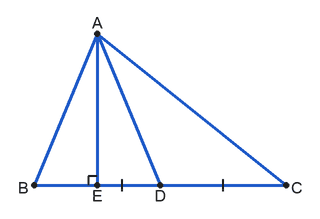
On which board will AD and AE be the same line?
- 31 mark
Question 3
Competency: Analysis
Ravi wants to find the distance AB across a pond. He fixes a pole at O on open ground. He walks from A through O to a point C so that OC = OA, and from B through O to a point D so that OD = OB. Then he measures CD.
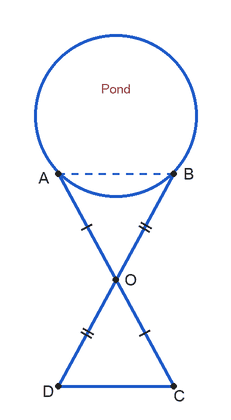
CD is equal to AB because ΔAOB ≅ ΔCOD. Which condition of congruency proves this?
- 41 mark
Question 4
Competency: Application
Two set squares are congruent, with ΔABC ≅ ΔFED. In ΔABC, ∠A = 90°, ∠B = 60° and BC = 12 cm.
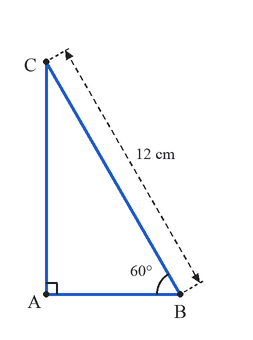
Which of the following is true for ΔFED?
- 51 mark
Question 5
Competency: Analysis
A triangular glass pane has broken into three pieces.
Piece 1 has one complete corner of the pane, with only parts of the two sides at that corner.
Piece 2 has one complete side of the pane, together with both corners at its ends.
Piece 3 has only the middle parts of two sides, with no corner.
The glass cutter can carry only one piece to the shop. Which piece is enough to cut an identical pane?
- 61 mark
Question 6
Competency: Evaluation
Assertion (A): In ΔABC, if ∠B = 90°, then AC is the longest side of the triangle.
Reason (R): In a triangle, the side opposite to the smaller angle is longer.
- 72 marks
Question 7
Competency: Application
Three villages P, Q and R are joined by three straight roads PQ, QR and RP. On a map, ∠QPR = 65°, and when the road QR is produced beyond R to a point S, ∠PRS = 130°.
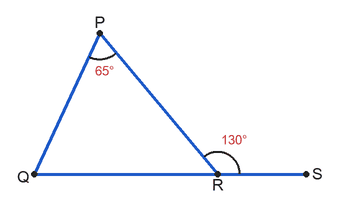
Which two roads are equal in length? Which road is the shortest? Give reasons.
- 82 marks
Question 8
Competency: Analysis
The figure shows a kite ABCD made with two short sticks AB = AD and two long sticks CB = CD. The spine AC is tied along the middle.
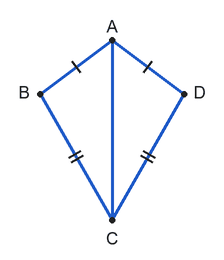
Explain why the spine divides the kite into two congruent triangles. What does this tell you about ∠ABC and ∠ADC?
- 92 marks
Question 9
Competency: Evaluation
In ΔABC and ΔDEF, it is given that ∠B = ∠E, ∠C = ∠F and AB = DE.

Tina says, "AB does not lie between ∠B and ∠C, so A.S.A. cannot be used. These triangles need not be congruent."
Is Tina's conclusion correct? Justify your answer.
- 102 marks
Question 10
Competency: Application
The front of a tent is a triangle ABC with BC on the ground. The centre pole AD stands at the mid-point D of BC and is perpendicular to BC.

Prove that the two slant edges AB and AC of the tent are equal.
- 113 marks
Question 11
Competency: Application
To find the width AB of a canal, Meera stands at B, exactly opposite a tree A on the other bank, so that AB is perpendicular to the bank. She walks 30 m along the bank to C and fixes a pole there. She walks another 30 m in the same direction to D. Then she turns and walks at right angles to the bank, away from the canal, until she reaches a point E from where the pole C and the tree A are in one straight line. She measures DE = 42 m.
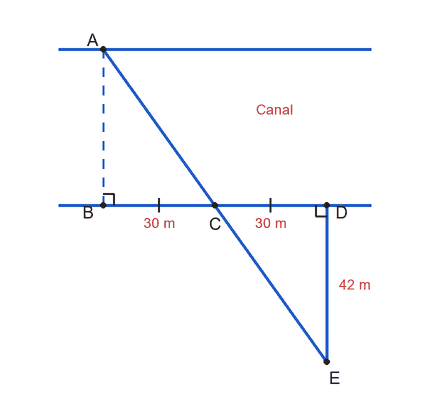
Prove that ΔABC ≅ ΔEDC, and hence find the width of the canal.
- 123 marks
Question 12
Competency: Analysis & Evaluation
In the figure, AB = DC and AB ∥ DC. Sameer has to prove that BC = DA.
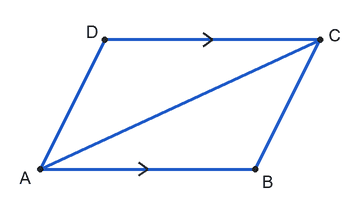
He writes:
"In ΔABC and ΔCDA : AB = CD (given), AC = CA (common), ∠ACB = ∠CAD (alternate angles). So ΔABC ≅ ΔCDA by S.A.S., and BC = DA."
Sameer's result is true, but his proof is not acceptable. Point out the two faults in it and write a correct proof.
- 133 marks
Question 13
Competency: Creativity
Frame a proof question of your own in which two triangles are shown to be congruent by the R.H.S. condition.
Describe the figure in words, state exactly what is given, say what is to be proved (it must include one result that follows from the congruence), and write the full proof.
- 145 marks
Question 14
Competency: Analysis & Evaluation
Case study — Is the gate frame "square"?
A welder makes a gate frame ABCD from four bars and fixes two diagonal braces AC and BD. To test whether the corners are true right angles, welders compare the lengths of the two diagonals.

(a) Suppose ABCD is a rectangle, so that AB = DC and ∠ABC = ∠DCB = 90°. Prove that ΔABC ≅ ΔDCB, and hence that the diagonals AC and DB are equal.
(b) For another frame ABCD, the welder knows only that AB = DC and AB ∥ DC. He measures the diagonals and finds AC = DB. Prove that ∠ABC = ∠DCB.
(c) Hence show that in the frame of part (b), ∠ABC and ∠DCB are right angles. A third frame has diagonals of 152 cm and 149 cm. Can it be a rectangle? Give a reason.
- 154 marks
Question 15
Competency: Application & Analysis
Case study — Three mobile towers
Three mobile towers stand at A, B and C. A surveyor measures ∠ABC = 50° and ∠BAC = 70°. A relay tower is to be put up at D, the point where the bisector of ∠BAC meets BC.
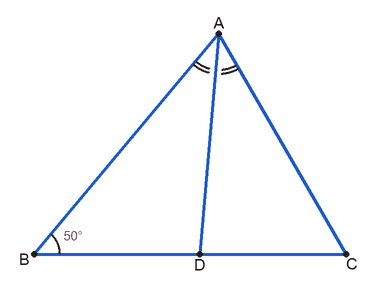
(a) Find ∠ACB.
(b) Without measuring, arrange the distances AB, BC and CA in ascending order. Give a reason.
(c) Find the angles of ΔABD and of ΔADC. Hence show that the relay tower D is nearer to A than either B or C is, that is, AD < AB and AD < AC.
- 161 mark
Question 16
Competency: Understanding
A triangular plot ABC has one angle . The owner wants to know what this tells him about the other two angles, and .
Which statement must be true?
- 171 mark
Question 17
Competency: Application
On a triangular card ABC, the sides AB and AC are not equal. From A, Ria draws the median AD and the altitude AE to the line BC, and she finds that D and E are two different points.
Which statement about the lengths AD and AE is true?
- 181 mark
Question 18
Competency: Analysis
A teacher gives four paper triangles and writes the measurements she took on each one.
Triangle Two sides One angle T1 = ΔABC AB = 6 cm, BC = 8 cm ∠B = 40° T2 = ΔPQR PQ = 8 cm, QR = 6 cm ∠P = 40° T3 = ΔXYZ XY = 8 cm, YZ = 6 cm ∠Y = 40° T4 = ΔLMN LM = 6 cm, MN = 8 cm ∠N = 40° Which two triangles can be proved congruent using only the information in the table?
- 191 mark
Question 19
Competency: Evaluation
Assertion (A): If a side of a triangle is produced, the exterior angle so formed is greater than each of the two interior opposite angles.
Reason (R): The exterior angle of a triangle is equal to the sum of the two interior opposite angles.
- 201 mark
Question 20
Competency: Evaluation
Assertion (A): Two congruent triangles can have different perimeters.
Reason (R): Corresponding parts of congruent triangles are equal.
- 211 mark
Question 21
Competency: Analysis
A tailor has two triangular patches ABC and DEF. He has checked that AB = DE = 7 cm and . He wants one more equal pair of parts that will be enough to prove that the patches are congruent.
Which one should he check?
- 221 mark
Question 22
Competency: Application
In a roof frame , . A carpenter fits a support BD from B that is perpendicular to the line AC, with D on the line AC.
Where does D lie?
- 231 mark
Question 23
Competency: Application
Two congruent triangular tiles are cut so that . In the first tile, and . In the second tile, .
What is ?
- 241 mark
Question 24
Competency: Evaluation
In , AB = 9 cm and AC = 6 cm. Three students make claims about the angles at B and C.
Asha says that the angle at C is the greater one. Bina says that the angle at B is the greater one. Chitra says that nobody can tell without measuring the angles.
Whose claim is correct?
- 251 mark
Question 25
Competency: Analysis
A flagpole PO stands vertically at O on level ground. Two ropes PA and PB of equal length run from the top P to pegs A and B on the ground, one on each side of the pole.

Raju says the pegs are at equal distances from the foot of the pole, that is, OA = OB.
Which reason proves his claim?
- 262 marks
Question 26
Competency: Analysis
A school garden has two triangular flower beds, ABD and CBD, that share the path BD. A and C lie on opposite sides of BD. In bed ABD, and . In bed CBD, and .
Without measuring, arrange the five paths AB, AD, BD, CD and CB in ascending order of length. Give reasons.
- 272 marks
Question 27
Competency: Evaluation
A triangular steel plate ABC of even thickness balances flat on a pin placed at the point where its three medians meet. D is the mid-point of BC, and the median AD is 18 cm long.
(a) What is this balancing point called?
(b) Kabir marks the point K on AD with AK = 9 cm. He says the pin should go at K, because "the medians meet half-way along each median". Is he right? If not, how far from A should the pin be placed on AD?
- 282 marks
Question 28
Competency: Application
A school cuts two triangular flags ABC and DEF so that . The tailor measures AB = cm, DE = cm, BC = 10 cm and DF = 13 cm.
How much braid is needed to go all the way round the flag DEF?
- 292 marks
Question 29
Competency: Creativity
Meena is planning a triangular flower bed ABC beside her house. She wants the side BC, which faces the house, to be the longest side and the side AB to be the shortest side. All three angles must be different, none of them a right angle, and each a whole number of degrees.
Suggest one possible set of values for , and , and explain why your plan works.
- 302 marks
Question 30
Competency: Analysis
A triangular steel plate PQR has . Two of its sides are equal.
Find and , and name the two equal sides.
- 312 marks
Question 31
Competency: Application
A tiler has two congruent triangular tiles, with . He places them side by side along their common edge AC, with D on the other side of AC from B, to make a four-sided tile ABCD. In , and .
Find and , and hence find all four angles of the tile ABCD.
- 323 marks
Question 32
Competency: Application
Two vertical posts AB and CD of the same height stand on level ground, with feet B and D. At the same time of day, the sun's rays AE and CF, which are parallel, cast the shadows BE and DF of the two posts. The points B, E, D and F lie in this order along the ground.

Prove that . Hence find the length of the shadow DF, if BE = 2.4 m.
- 333 marks
Question 33
Competency: Application
A solar-panel stand is a triangular frame ABC. A support AD runs from the top corner A to the base BC. The support AD bisects and is perpendicular to BC.
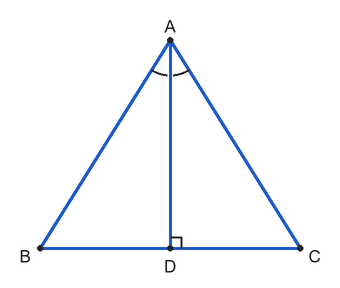
Prove that the two slanting legs are equal, AB = AC, and that D is the mid-point of BC.
- 343 marks
Question 34
Competency: Analysis
Ria has a triangular sheet of paper ABC with AB = 6 cm and AC = 9 cm. She folds it along a crease AD, with D on BC, so that the edge AB falls along the edge AC. The corner B lands at the point B' on AC. She unfolds the sheet and draws the crease AD and the line DB'. Folding AB onto AC makes the crease bisect .

(i) Prove that .
(ii) Find the length B'C.
(iii) If , find .
- 353 marks
Question 35
Competency: Application
In the frame ABC of a ramp, AD is drawn perpendicular to BC, with D on BC. It is measured that and .
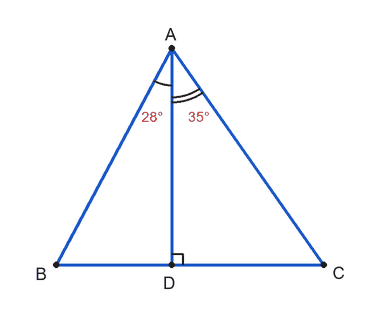
Find , and . Then arrange the sides AB, BC and CA in ascending order of length.
- 363 marks
Question 36
Competency: Analysis & Evaluation
A hardware shop sells two shelf brackets. Bracket 1 is a triangle made from three metal bars of 30 cm, 40 cm and 50 cm, joined at the corners by hinges. Bracket 2 is a rectangle made from four bars of 30 cm, 40 cm, 30 cm and 40 cm, joined at the corners by hinges. A customer pushes on both brackets.
(i) Explain why bracket 1 cannot change its shape. Name the condition you use.
(ii) What happens to bracket 2 when it is pushed?
(iii) How can bracket 2 be made firm by adding one more bar?
- 374 marks
Question 37
Competency: Analysis
Case study — Three triangular parks
The town council has three triangular parks. Each park is a triangle PQR. A surveyor measured two angles of each park and wrote them in a table.
Park ∠P ∠Q Rose Park 40° 70° Lotus Park 45° 45° Neem Park 35° 75° (a) Find for each park.
(b) In Rose Park, which two boundary sides are equal, and which side is the shortest? Give a reason.
(c) Name the longest boundary of Lotus Park, and arrange the three boundaries of Neem Park in ascending order of length.
- 385 marks
Question 38
Competency: Analysis & Evaluation
Case study — The seesaw
A seesaw plank AB, 4 m long, is pivoted at its mid-point O on a support. The dashed line PQ is the horizontal line through O. When the end A goes up, the end B goes down. AP and BQ are perpendicular to PQ, so AP is the height of A above the level of the pivot and BQ is the depth of B below it.

(a) Prove that .
(b) Hence show that AP = BQ. If A is 0.6 m above the level PQ, how far below it is B?
(c) Another seesaw has its pivot O not at the mid-point of the plank, with OA = 1 m and OB = 3 m. While the plank is tilted, can AP be equal to BQ for this seesaw? Give a reason.
- 395 marks
Question 39
Competency: Analysis & Evaluation
Case study — The footbridge frame
The steel frame of a footbridge is shown. BC is the base beam and AD is the top beam. The sloping bars AB and DC are equal, and the two cross-braces AC and DB are equal. The braces cross at O.
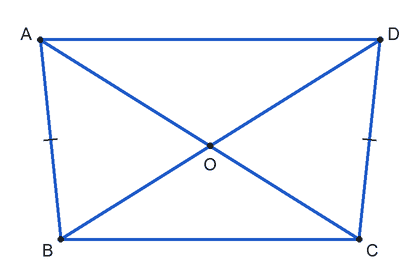
(a) Prove that . Name the condition used.
(b) Hence show that and .
(c) It is measured that and . Find , and . Which of OB, OC and BC is the longest side of ? Give a reason.
- 404 marks
Question 40
Competency: Application & Analysis
Case study — The kite sail
A kite maker cuts a triangular sail ABC from a plastic sheet, with AB = AC = 39 cm and BC = 30 cm. D is the mid-point of BC, and a light stick AD, 36 cm long, joins the top corner A to D to stiffen the sail.
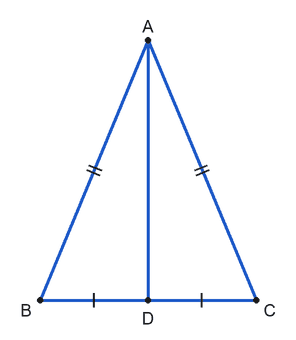
(a) Which angle of the sail is the smallest, and which two angles are equal? Give reasons.
(b) Prove that , and hence that the stick AD is perpendicular to BC.
(c) A second sail A'B'C' has A'B' = A'C' = 39 cm. Its stick A'D' joins A' to the mid-point D' of B'C', is 36 cm long and is perpendicular to B'C'. Show that , and hence that B'C' = 30 cm.