
Question 233 marksEasy
In a Δ ABC, BD is the median to the side AC, BD is produced to E such that BD = DE.
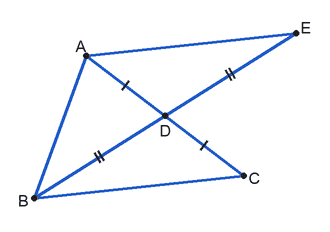
Prove that : AE is parallel to BC.
Confirming your payment
Sign up now and get 250 free tokens.
Triangles · Question 23 of 42
In a Δ ABC, BD is the median to the side AC, BD is produced to E such that BD = DE.
Prove that : AE is parallel to BC.
Solution:
Concept: S.A.S. test: two sides and the angle BETWEEN them in one triangle equal two sides and the included angle in the other, so the triangles are congruent. When a line crosses two parallel lines, alternate angles are equal and corresponding angles are equal.
Given: BD is the median to AC, and BD is produced to E with DE = BD.
Step 1 — Compare ΔADE and ΔCDB.
AD = CD (BD is the median, so D is the mid-point of AC)
∠ADE = ∠CDB (vertically opposite angles)
DE = DB (given)
So ΔADE ≅ ΔCDB by S.A.S., and by C.P.C.T.C. ∠DAE = ∠DCB.
Step 2 — Use the alternate angles.
∠DAE and ∠DCB are alternate angles made by the transversal AC with the lines AE and BC. They are equal, so the lines are parallel: AE ∥ BC.
Watch out: A median joins a vertex to the MID-POINT of the opposite side; that is where AD = CD comes from.
Therefore, AE ∥ BC. Hence proved.