
Question 383 marksMedium
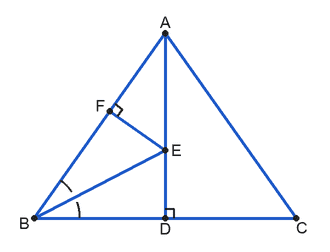
In the following figure, AB = AC and AD is perpendicular to BC. BE bisects angle B and EF is perpendicular to AB. Prove that :
(i) BD = CD
(ii) ED = EF
Confirming your payment
Sign up now and get 250 free tokens.
Triangles · Question 38 of 42
In the following figure, AB = AC and AD is perpendicular to BC. BE bisects angle B and EF is perpendicular to AB. Prove that :
(i) BD = CD
(ii) ED = EF
Solution:
Concept: R.H.S. test: two right-angled triangles are congruent when their hypotenuses are equal and one other pair of sides is equal. A.S.A. test: two angles and the side between them in one triangle equal the matching parts of the other, so the triangles are congruent. A.A.S. (two angles and a side not between them) works too, because the third angles are then equal as well.
Given: AB = AC, AD ⊥ BC, BE bisects ∠B and EF ⊥ AB.
Step 1 — Part (i): compare ΔADB and ΔADC.
∠ADB = ∠ADC (both 90°, as AD ⊥ BC)
AB = AC (given hypotenuses)
AD = AD (common)
So ΔADB ≅ ΔADC by R.H.S., and by C.P.C.T.C. BD = CD.
Step 2 — Part (ii): compare ΔEBD and ΔEBF.
∠EBD = ∠EBF (BE bisects ∠B)
∠EDB = ∠EFB (both 90°, as AD ⊥ BC and EF ⊥ AB)
BE = BE (common)
So ΔEBD ≅ ΔEBF by A.A.S., and by C.P.C.T.C. ED = EF.
Watch out: E lies on AD, so ED is a part of AD and is perpendicular to BC; that gives the right angle at D.
Therefore, (i) BD = CD and (ii) ED = EF. Hence proved.