Solution:
Concept: Two triangles are congruent when one of the tests S.S.S., S.A.S., A.S.A. (or A.A.S.) or R.H.S. holds; then all their corresponding parts are equal (C.P.C.T.C. = corresponding parts of congruent triangles are congruent).
Given: Five pairs of triangles with some equal sides and angles.
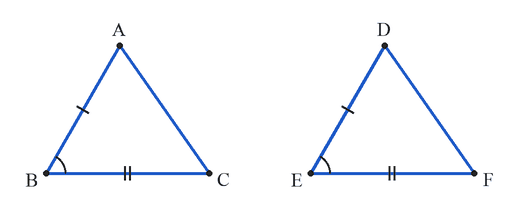
Step 1 — Pair (a).
We have AB = DE, BC = EF and ∠B = ∠E. ∠B lies between AB and BC, and ∠E lies between DE and EF, so the equal angle is the included angle.
ΔABC ≅ ΔDEF by S.A.S.
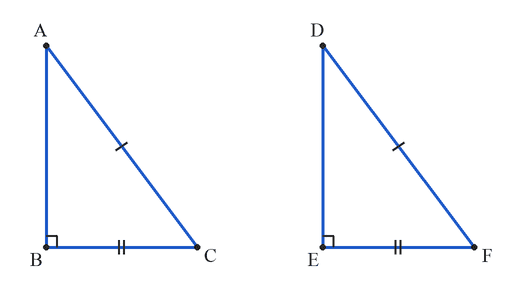
Step 2 — Pair (b).
Both triangles have a right angle (at B and at E). AC and DF are opposite the right angles, so they are the hypotenuses, and they are equal. One more pair of sides is equal: BC = EF.
ΔABC ≅ ΔDEF by R.H.S.
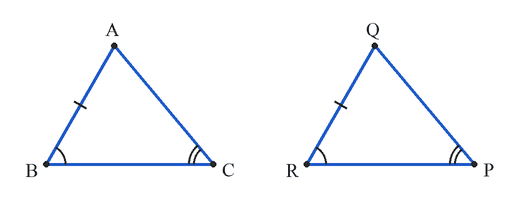
Step 3 — Pair (c).
Two angles are equal, ∠B = ∠R and ∠C = ∠P, so the vertices match as A ↔ Q, B ↔ R, C ↔ P. The side AB matches QR, and AB = QR is given. AB is not between ∠B and ∠C, so this is two angles and a non-included side.
ΔABC ≅ ΔQRP by A.A.S. (the third angles ∠A and ∠Q are then equal too, so A.S.A. also applies)
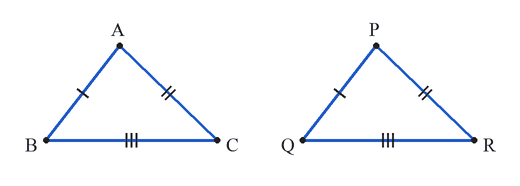
Step 4 — Pair (d).
All three pairs of sides are equal: AB = PQ, AC = PR and BC = QR.
ΔABC ≅ ΔPQR by S.S.S.
Step 5 — Pair (e): find ∠B.
The angles of ΔABC add up to 180°, and we know ∠A = 90° and ∠C = 40°.
∠B=180∘−90∘−40∘=50∘
Step 6 — Pair (e): match the parts.
So ∠B = ∠Q, since both are 50°. We also have ∠C = ∠R (both 40°) and BC = QR. BC lies between ∠B and ∠C, and QR lies between ∠Q and ∠R, so the equal side is the included side.
ΔABC ≅ ΔPQR by A.S.A.
Watch out: Check WHERE the equal angle sits: between the two equal sides for S.A.S., between the two equal angles for the side in A.S.A.
Therefore, all five pairs are congruent: (a) S.A.S., (b) R.H.S., (c) A.A.S. (or A.S.A.), (d) S.S.S., (e) A.S.A.