
Question 143 marksMedium
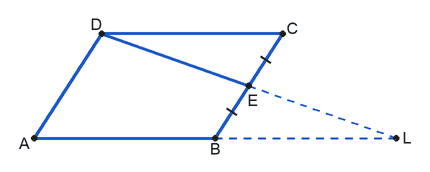
From the given diagram, in which ABCD is a parallelogram, ABL is a line segment and E is mid point of BC.
Prove that :
(i) Δ DCE ≅ Δ LBE
(ii) AB = BL.
(iii) AL = 2DC
Confirming your payment
Sign up now and get 250 free tokens.
Triangles · Question 14 of 42
From the given diagram, in which ABCD is a parallelogram, ABL is a line segment and E is mid point of BC.
Prove that :
(i) Δ DCE ≅ Δ LBE
(ii) AB = BL.
(iii) AL = 2DC
Solution:
Concept: A.S.A. test: two angles and the side between them in one triangle equal the matching parts of the other, so the triangles are congruent. A.A.S. (two angles and a side not between them) works too, because the third angles are then equal as well. When a line crosses two parallel lines, alternate angles are equal and corresponding angles are equal.
Given: ABCD is a parallelogram, ABL is a straight line and E is the mid-point of BC.
Step 1 — Part (i): compare ΔDCE and ΔLBE.
DC ∥ AB, and ABL is a straight line, so DC ∥ AL.
∠DCE = ∠LBE (alternate angles, DC ∥ AL with BC as transversal)
CE = BE (E is the mid-point of BC)
∠DEC = ∠LEB (vertically opposite angles)
The side CE lies between the two angles at C and E, so ΔDCE ≅ ΔLBE by A.S.A.
Step 2 — Part (ii).
From (i), DC = BL by C.P.C.T.C.
Also DC = AB, because opposite sides of a parallelogram are equal.
So AB = BL.
Step 3 — Part (iii).
AL is made of AB and BL, and each of these equals DC.
Watch out: The alternate angles come from DC ∥ AL; AL is the side AB produced, so it is parallel to DC as well.
Therefore, (i) ΔDCE ≅ ΔLBE, (ii) AB = BL and (iii) AL = 2DC. Hence proved.