
Question 323 marksMedium
PQRS is a parallelogram. L and M are points on PQ and SR respectively such that PL = MR.
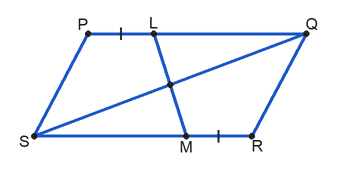
Show that LM and QS bisect each other.
Confirming your payment
Sign up now and get 250 free tokens.
Triangles · Question 32 of 42
PQRS is a parallelogram. L and M are points on PQ and SR respectively such that PL = MR.
Show that LM and QS bisect each other.
Solution:
Concept: A.S.A. test: two angles and the side between them in one triangle equal the matching parts of the other, so the triangles are congruent. A.A.S. (two angles and a side not between them) works too, because the third angles are then equal as well. When a line crosses two parallel lines, alternate angles are equal and corresponding angles are equal.
Given: PQRS is a parallelogram, L on PQ and M on SR with PL = MR.
Step 1 — Set up.
Let LM and QS meet at O.
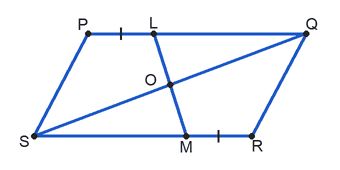
We show ΔOLQ ≅ ΔOMS.
Step 2 — Show LQ = MS.
L is on PQ and M is on SR, so LQ is what is left of PQ after PL, and MS is what is left of SR after MR.
LQ = PQ − PL
MS = SR − MR
PQ = SR (opposite sides of a parallelogram) and PL = MR, so LQ = MS.
Step 3 — Compare ΔOLQ and ΔOMS.
∠OQL = ∠OSM (alternate angles, PQ ∥ SR with QS as transversal)
LQ = MS (Step 2)
∠OLQ = ∠OMS (alternate angles, PQ ∥ SR with LM as transversal)
So ΔOLQ ≅ ΔOMS by A.S.A., and by C.P.C.T.C. OL = OM and OQ = OS.
Watch out: The equal pieces are LQ and MS (what is LEFT of the sides), not PL and MR themselves.
Therefore, O is the mid-point of both LM and QS, so LM and QS bisect each other. Hence shown.