
Question 333 marksMedium
In the following figure, ABC is an equilateral triangle in which QP is parallel to AC. Side AC is produced upto point R so that CR = BP.
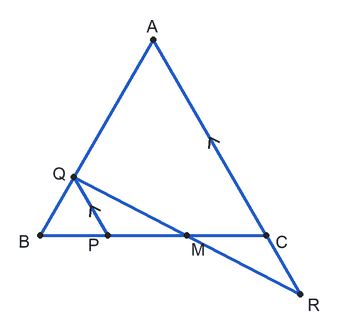
Prove that QR bisects PC.
Confirming your payment
Sign up now and get 250 free tokens.
Triangles · Question 33 of 42
In the following figure, ABC is an equilateral triangle in which QP is parallel to AC. Side AC is produced upto point R so that CR = BP.
Prove that QR bisects PC.
Solution:
Concept: A.S.A. test: two angles and the side between them in one triangle equal the matching parts of the other, so the triangles are congruent. A.A.S. (two angles and a side not between them) works too, because the third angles are then equal as well. When a line crosses two parallel lines, alternate angles are equal and corresponding angles are equal. Each angle of an equilateral triangle is 60°.
Given: ABC is equilateral, QP ∥ AC, and AC is produced to R with CR = BP.
Step 1 — ΔQBP is equilateral.
QP ∥ AC, so the angles at P and Q equal the angles of ΔABC (corresponding angles).
∠QPB = ∠ACB (each 60°)
∠BQP = ∠BAC (each 60°)
All three angles of ΔQBP are 60°, so it is equilateral and PQ = BP.
Also CR = BP, so PQ = CR.
Step 2 — Find the angles at P and C.
∠QPM is the linear pair of ∠QPB, and ∠RCM is the linear pair of ∠ACB (R is on AC produced).
Step 3 — Compare ΔQPM and ΔRCM.
Let QR meet BC at M.
∠QMP = ∠RMC (vertically opposite angles)
∠QPM = ∠RCM (both 120°)
PQ = CR (Step 1)
So ΔQPM ≅ ΔRCM by A.A.S., and by C.P.C.T.C. PM = CM.
Watch out: PQ = CR is the key length; it comes from ΔQBP being equilateral, so prove that first.
Therefore, M is the mid-point of PC, so QR bisects PC. Hence proved.