
Question 303 marksMedium
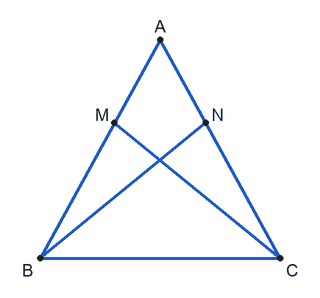
The following figure shows a triangle ABC in which AB = AC. M is a point on AB and N is a point on AC such that BM = CN.
Prove that :
(i) AM = AN
(ii) Δ AMC ≅ Δ ANB
(iii) BN = CM
(iv) Δ BMC ≅ Δ CNB
Confirming your payment
Sign up now and get 250 free tokens.
Triangles · Question 30 of 42
The following figure shows a triangle ABC in which AB = AC. M is a point on AB and N is a point on AC such that BM = CN.
Prove that :
(i) AM = AN
(ii) Δ AMC ≅ Δ ANB
(iii) BN = CM
(iv) Δ BMC ≅ Δ CNB
Solution:
Concept: S.A.S. test: two sides and the angle BETWEEN them in one triangle equal two sides and the included angle in the other, so the triangles are congruent. S.S.S. test: if all three sides of one triangle equal the three sides of another, the triangles are congruent.
Given: AB = AC, M on AB and N on AC with BM = CN.
Step 1 — Part (i).
M is on AB and N is on AC, so AM is what is left of AB after BM, and AN is what is left of AC after CN.
AM = AB − BM
AN = AC − CN
AB = AC and BM = CN, so the right-hand sides are equal and AM = AN.
Step 2 — Part (ii).
AM = AN (part (i))
∠MAC = ∠NAB (the same angle A)
AC = AB (given)
So ΔAMC ≅ ΔANB by S.A.S.
Step 3 — Part (iii).
CM and BN are matching sides of the triangles in (ii), so BN = CM by C.P.C.T.C.
Step 4 — Part (iv).
BM = CN (given)
MC = NB (part (iii))
BC = CB (common)
So ΔBMC ≅ ΔCNB by S.S.S.
Watch out: Each part uses the one before it, so prove them in order.
Therefore, (i) AM = AN, (ii) ΔAMC ≅ ΔANB, (iii) BN = CM and (iv) ΔBMC ≅ ΔCNB. Hence proved.