
Question 253 marksMedium
In the parallelogram ABCD, the angles A and C are obtuse. Points X and Y are taken on the diagonal BD such that the angles XAD and YCB are right angles.
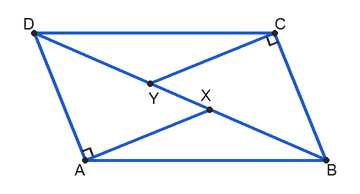
Prove that : XA = YC.
Confirming your payment
Sign up now and get 250 free tokens.
Triangles · Question 25 of 42
In the parallelogram ABCD, the angles A and C are obtuse. Points X and Y are taken on the diagonal BD such that the angles XAD and YCB are right angles.
Prove that : XA = YC.
Solution:
Concept: A.S.A. test: two angles and the side between them in one triangle equal the matching parts of the other, so the triangles are congruent. A.A.S. (two angles and a side not between them) works too, because the third angles are then equal as well. When a line crosses two parallel lines, alternate angles are equal and corresponding angles are equal.
Given: ABCD is a parallelogram; X and Y are on BD with ∠XAD and ∠YCB both 90°.
Step 1 — Compare ΔXAD and ΔYCB.
∠XAD = ∠YCB (both 90°, given)
AD = CB (opposite sides of a parallelogram)
∠ADX = ∠CBY (alternate angles, AD ∥ BC with BD as transversal)
The side AD lies between the angles at A and D, and CB between the angles at C and B, so ΔXAD ≅ ΔYCB by A.S.A.
Step 2 — Use C.P.C.T.C.
XA and YC are matching sides, so XA = YC.
Watch out: The angles at D and B are ∠ADB and ∠CBD, the angles the diagonal makes with the parallel sides AD and BC.
Therefore, XA = YC. Hence proved.