
Question 103 marksMedium
A triangle ABC has ∠B = ∠C.
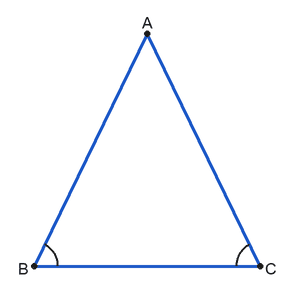
Prove that :
(i) the perpendiculars from the mid-point of BC to AB and AC are equal.
(ii) the perpendiculars from B and C to the opposite sides are equal.
Confirming your payment
Sign up now and get 250 free tokens.
Triangles · Question 10 of 42
A triangle ABC has ∠B = ∠C.
Prove that :
(i) the perpendiculars from the mid-point of BC to AB and AC are equal.
(ii) the perpendiculars from B and C to the opposite sides are equal.
Solution:
Concept: A.S.A. test: two angles and the side between them in one triangle equal the matching parts of the other, so the triangles are congruent. A.A.S. (two angles and a side not between them) works too, because the third angles are then equal as well.
Given: In ΔABC, ∠B = ∠C.
Step 1 — Part (i): set up.
Let D be the mid-point of BC, and draw DE ⊥ AB and DF ⊥ AC.
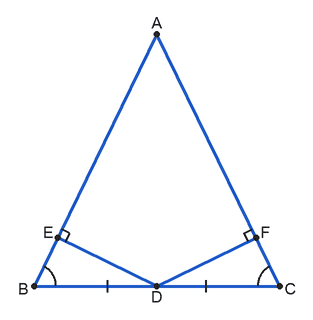
Step 2 — Part (i): compare ΔBED and ΔCFD.
∠BED = ∠CFD (both 90°)
∠EBD = ∠FCD (the given equal angles B and C)
BD = CD (D is the mid-point)
So ΔBED ≅ ΔCFD by A.A.S., and by C.P.C.T.C. DE = DF.
Step 3 — Part (ii): set up.
Draw BL ⊥ AC and CM ⊥ AB.
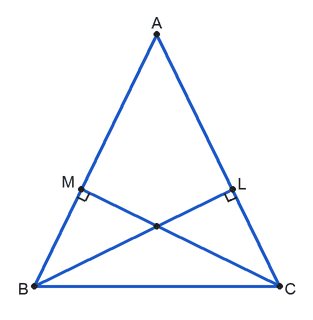
Step 4 — Part (ii): compare ΔBLC and ΔCMB.
∠BLC = ∠CMB (both 90°)
∠LCB = ∠MBC (the given equal angles C and B)
BC = CB (common)
So ΔBLC ≅ ΔCMB by A.A.S., and by C.P.C.T.C. BL = CM.
Watch out: In (ii) the common side BC is the hypotenuse of both right triangles; match it with itself.
Therefore, (i) the perpendiculars DE and DF are equal and (ii) the perpendiculars BL and CM are equal. Hence proved.