
Opening your dashboard
Class 9 Maths Chapter 16: Area Theorems Solutions
42 textbook questions with step-by-step answers, free to read, for ICSE 2026-27.
Get talked through Ch 16, not just shown the answer
Reading a finished solution is not the same as being able to do it. The AI tutor takes one question at a time and works it with you, in your own words, until you can.
- Ask it out loud, in your own words
- It gives you the next step, not the answer
- Stuck on part (ii)? Start there
42 questions with solutions
1–3 marks · Mixed difficulty
- 11 mark
Question 1
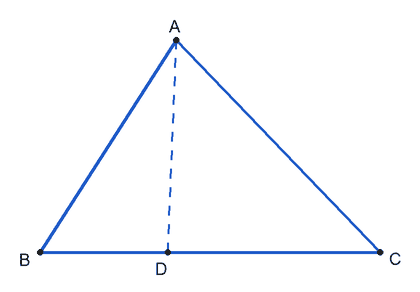
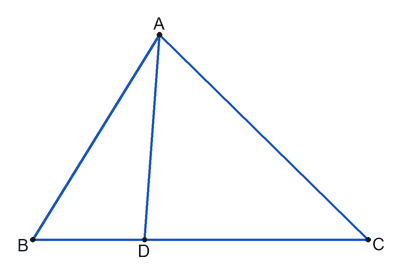
In the given figure, BD : DC = 3 : 5, then area of ΔABD : area of ΔACD is :
 Solve with AI
Answer
(A) 5 : 3
- Correct
(B) 3 : 5
(C) 25 : 9
(D) 9 : 25
Answer: (B) 3 : 5
Concept: Triangles with the same height (for example, a common vertex and bases on one line) have areas in the ratio of their bases.
Step 1 — Notice the common height.
ΔABD and ΔACD have the same vertex A, and their bases BD and DC lie on the same line BC. So both have the same height: the perpendicular distance from A to BC.
Step 2 — Compare the areas.
With equal heights, the areas are in the ratio of the bases.
Here is the common height from A to BC.
Watch out: Do not square the ratio; squaring is for similar figures, not for triangles with a common height.
Why the other options are wrong:
- (A) 5 : 3: 5 : 3 is the ratio of the areas the other way round, ΔACD : ΔABD.
- (C) 25 : 9: 25 : 9 squares the reversed ratio; squaring applies to similar figures, and these triangles are not similar.
- (D) 9 : 25: 9 : 25 squares the ratio of the bases, but with equal heights the areas are in the simple ratio of the bases.
Therefore, ar(ΔABD) : ar(ΔACD) = 3 : 5, option (B).
- 21 mark
Question 2
A median of a triangle divides it into two :
Solve with AIAnswer
- Correct
(A) triangles of equal areas.
(B) congruent triangles
(C) triangles of areas in the ratio 2 : 1.
(D) right triangles
Answer: (A) triangles of equal areas.
Concept: A median of a triangle divides it into two triangles of equal area, because the two bases are equal and the height from the vertex is the same.
Step 1 — Look at the two parts.
A median AD joins A to the mid-point D of BC, so BD = DC.
Step 2 — Compare the areas.
ΔABD and ΔACD have equal bases BD and DC and the same height from A, so their areas are equal.
Watch out: Equal areas do not mean congruent triangles.
Why the other options are wrong:
- (B) congruent triangles: The two triangles have equal areas but are not congruent in general, because AB and AC can differ.
- (C) triangles of areas in the ratio 2 : 1: 2 : 1 is the ratio in which the centroid divides each median, not the ratio of the two areas.
- (D) right triangles: A median is perpendicular to the side only in special triangles (such as isosceles), so the parts are not right triangles in general.
Therefore, a median divides a triangle into two triangles of equal area, option (A).
- 31 mark
Question 3
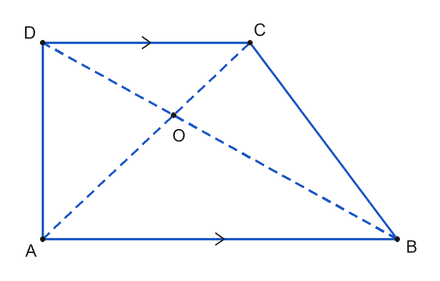
In the given figure, AB is parallel to DC and AB ≠ DC, the area of ΔAOD is equal to area of triangle :
 Solve with AI
Answer
(A) AOB
(B) COD
(C) ACB
- Correct
(D) BOC
Answer: (D) BOC
Concept: Triangles (or parallelograms) on the same base and between the same parallels are equal in area. A triangle and a parallelogram on the same base and between the same parallels: the triangle is half the parallelogram.
Step 1 — Find two equal triangles.
ΔABD and ΔABC stand on the same base AB and lie between the same parallels AB and DC, so they are equal in area.
Step 2 — Remove the common part.
Both triangles contain ΔAOB. Taking it away from each leaves ΔAOD and ΔBOC.
Watch out: The equal pair is the two side triangles AOD and BOC, not the top and bottom triangles.
Why the other options are wrong:
- (A) AOB: ar(ΔAOB) and ar(ΔAOD) have the same height from A on BD, so they are equal only if OB = OD, which would need AB = DC (a parallelogram).
- (B) COD: ar(ΔCOD) and ar(ΔAOD) have the same height from D on AC, so they are equal only if OC = OA, which again needs AB = DC.
- (C) ACB: ΔACB contains ΔBOC and also ΔAOB, so it is larger than ΔBOC, which equals ΔAOD.
Therefore, ar(ΔAOD) = ar(ΔBOC), option (D).
- 41 mark
Question 4
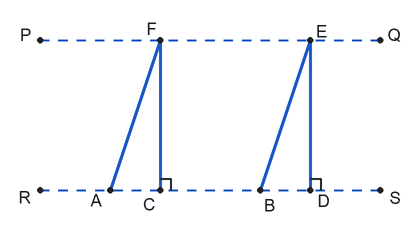
In the given figure, PQ is parallel to RS, FC and ED are perpendiculars to RS. The area of parallelogram ABEF is equal to :
 Solve with AI
Answer
- Correct
(A) rect. CDEF
(B) quad. CBEF
(C) 2 × ΔACF
(D) 2 × ΔEBD
Answer: (A) rect. CDEF
Concept: Triangles (or parallelograms) on the same base and between the same parallels are equal in area. A triangle and a parallelogram on the same base and between the same parallels: the triangle is half the parallelogram.
Step 1 — Identify the base and the parallels.
Parallelogram ABEF and rectangle CDEF have the same base FE, and both lie between the parallel lines PQ and RS.
Step 2 — Apply the theorem.
Parallelograms on the same base and between the same parallels are equal in area, and a rectangle is a parallelogram.
Watch out: A rectangle counts as a parallelogram here, so the theorem applies to it.
Why the other options are wrong:
- (B) quad. CBEF: Quadrilateral CBEF is the parallelogram without the corner triangle ACF, so it is smaller than ABEF.
- (C) 2 × ΔACF: 2 × ar(ΔACF) is AC × CF, while ar(ABEF) is AB × CF; since AC is shorter than AB, they are not equal.
- (D) 2 × ΔEBD: ΔEBD is congruent to ΔFAC, so 2 × ar(ΔEBD) is also AC × CF, smaller than AB × CF.
Therefore, ar(parallelogram ABEF) = ar(rectangle CDEF), option (A).
- 51 mark
Question 5
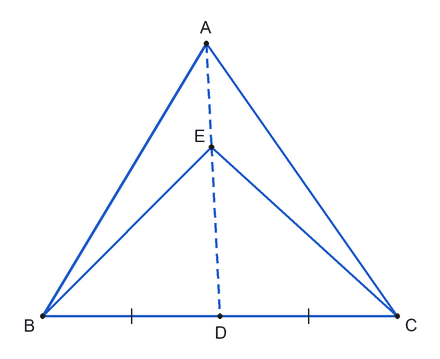
In the given figure, D is mid-point of side BC, the area of triangle BEA is equal to area of triangle :
 Solve with AI
Answer
(A) BED
(B) CED
- Correct
(C) CEA
(D) ACD
Answer: (C) CEA
Concept: A median of a triangle divides it into two triangles of equal area, because the two bases are equal and the height from the vertex is the same.
Step 1 — Use the median AD.
D is the mid-point of BC, so AD is a median of ΔABC and it halves the area.
Step 2 — Use the median ED.
D is also the mid-point of the base BC of ΔEBC, so ED is a median of ΔEBC.
Step 3 — Subtract.
Taking the second result away from the first leaves the two triangles at A.
Watch out: E is any point on AD, so the answer cannot depend on where E is.
Why the other options are wrong:
- (A) BED: ΔBED and ΔBEA together make ΔABD; they are equal only when E is the mid-point of AD.
- (B) CED: ΔCED equals ΔBED (median ED), so it equals ΔBEA only in that same special case.
- (D) ACD: ΔACD is half of ΔABC and contains ΔCEA, so it is larger than ΔBEA.
Therefore, ar(ΔBEA) = ar(ΔCEA), option (C).
- 63 marks
Question 6
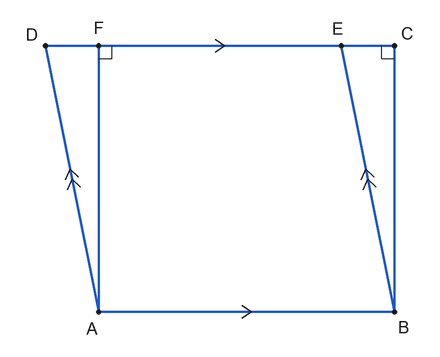
In the given figure, if area of triangle ADE is 60 cm²; state, giving reason, the area of :
(i) parallelogram ABED;
(ii) rectangle ABCF;
(iii) triangle ABE.
 Solve with AI
Written solution
Solution:
Concept: Triangles (or parallelograms) on the same base and between the same parallels are equal in area. A triangle and a parallelogram on the same base and between the same parallels: the triangle is half the parallelogram.
Given: Ar(ΔADE) = 60 cm²; ABED is a parallelogram and ABCF a rectangle, all between the parallels AB and DC.
Step 1 — Area of parallelogram ABED.
ΔADE and parallelogram ABED are on the same base DE and between the same parallels DC and AB, so the triangle is half the parallelogram.
So the area is 120 cm².
Step 2 — Area of rectangle ABCF.
Rectangle ABCF and parallelogram ABED are on the same base AB and between the same parallels AB and DC, so they are equal in area.
So the area is 120 cm².
Step 3 — Area of triangle ABE.
ΔABE and parallelogram ABED are on the same base AB and between the same parallels, so the triangle is half the parallelogram.
So the area is 60 cm².
Watch out: ΔADE is on the base DE, not AB; it is still between the same two parallels.
Therefore, (i) ar(ABED) = 120 cm², (ii) ar(ABCF) = 120 cm², (iii) ar(ΔABE) = 60 cm².
- 73 marks
Question 7
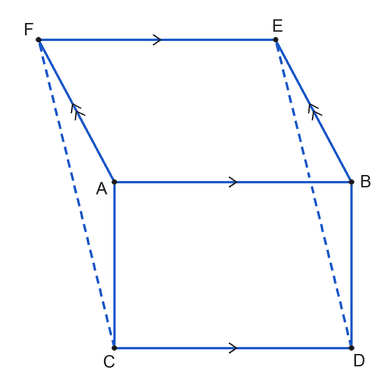
The given figure shows a rectangle ABDC and a parallelogram ABEF;drawn on opposite sides of AB. Prove that :
(i) quadrilateral CDEF is a parallelogram;
(ii) Area of quad. CDEF
= Area of rect. ABDC
- Area of //gm. ABEF.
 Solve with AI
Written solution
Solution:
Concept: A quadrilateral with one pair of opposite sides equal and parallel is a parallelogram. Congruent triangles have equal areas.
Given: ABDC is a rectangle and ABEF a parallelogram, drawn on opposite sides of AB.
Step 1 — Show that CD and FE are equal and parallel.
In rectangle ABDC, CD = AB and CD ∥ AB. In parallelogram ABEF, FE = AB and FE ∥ AB.
Step 2 — Conclude part (i).
Lines parallel to the same line are parallel to each other, so CD ∥ FE, and both equal AB, so CD = FE. One pair of opposite sides of CDEF is equal and parallel, so CDEF is a parallelogram.
Step 3 — Show that ΔACF ≅ ΔBDE.
Compare the two side triangles, side by side.
AC = BD (opposite sides of the rectangle).
AF = BE (opposite sides of parallelogram ABEF).
CF = DE (opposite sides of parallelogram CDEF, from part (i)).
So ΔACF ≅ ΔBDE by SSS, and congruent triangles have equal areas.
Step 4 — Build CDEF from the pieces.
CDEF is made of the rectangle, the parallelogram and ΔACF on the left, without ΔBDE on the right (which lies outside CDEF).
Watch out: The triangle gained (ACF) and the triangle lost (BDE) cancel only because they are congruent; say why.
Therefore, (i) CDEF is a parallelogram, and (ii) ar(CDEF) = ar(ABDC) + ar(ABEF). Hence proved.
- 83 marks
Question 8
In the given figure, diagonals PR and QS of the parallelogram PQRS intersect at point O and LM is parallel to PS. Show that :
(i) 2 Area (Δ POS) = Area (//gm PMLS)
(ii) Area (Δ POS) + Area (Δ QOR)
= Area (//gm PQRS)
(iii) Area (Δ POS) + Area (Δ QOR)
=Area (Δ POQ) + Area (Δ SOR).
 Solve with AI
Written solution
Solution:
Concept: A triangle and a parallelogram on the same base and between the same parallels: the triangle is half the parallelogram. In the figure, LM ∥ PS passes through O, the point where the diagonals meet.
Given: PQRS is a parallelogram; its diagonals meet at O; LM ∥ PS with O on LM (as in the figure).
Step 1 — Part (i): ΔPOS and parallelogram PMLS.
ΔPOS and parallelogram PMLS are on the same base PS, and the vertex O lies on ML, which is parallel to PS. So they are between the same parallels PS and ML.
Step 2 — Part (ii): ΔQOR and parallelogram MQRL.
In the same way, ΔQOR and parallelogram MQRL are on the same base QR and between the same parallels QR and ML.
Step 3 — Add the two results.
The parallelograms PMLS and MQRL together make PQRS.
Dividing by 2 gives part (ii).
Step 4 — Part (iii): the other two triangles.
The four triangles at O fill the parallelogram, so the other two triangles make up the remaining half.
Watch out: Part (i) needs O to lie on LM; this is shown in the figure, so use it.
Therefore, (i) 2 ar(ΔPOS) = ar(PMLS), (ii) ar(ΔPOS) + ar(ΔQOR) = ½ ar(PQRS), (iii) ar(ΔPOS) + ar(ΔQOR) = ar(ΔPOQ) + ar(ΔSOR). Hence proved.
- 93 marks
Question 9
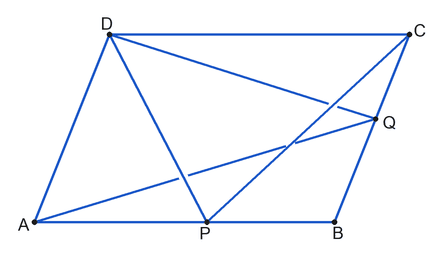
In parallelogram ABCD, P is a point on side AB and Q is a point on side BC.
Prove that :
(i) Δ CPD and Δ AQD are equal in area.
(ii) Area (Δ AQD)
= Area (Δ APD) + Area (Δ CPB)
Solve with AIWritten solution
Solution:
Concept: A triangle with one side on a side of a parallelogram and its third vertex on the opposite side is half the parallelogram (same base, same parallels).
Given: ABCD is a parallelogram, P is on AB and Q is on BC.
Step 1 — ΔCPD is half the parallelogram.
ΔCPD has base CD, and P lies on AB, which is parallel to CD.
Step 2 — ΔAQD is half the parallelogram.
ΔAQD has base AD, and Q lies on BC, which is parallel to AD.
Step 3 — Conclude part (i).
Both triangles equal half of ABCD, so they are equal.
Step 4 — Part (ii): split the parallelogram at P.
The segments PD and PC cut ABCD into ΔAPD, ΔCPD and ΔCPB.
Watch out: Q can be anywhere on BC; the vertex only has to lie on the side parallel to the base.
Therefore, (i) ar(ΔCPD) = ar(ΔAQD) and (ii) ar(ΔAQD) = ar(ΔAPD) + ar(ΔCPB). Hence proved.
- 103 marks
Question 10
In the given figure, M and N are the mid-points of the sides DC and AB respectively of the parallelogram ABCD.
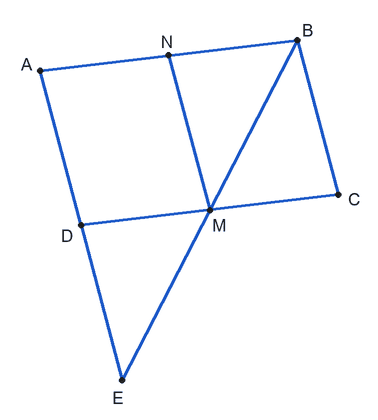
If the area of parallelogram ABCD is 48 cm²;
(i) state the area of the triangle BEC.
(ii) name the parallelogram which is equal in area to the triangle BEC.
Solve with AIWritten solution
Solution:
Concept: A triangle and a parallelogram on the same base and between the same parallels: the triangle is half the parallelogram. NM divides ABCD into two equal parallelograms.
Given: ABCD is a parallelogram with area 48 cm²; M and N are the mid-points of DC and AB; BM produced meets AD produced at E (as in the figure).
Step 1 — Find the base and parallels of ΔBEC.
ΔBEC has base BC, and its vertex E lies on AD produced. AD is parallel to BC, so ΔBEC and parallelogram ABCD are on the same base BC and between the same parallels.
Step 2 — Split ABCD by NM.
N and M are the mid-points of AB and DC, so AN, BN, DM and CM are all equal (halves of the equal sides AB and DC), and NM ∥ BC. NM cuts ABCD into two parallelograms with equal bases and the same height.
Step 3 — Compare.
The area of BNMC is 24 cm², which equals the area of ΔBEC.
Watch out: E is outside the parallelogram, but it still lies on the line AD, which is all the theorem needs.
Therefore, (i) ar(ΔBEC) = 24 cm², and (ii) parallelogram BNMC (and equally ANMD) has the same area as ΔBEC.
- 113 marks
Question 11
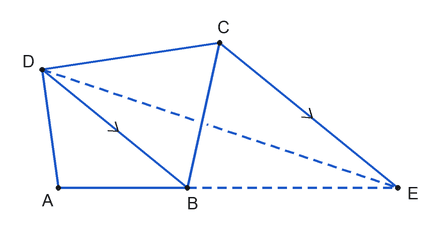
In the following figure, CE is drawn parallel to diagonal DB of the quadrilateral ABCD which meets AB produced at point E.
Prove that Δ ADE and quadrilateral ABCD are equal in area.
 Solve with AI
Written solution
Solution:
Concept: Triangles (or parallelograms) on the same base and between the same parallels are equal in area. A triangle and a parallelogram on the same base and between the same parallels: the triangle is half the parallelogram.
Given: CE ∥ DB, and CE meets AB produced at E.
Step 1 — Find two equal triangles.
ΔBDC and ΔBDE stand on the same base DB, and C and E lie on CE, which is parallel to DB. So they are between the same parallels and are equal in area.
Step 2 — Split ΔADE along DB.
B lies on AE, so DB divides ΔADE into ΔADB and ΔBDE.
Watch out: The common base is DB (the diagonal), not AB.
Therefore, ar(ΔADE) = ar(quadrilateral ABCD). Hence proved.
- 123 marks
Question 12
ABCD is a parallelogram, a line through A cuts DC at point P and BC produced at Q. Prove that triangle BCP is equal in area to triangle DPQ.
 Solve with AI
Written solution
Solution:
Concept: A triangle with one side on a side of a parallelogram and its third vertex on the opposite side (or that side produced) is half the parallelogram.
Given: ABCD is a parallelogram; a line through A cuts DC at P and BC produced at Q.
Step 1 — ΔADQ is half the parallelogram.
ΔADQ has base AD, and Q lies on BC produced, which is parallel to AD.
Step 2 — ΔAPB is half the parallelogram.
ΔAPB has base AB, and P lies on DC, which is parallel to AB.
Step 3 — Find ΔADP + ΔBCP.
The segments PA and PB cut ABCD into ΔADP, ΔAPB and ΔBCP.
Step 4 — Find ΔADP + ΔDPQ.
P lies on AQ, so DP splits ΔADQ into ΔADP and ΔDPQ.
Step 5 — Compare.
Both sums equal half of ABCD, so they are equal, and the common part ΔADP can be removed.
Watch out: Q is on BC produced, outside the parallelogram; the parallels AD and BC still contain it.
Therefore, ar(ΔBCP) = ar(ΔDPQ). Hence proved.
- 133 marks
Question 13
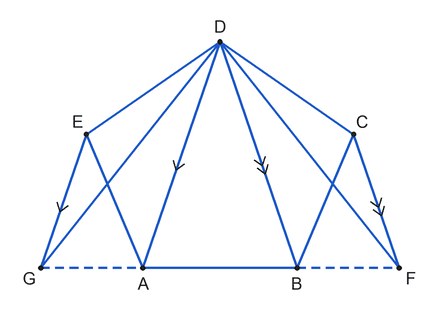
The given figure shows a pentagon ABCDE. EG drawn parallel to DA meets BA produced at G and CF drawn parallel to DB meets AB produced at F.
Prove that the area of pentagon ABCDE is equal to the area of triangle GDF.
 Solve with AI
Written solution
Solution:
Concept: Triangles (or parallelograms) on the same base and between the same parallels are equal in area. A triangle and a parallelogram on the same base and between the same parallels: the triangle is half the parallelogram.
Given: Pentagon ABCDE; EG ∥ DA meets BA produced at G; CF ∥ DB meets AB produced at F.
Step 1 — Replace ΔDAE by ΔDAG.
ΔDAE and ΔDAG stand on the same base DA, and E and G lie on EG, which is parallel to DA.
Step 2 — Replace ΔDBC by ΔDBF.
ΔDBC and ΔDBF stand on the same base DB, and C and F lie on CF, which is parallel to DB.
Step 3 — Add the middle triangle.
The diagonals DA and DB cut the pentagon into ΔDAE, ΔDAB and ΔDBC, and the same lines cut ΔGDF into ΔDAG, ΔDAB and ΔDBF.
Watch out: G and F are on AB produced, so G, A, B and F are on one line; that is why the three triangles make ΔGDF.
Therefore, ar(pentagon ABCDE) = ar(ΔGDF). Hence proved.
- 143 marks
Question 14
In the given figure, AP is parallel to BC, BP is parallel to CQ. Prove that the areas of triangles ABC and BQP are equal.
 Solve with AI
Written solution
Solution:
Concept: Triangles (or parallelograms) on the same base and between the same parallels are equal in area. A triangle and a parallelogram on the same base and between the same parallels: the triangle is half the parallelogram.
Given: AP ∥ BC and BP ∥ CQ.
Step 1 — Move the vertex A to P.
ΔABC and ΔPBC stand on the same base BC, and A and P lie on AP, which is parallel to BC.
Step 2 — Move the vertex C to Q.
ΔPBC and ΔPBQ stand on the same base PB, and C and Q lie on CQ, which is parallel to BP.
Step 3 — Combine.
Both steps together link the first triangle to the last.
Watch out: In the second step the base is PB, not BC; the parallel line used is CQ.
Therefore, ar(ΔABC) = ar(ΔBQP). Hence proved.
- 153 marks
Question 15
In the figure given alongside, squares ABDE and AFGC are drawn on the side AB and the hypotenuse AC of the right triangle ABC.
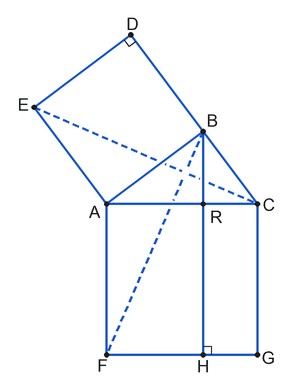
If BH is perpendicular to FG, prove that :
(i) Δ EAC ≅ Δ BAF.
(ii) Area of the square ABDE
= Area of the rectangle ARHF.
Solve with AIWritten solution
Solution:
Concept: Congruent triangles have equal areas. A triangle and a parallelogram (square or rectangle) on the same base and between the same parallels: the triangle is half of it.
Given: ABC is right-angled at B; ABDE and AFGC are squares on AB and AC; BH ⟂ FG meets AC at R.
Step 1 — Part (i): compare ΔEAC and ΔBAF.
Check two sides and the included angle.
EA = BA (sides of square ABDE).
AC = AF (sides of square AFGC).
∠EAC = 90° + ∠BAC, and ∠BAF = 90° + ∠BAC, so ∠EAC = ∠BAF.
Hence ΔEAC ≅ ΔBAF by SAS, and so their areas are equal.
Step 2 — D, B and C are in a line.
∠ABD = 90° (square) and ∠ABC = 90° (given), and they add up to 180°. So D, B, C are collinear, and the line DC is parallel to EA (opposite sides of the square).
Step 3 — ΔEAC is half the square.
ΔEAC and square ABDE are on the same base EA and between the parallels EA and DC.
Step 4 — ΔBAF is half the rectangle.
BH ⟂ FG and AF ⟂ FG, so BH ∥ AF. ΔBAF and rectangle ARHF are on the same base AF and between the parallels AF and BH.
Step 5 — Conclude part (ii).
The two triangles are equal by part (i), so their doubles are equal too.
Watch out: The angle ∠EAC is 90° + ∠BAC because the square's corner and the triangle's angle sit side by side at A.
Therefore, (i) ΔEAC ≅ ΔBAF, and (ii) ar(square ABDE) = ar(rectangle ARHF). Hence proved.
- 163 marks
Question 16
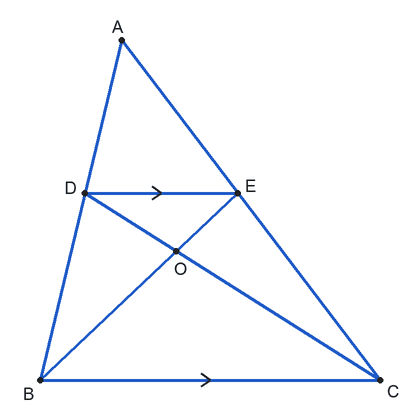
In the following figure, DE is parallel to BC. Show that :
(i) Area (Δ ADC) = Area (Δ AEB)
(ii) Area (Δ BOD) = Area (Δ COE).
 Solve with AI
Written solution
Solution:
Concept: Triangles (or parallelograms) on the same base and between the same parallels are equal in area. A triangle and a parallelogram on the same base and between the same parallels: the triangle is half the parallelogram.
Given: DE ∥ BC; BE and CD meet at O.
Step 1 — Find two equal triangles.
ΔDBC and ΔEBC stand on the same base BC, and D and E lie on DE, which is parallel to BC.
Step 2 — Part (i): subtract from ΔABC.
Taking each of these equal triangles away from ΔABC leaves ΔADC and ΔAEB.
Step 3 — Part (ii): subtract ΔOBC.
Both equal triangles contain ΔOBC. Taking it away leaves ΔBOD and ΔCOE.
Watch out: The common part removed in (ii) is ΔOBC, the triangle on the base BC.
Therefore, (i) ar(ΔADC) = ar(ΔAEB) and (ii) ar(ΔBOD) = ar(ΔCOE). Hence proved.
- 173 marks
Question 17
Show that :
(i) a diagonal divides a parallelogram into two triangles of equal area.
(ii) the ratio of the areas of two triangles of the same height is equal to the ratio of their bases.
(iii) the ratio of the areas of two triangles on the same base is equal to the ratio of their heights.
Solve with AIWritten solution
Solution:
Concept: Congruent triangles have equal areas, and the area of a triangle is ½ × base × height.
Step 1 — Part (i): use congruence.
Let ABCD be a parallelogram with diagonal AC. AB = CD and BC = DA (opposite sides), and AC is common. So ΔABC ≅ ΔCDA by SSS.

Congruent triangles have equal areas.
Step 2 — Part (ii): same height.
Let the two triangles have bases and and the same height . Divide one area by the other; the ½ and the cancel.
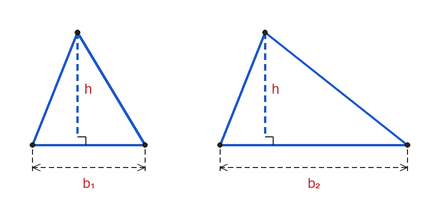
Step 3 — Part (iii): same base.
Let the two triangles have the same base and heights and . Now the ½ and the cancel.
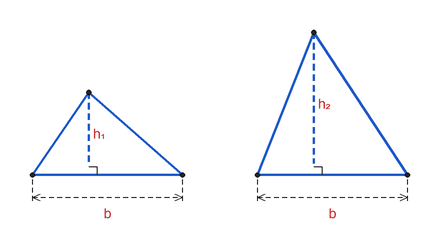
Watch out: In (ii) the heights must be equal, and in (iii) the bases must be equal, before anything cancels.
Therefore, (i) a diagonal divides a parallelogram into two triangles of equal area; (ii) ar₁ : ar₂ = b₁ : b₂; (iii) ar₁ : ar₂ = h₁ : h₂. Hence proved.
- 183 marks
Question 18
In the given figure; AD is median of Δ ABC and E is any point on median AD. Prove that Area (Δ ABE) = Area (Δ ACE).
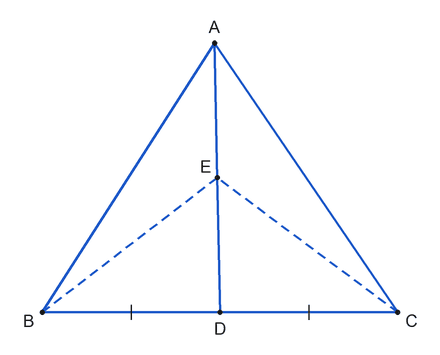 Solve with AI
Written solution
Solution:
Concept: A median of a triangle divides it into two triangles of equal area, because the two bases are equal and the height from the vertex is the same.
Given: AD is a median of ΔABC and E is any point on AD.
Step 1 — Use the median AD of ΔABC.
D is the mid-point of BC, so AD halves ΔABC.
Step 2 — Use the median ED of ΔEBC.
D is also the mid-point of the base BC of ΔEBC, so ED halves ΔEBC.
Step 3 — Subtract.
Taking the second result away from the first leaves ΔABE and ΔACE.
Watch out: E is any point on AD, not necessarily its mid-point; the proof does not need it.
Therefore, ar(ΔABE) = ar(ΔACE). Hence proved.
- 193 marks
Question 19
In the figure of question 14, if E is the mid point of median AD, then prove that :
Area (Δ ABE) = Area (Δ ABC).
Solve with AIWritten solution
Solution:
Concept: A median of a triangle divides it into two triangles of equal area, because the two bases are equal and the height from the vertex is the same.
Given: AD is a median of ΔABC and E is the mid-point of AD.
Step 1 — Use the median BE of ΔABD.
E is the mid-point of AD, so BE is a median of ΔABD and halves it.
Step 2 — Use the median AD of ΔABC.
D is the mid-point of BC, so AD halves ΔABC.
Step 3 — Combine.
Put the second result into the first.
Watch out: Halving twice gives a quarter, not a half.
Therefore, ar(ΔABE) = ¼ ar(ΔABC). Hence proved.
- 203 marks
Question 20
ABCD is a parallelogram. P and Q are the mid-points of sides AB and AD respectively.
Prove that area of triangle APQ = of the area of parallelogram ABCD.
(Join PD and BD.)
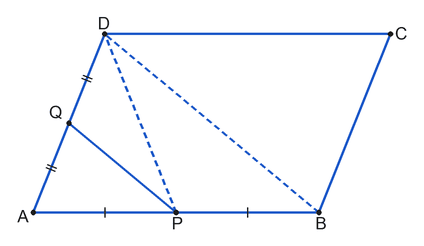 Solve with AI
Written solution
Solution:
Concept: A diagonal halves a parallelogram, and a median halves a triangle.
Given: ABCD is a parallelogram; P and Q are the mid-points of AB and AD; join PD and BD.
Step 1 — Use the diagonal BD.
A diagonal divides a parallelogram into two equal triangles.
Step 2 — Use the median DP of ΔABD.
P is the mid-point of AB, so DP halves ΔABD.
Step 3 — Use the median PQ of ΔAPD.
Q is the mid-point of AD, so PQ halves ΔAPD.
Watch out: Each halving uses a different triangle; name the median and its triangle each time.
Therefore, ar(ΔAPQ) = ⅛ ar(parallelogram ABCD). Hence proved.
- 213 marks
Question 21
The base BC of triangle ABC is divided at D so that BD = DC.
Prove that area of Δ ABD = of the area of Δ ABC.
Solve with AIWritten solution
Solution:
Concept: Triangles with the same height (for example, a common vertex and bases on one line) have areas in the ratio of their bases.
Given: D is on BC with BD = ½ DC.
Step 1 — Express BC in terms of BD.
DC is twice BD, so the whole base BC is three times BD.
Step 2 — Compare the areas.
ΔABD and ΔABC have the same height from A, so their areas are in the ratio BD : BC.
Watch out: The ratio is BD : BC (part to whole), not BD : DC.
Therefore, ar(ΔABD) = ⅓ ar(ΔABC). Hence proved.
- 223 marks
Question 22
In a parallelogram ABCD, point P lies in DC such that DP : PC = 3 : 2.

If area of Δ DPB = 30 sq. cm, find the area of the parallelogram ABCD.
Solve with AIWritten solution
Solution:
Concept: Triangles with the same height (for example, a common vertex and bases on one line) have areas in the ratio of their bases. A diagonal halves a parallelogram.
Given: ABCD is a parallelogram; P is on DC with DP : PC = 3 : 2; ar(ΔDPB) = 30 sq. cm.
Step 1 — Compare ΔDPB with ΔDCB.
Both triangles have vertex B and bases DP and DC on the same line, so their areas are in the ratio DP : DC = 3 : 5.
Step 2 — Find ar(ΔDCB).
ΔDCB is 5/3 times ΔDPB.
Step 3 — Find ar(ABCD).
The diagonal BD halves the parallelogram, so ABCD is twice ΔDCB.
Watch out: DP : DC is 3 : 5 (part to whole), not 3 : 2.
Therefore, the area of parallelogram ABCD is 100 sq. cm.
- 233 marks
Question 23
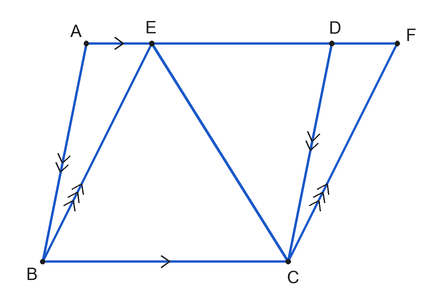
ABCD and BCFE are parallelograms. If area of triangle EBC = 480 cm², AB = 30 cm and BC = 40 cm; Calculate;
(i) area of parallelogram ABCD;
(ii) area of the parallelogram BCFE;
(iii) length of altitude from A on CD;
(iv) area of triangle ECF.
Solve with AIWritten solution
Solution:
Concept: Triangles (or parallelograms) on the same base and between the same parallels are equal in area. A triangle and a parallelogram on the same base and between the same parallels: the triangle is half the parallelogram. The area of a parallelogram is base × height.
Given: ABCD and BCFE are parallelograms; ar(ΔEBC) = 480 cm², AB = 30 cm, BC = 40 cm.
Step 1 — Part (i): parallelogram ABCD.
ΔEBC and parallelogram ABCD are on the same base BC and between the same parallels BC and AF, so the triangle is half the parallelogram.
So it is 960 cm².
Step 2 — Part (ii): parallelogram BCFE.
Parallelograms ABCD and BCFE are on the same base BC and between the same parallels, so they are equal.
So it is 960 cm².
Step 3 — Part (iii): the altitude from A on CD.
Take CD as the base; CD equals AB, which is 30 cm. Since area = base × height, the height h is the area divided by the base.
So the altitude is 32 cm.
Step 4 — Part (iv): triangle ECF.
The diagonal EC halves parallelogram BCFE.
So it is 480 cm².
Watch out: The altitude on CD uses the base CD = 30 cm, not BC = 40 cm.
Therefore, (i) 960 cm², (ii) 960 cm², (iii) 32 cm, (iv) 480 cm².
- 243 marks
Question 24
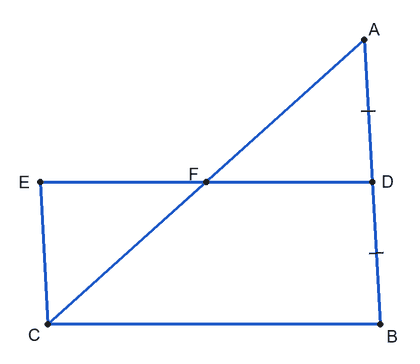
In the given figure, D is mid-point of side AB of ΔABC and BDEC is a parallelogram.
Prove that :
Area of Δ ABC = Area of // gm BDEC.
Solve with AIWritten solution
Solution:
Concept: The converse of the mid-point theorem: a line through the mid-point of one side of a triangle, parallel to another side, bisects the third side. Congruent triangles have equal areas.
Given: D is the mid-point of AB, and BDEC is a parallelogram; ED meets AC at F.
Step 1 — F is the mid-point of AC.
In ΔABC, D is the mid-point of AB and DF ∥ BC (DE ∥ BC, as BDEC is a parallelogram). So F is the mid-point of AC, and by the mid-point theorem DF = ½ BC.
Step 2 — Show that EF = DF.
ED = BC, because they are opposite sides of parallelogram BDEC. So EF is the rest of ED after DF.
So EF = DF.
Step 3 — Show that ΔADF ≅ ΔCEF.
Compare the two triangles at F.
AF = CF (F is the mid-point of AC).
DF = EF (from Step 2).
∠AFD = ∠CFE (vertically opposite angles).
So ΔADF ≅ ΔCEF by SAS, and their areas are equal.
Step 4 — Swap the triangles.
ΔABC is quadrilateral BDFC plus ΔADF; parallelogram BDEC is BDFC plus ΔCEF.
Watch out: F is the mid-point because DF is parallel to BC; this must be shown, not just read off the figure.
Therefore, ar(ΔABC) = ar(parallelogram BDEC). Hence proved.
- 253 marks
Question 25
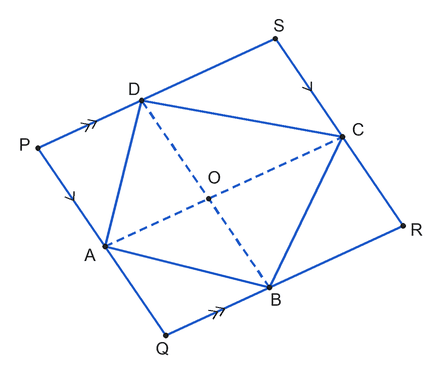
In the following figure, AC // PS // QR and PQ // DB // SR.
Prove that :
Area of quadrilateral PQRS = 2 × Area of quad. ABCD.
Solve with AIWritten solution
Solution:
Concept: A diagonal divides a parallelogram into two triangles of equal area.
Given: AC ∥ PS ∥ QR and PQ ∥ DB ∥ SR; the diagonals AC and BD of ABCD meet at O.
Step 1 — Find four parallelograms.
Each side of PQRS is parallel to one diagonal of ABCD, so the diagonals cut PQRS into four parallelograms: PAOD, AQBO, OBRC and DOCS.
Step 2 — Halve each one.
In each small parallelogram, a side of ABCD is a diagonal, so it cuts off half.
Step 3 — Add the four results.
The four triangles make ABCD, and the four parallelograms make PQRS.
Watch out: PAOD is a parallelogram because PA ∥ DO (both ∥ DB) and PD ∥ AO (both ∥ AC).
Therefore, ar(PQRS) = 2 × ar(ABCD). Hence proved.
- 263 marks
Question 26
ABCD is a trapezium with AB // DC. A line parallel to AC intersects AB at point M and BC at point N. Prove that :
area of Δ ADM = area of Δ ACN.
(Join C and M)
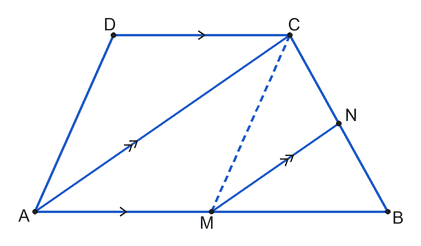 Solve with AI
Written solution
Solution:
Concept: Triangles (or parallelograms) on the same base and between the same parallels are equal in area. A triangle and a parallelogram on the same base and between the same parallels: the triangle is half the parallelogram.
Given: ABCD is a trapezium with AB ∥ DC; MN ∥ AC with M on AB and N on BC; join CM.
Step 1 — Move the vertex D to C.
ΔADM and ΔACM stand on the same base AM, and D and C lie on DC, which is parallel to AB.
Step 2 — Move the vertex M to N.
ΔACM and ΔACN stand on the same base AC, and M and N lie on MN, which is parallel to AC.
Step 3 — Combine.
The two steps link ΔADM to ΔACN.
Watch out: The base changes from AM in the first step to AC in the second; check the parallel line each time.
Therefore, ar(ΔADM) = ar(ΔACN). Hence proved.
- 273 marks
Question 27
In the given figure, AD // BE // CF.
Prove that :
area (ΔAEC)
= area (ΔDBF)
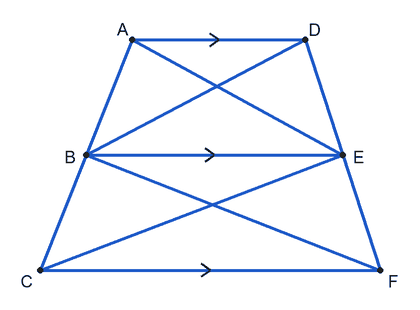 Solve with AI
Written solution
Solution:
Concept: Triangles (or parallelograms) on the same base and between the same parallels are equal in area. A triangle and a parallelogram on the same base and between the same parallels: the triangle is half the parallelogram.
Given: AD ∥ BE ∥ CF; in the figure, A, B, C lie on one line and D, E, F on another.
Step 1 — Split each triangle along BE.
B lies on AC, so BE splits ΔAEC; E lies on DF, so BE splits ΔDBF.
Step 2 — Compare the left pieces.
ΔABE and ΔDBE stand on the same base BE, and A and D lie on AD, which is parallel to BE.
Step 3 — Compare the right pieces.
ΔCBE and ΔFBE stand on the same base BE, and C and F lie on CF, which is parallel to BE.
Step 4 — Add.
Adding the two equal pairs gives the two whole triangles.
Watch out: Both comparisons use the same base BE, with a different pair of parallels each time.
Therefore, ar(ΔAEC) = ar(ΔDBF). Hence proved.
- 283 marks
Question 28
In the given figure, ABCD is a parallelogram. BC is produced to point X. Prove that :
area (Δ ABX) = area (quad. ACXD)
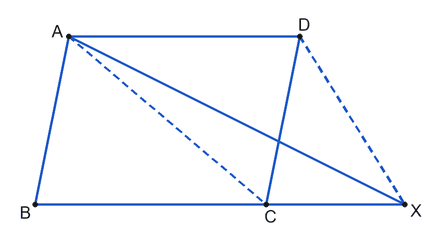 Solve with AI
Written solution
Solution:
Concept: Triangles (or parallelograms) on the same base and between the same parallels are equal in area. A triangle and a parallelogram on the same base and between the same parallels: the triangle is half the parallelogram. A diagonal halves a parallelogram.
Given: ABCD is a parallelogram and BC is produced to X.
Step 1 — Move the vertex C to X.
ΔACD and ΔAXD stand on the same base AD, and C and X lie on BX, which is parallel to AD.
Step 2 — Use the diagonal AC.
The diagonal AC halves the parallelogram.
Step 3 — Add ΔACX.
Quadrilateral ACXD is ΔACX plus ΔAXD, and ΔABX is ΔABC plus ΔACX.
Watch out: ΔAXD and ΔACD share the base AD; their third vertices are both on the line BX.
Therefore, ar(ΔABX) = ar(quadrilateral ACXD). Hence proved.
- 293 marks
Question 29
The given figure shows parallelograms ABCD and APQR. Show that these parallelograms are equal in area.
[Join B and R]
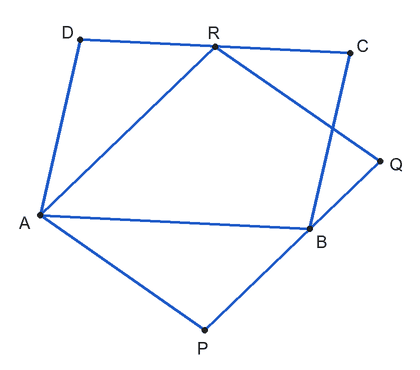 Solve with AI
Written solution
Solution:
Concept: A triangle and a parallelogram on the same base and between the same parallels: the triangle is half the parallelogram.
Given: ABCD and APQR are parallelograms; in the figure R lies on DC and B on PQ; join BR.
Step 1 — ΔABR is half of ABCD.
ΔABR and parallelogram ABCD stand on the same base AB, and R lies on DC, which is parallel to AB.
Step 2 — ΔABR is half of APQR.
ΔABR and parallelogram APQR stand on the same base AR, and B lies on PQ, which is parallel to AR.
Step 3 — Compare.
Both parallelograms are twice the same triangle.
Watch out: ΔABR is used twice, with a different side as its base each time (AB, then AR).
Therefore, ar(ABCD) = ar(APQR); the parallelograms are equal in area.
- 303 marks
Question 30
ABCD is a parallelogram in which BC is produced to E such that CE = BC and AE intersects CD at F.
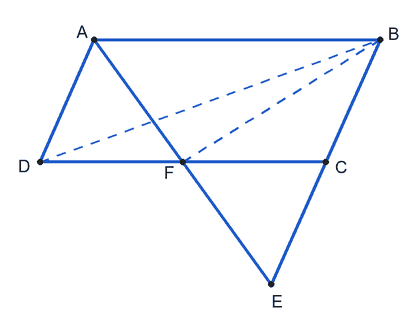
If ar.(Δ DFB) = 30 cm²; find the area of parallelogram
Solve with AIWritten solution
Solution:
Concept: Congruent triangles have equal areas; a median halves a triangle; a diagonal halves a parallelogram.
Given: ABCD is a parallelogram; BC is produced to E with CE = BC; AE meets CD at F; ar(ΔDFB) = 30 cm².
Step 1 — Show that ΔADF ≅ ΔECF.
Compare the two triangles at F.
AD = BC (opposite sides of the parallelogram), and BC = CE (given), so AD = CE.
∠DAF = ∠CEF (alternate angles, AD ∥ BE).
∠AFD = ∠EFC (vertically opposite angles).
So ΔADF ≅ ΔECF by AAS, and DF = CF: F is the mid-point of DC.
Step 2 — Use the median BF.
F is the mid-point of DC, so BF is a median of ΔBDC and halves it.
Step 3 — Use the diagonal BD.
The diagonal BD halves the parallelogram.
Watch out: F being the mid-point of DC is the key; it comes from the congruence, not from the figure.
Therefore, the area of parallelogram ABCD is 120 cm².
- 313 marks
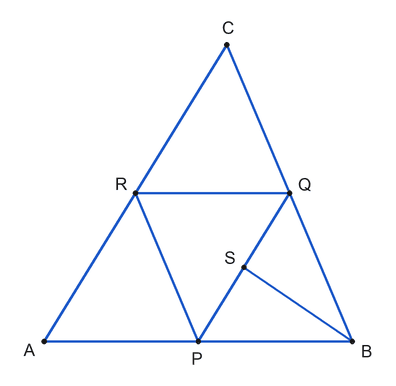
Question 31
The following figure shows a triangle ABC in which P, Q and R are mid-points of sides AB, BC and CA respectively. S is mid-point of PQ. Prove that :
ar.(Δ ABC) = 8 × ar.(Δ QSB)
 Solve with AI
Written solution
Solution:
Concept: A median of a triangle divides it into two triangles of equal area, because the two bases are equal and the height from the vertex is the same. The mid-point theorem: the segment joining the mid-points of two sides is parallel to the third side and half of it.
Given: P, Q, R are the mid-points of AB, BC, CA; S is the mid-point of PQ.
Step 1 — The four small triangles are congruent.
By the mid-point theorem, PQ is half of AC, so PQ equals AR and RC. In the same way, QR equals AP and PB, and RP equals BQ and QC. So ΔAPR, ΔPBQ, ΔRQC and ΔQRP are congruent (SSS), and each is a quarter of ΔABC.
Step 2 — Use the median BS of ΔPBQ.
S is the mid-point of PQ, so BS halves ΔPBQ.
Watch out: S halves ΔPBQ, not ΔABC; the factor 8 is 4 × 2.
Therefore, ar(ΔABC) = 8 × ar(ΔQSB). Hence proved.
- 323 marks
Question 32
In the given figure, the diagonals AC and BD intersect at point O. If OB = OD and AB//DC, prove that :
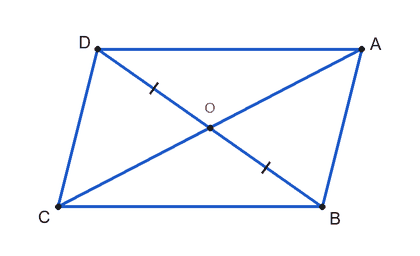
(i) Area (Δ DOC) = Area (Δ AOB).
(ii) Area (Δ DCB) = Area (Δ ACB).
(iii) ABCD is a parallelogram.
Solve with AIWritten solution
Solution:
Concept: Congruent triangles have equal areas. A quadrilateral whose diagonals bisect each other is a parallelogram.
Given: The diagonals AC and BD meet at O; OB = OD and AB ∥ DC.
Step 1 — Part (i): ΔAOB ≅ ΔCOD.
Compare the two triangles at O.
OB = OD (given).
∠AOB = ∠COD (vertically opposite angles).
∠OBA = ∠ODC (alternate angles, AB ∥ DC).
So ΔAOB ≅ ΔCOD by ASA, and their areas are equal.
Step 2 — Part (ii): add ΔBOC.
Add ar(ΔBOC) to both sides of the result of part (i).
Step 3 — Part (iii): the diagonals bisect each other.
From the congruence in part (i), OA = OC; also, OB = OD is given; so the diagonals AC and BD bisect each other, and ABCD is a parallelogram.
Watch out: OA = OC is not given; it comes from the congruent triangles.
Therefore, (i) ar(ΔDOC) = ar(ΔAOB), (ii) ar(ΔDCB) = ar(ΔACB), (iii) ABCD is a parallelogram. Hence proved.
- 333 marks
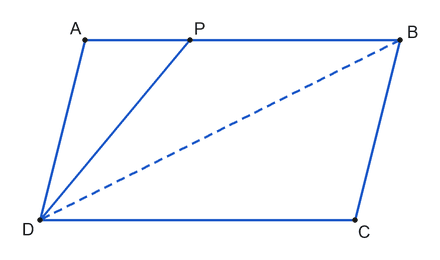
Question 33
The given figure shows a parallelogram ABCD with area 324 sq. cm. P is a point in AB such that AP : PB = 1 : 2. Find the area of Δ APD.
 Solve with AI
Written solution
Solution:
Concept: Triangles with the same height (for example, a common vertex and bases on one line) have areas in the ratio of their bases. A diagonal halves a parallelogram.
Given: ABCD is a parallelogram with area 324 sq. cm; P is on AB with AP : PB = 1 : 2.
Step 1 — Use the diagonal BD.
The diagonal BD halves the parallelogram.
Step 2 — Compare ΔAPD with ΔABD.
Both have vertex D and bases AP and AB on the same line, so their areas are in the ratio AP : AB = 1 : 3.
Watch out: AP : AB is 1 : 3 (part to whole), not 1 : 2.
Therefore, the area of ΔAPD is 54 sq. cm.
- 343 marks
Question 34
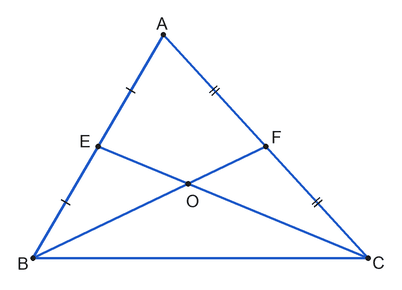
In Δ ABC, E and F are mid-points of sides AB and AC respectively. If BF and CE intersect each other at point O, prove that the Δ OBC and quadrilateral AEOF are equal in area.
 Solve with AI
Written solution
Solution:
Concept: A median of a triangle divides it into two triangles of equal area, because the two bases are equal and the height from the vertex is the same.
Given: E and F are the mid-points of AB and AC; BF and CE meet at O.
Step 1 — Two medians give equal triangles.
CE and BF are medians of ΔABC, so each cuts off half of it.
Step 2 — Remove ΔBOC.
Both triangles contain ΔBOC; removing it leaves ΔBOE and ΔCOF.
Step 3 — Use the median BF.
BF halves ΔABC, so ΔABF and ΔCBF are equal. Remove the equal pieces ΔBOE and ΔCOF.
Watch out: Quadrilateral AEOF is ΔABF without ΔBOE; check this on a rough sketch.
Therefore, ar(ΔOBC) = ar(quadrilateral AEOF). Hence proved.
- 353 marks
Question 35
In parallelogram ABCD, P is mid-point of AB. CP and BD intersect each other at point O.
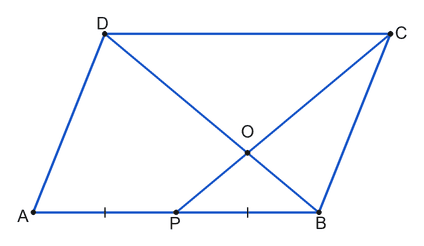
If area of Δ POB = 40 cm² and OP : OC = 1 : 2, find :
(i) Areas of Δ BOC and Δ PBC
(ii) Areas of Δ ABC and parallelogram ABCD.
Solve with AIWritten solution
Solution:
Concept: Triangles with the same height (for example, a common vertex and bases on one line) have areas in the ratio of their bases. A median halves a triangle; a diagonal halves a parallelogram.
Given: ABCD is a parallelogram; P is the mid-point of AB; CP and BD meet at O; ar(ΔPOB) = 40 cm² and OP : OC = 1 : 2.
Step 1 — Find ar(ΔBOC).
ΔPOB and ΔBOC have the same vertex B and bases OP and OC on one line, so their areas are in the ratio 1 : 2.
Step 2 — Find ar(ΔPBC).
ΔPBC is made of ΔPOB and ΔBOC.
Step 3 — Find ar(ΔABC).
P is the mid-point of AB, so CP is a median of ΔABC.
Step 4 — Find ar(ABCD).
The diagonal AC halves the parallelogram.
Watch out: The given ratio OP : OC = 1 : 2 agrees with the figure: ΔPOB and ΔCOD are similar with PB : DC = 1 : 2.
Therefore, (i) ar(ΔBOC) = 80 cm² and ar(ΔPBC) = 120 cm²; (ii) ar(ΔABC) = 240 cm² and ar(ABCD) = 480 cm².
- 363 marks
Question 36
The medians of a triangle ABC intersect each other at point G.
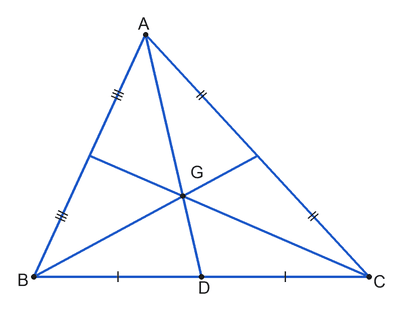
If one of its medians is AD, prove that :
(i) Area (Δ ABD) = 3 × Area (Δ BGD)
(ii) Area (Δ ACD) = 3 × Area (CGD)
(iii) Area (Δ BGC) = × Area (Δ ABC)
Solve with AIWritten solution
Solution:
Concept: The three medians of a triangle meet at the centroid G. Each median of a small triangle at G halves it, so the six small triangles have equal areas.
Given: The medians AD, BE and CF of ΔABC meet at G.
Step 1 — Name the six parts.
GD is a median of ΔGBC, GE of ΔGCA and GF of ΔGAB, so the small triangles pair up.

Call these areas , and in that order.
Step 2 — Use the median AD.
AD halves ΔABC: ΔABD has parts , , and ΔACD has parts , , .
So .
Step 3 — Use the median BE.
BE halves ΔABC: ΔBCE has parts , , and ΔBAE has parts , , .
So . All six parts are equal, and ar(ΔABC) = .
Step 4 — Part (i).
ΔABD is three of the six parts, and ΔBGD is one of them.
Step 5 — Part (ii).
ΔACD is three of the six parts, and ΔCGD is one of them.
Step 6 — Part (iii).
ΔBGC is two of the six parts.
Watch out: A median of the whole triangle halves the whole triangle; GD halves only the small triangle GBC.
Therefore, (i) ar(ΔABD) = 3 ar(ΔBGD), (ii) ar(ΔACD) = 3 ar(ΔCGD), (iii) ar(ΔBGC) = ⅓ ar(ΔABC). Hence proved.
- 373 marks
Question 37
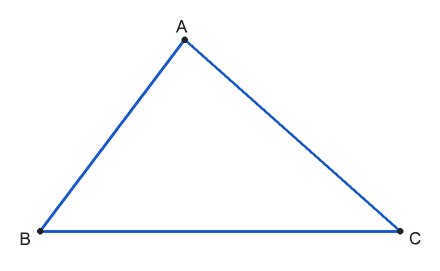
The perimeter of a triangle ABC is 37 cm and the ratio between the lengths of its altitudes be 6 : 5 : 4. Find the lengths of its sides.
 Solve with AI
Written solution
Solution:
Concept: For any side of a triangle, side × its altitude = 2 × area, the same number for all three sides. So the sides are inversely proportional to their altitudes.
Given: Perimeter = 37 cm; the altitudes are in the ratio 6 : 5 : 4.
Step 1 — Set up the sides.
Let the altitudes be , and , on the sides , and . Each product side × altitude equals twice the area, so the three products , and are equal.
Step 2 — Find the ratio of the sides.
So the sides are in the ratio of the reciprocals. Multiply by 60, the LCM of 6, 5 and 4, to clear the fractions.
Step 3 — Use the perimeter.
Let the sides be , and . Their sum is the perimeter.
Watch out: The sides follow the reciprocals of the altitudes (a longer altitude means a shorter side).
Therefore, the sides are 10 cm, 12 cm and 15 cm.
- 383 marks
Question 38
In parallelogram ABCD, E is a point in AB and DE meets diagonal AC at point F. If DF : FE = 5 : 3 and area of Δ ADF is 60 cm²; find :

(i) area of Δ ADE
(ii) if AE : EB = 3 : 2, find the area of Δ ADB
(iii) also, find area of parallelogram ABCD.
Solve with AIWritten solution
Solution:
Concept: Triangles with the same height (for example, a common vertex and bases on one line) have areas in the ratio of their bases. A diagonal halves a parallelogram.
Given: ABCD is a parallelogram; E is on AB; DE meets the diagonal AC at F; DF : FE = 5 : 3 and ar(ΔADF) = 60 cm²; in part (ii), AE : EB = 3 : 2.
Step 1 — Part (i): find ar(ΔAFE).
ΔADF and ΔAFE have the same vertex A and bases DF and FE on the line DE, so their areas are in the ratio 5 : 3.
Step 2 — Part (i): find ar(ΔADE).
ΔADE is made of ΔADF and ΔAFE.
Step 3 — Part (ii): compare ΔADE with ΔADB.
Both have vertex D and bases AE and AB on the same line. AE : EB = 3 : 2, so AE : AB = 3 : 5.
Step 4 — Part (iii): the parallelogram.
The diagonal BD halves the parallelogram, so ABCD is twice ΔADB.
Watch out: AE : AB is part to whole, 3 : 5, not 3 : 2.
Note: The book prints the ratio AE : EB as 4 : 5 in part (ii), but that cannot hold together with a ratio of 5 : 3 for DF : FE.
In a parallelogram, ΔAFE and ΔCFD are similar (AE ∥ DC), so the ratio DF : FE equals DC : AE. A ratio of 5 : 3 for DF : FE therefore makes AE : AB equal to 3 : 5, that is, AE : EB is 3 : 2.
The ratio is corrected here to 3 : 2 so that all the data fit together. As a check, three-fifths of 160 cm² is 96 cm², the area of ΔADE found in part (i).
Therefore, (i) ar(ΔADE) = 96 cm², (ii) ar(ΔADB) = 160 cm², (iii) ar(ABCD) = 320 cm².
- 393 marks
Question 39
In the following figure, BD is parallel to CA, E is mid-point of CA and BD = CA.
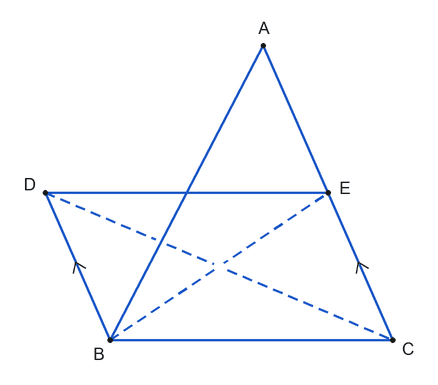
Prove that : ar.(Δ ABC) = 2 × ar.(Δ DBC)
Solve with AIWritten solution
Solution:
Concept: Triangles (or parallelograms) on the same base and between the same parallels are equal in area. A triangle and a parallelogram on the same base and between the same parallels: the triangle is half the parallelogram. A median of a triangle divides it into two triangles of equal area, because the two bases are equal and the height from the vertex is the same.
Given: BD ∥ CA, E is the mid-point of CA and BD = ½ CA.
Step 1 — BCED is a parallelogram.
BD is half of CA, so BD = CE; also BD ∥ CE (CE is part of CA). One pair of opposite sides of BCED is equal and parallel, so BCED is a parallelogram, and DE ∥ BC.
Step 2 — Move the vertex D to E.
ΔDBC and ΔEBC stand on the same base BC, and D and E lie on DE, which is parallel to BC.
Step 3 — Use the median BE.
E is the mid-point of CA, so BE is a median of ΔABC and halves it.
Step 4 — Combine.
Put the two results together.
Watch out: First show DE ∥ BC; it is not given, it comes from the parallelogram BCED.
Therefore, ar(ΔABC) = 2 × ar(ΔDBC). Hence proved.
- 403 marks
Question 40
In the following figure, OAB is a triangle and AB//DC.

If the area of Δ CAD = 140 cm² and the area of Δ ODC = 172 cm², find
(i) the area of Δ DBC
(ii) the area of Δ OAC
(iii) the area of Δ ODB.
Solve with AIWritten solution
Solution:
Concept: Triangles (or parallelograms) on the same base and between the same parallels are equal in area. A triangle and a parallelogram on the same base and between the same parallels: the triangle is half the parallelogram.
Given: AB ∥ DC; D is on OA and C is on OB; ar(ΔCAD) = 140 cm² and ar(ΔODC) = 172 cm².
Step 1 — Part (i): ΔDBC.
ΔCAD and ΔDBC stand on the same base DC, and A and B lie on AB, which is parallel to DC.
So ar(ΔDBC) = 140 cm².
Step 2 — Part (ii): ΔOAC.
D lies on OA, so CD splits ΔOAC into ΔODC and ΔCAD.
Step 3 — Part (iii): ΔODB.
C lies on OB, so DC splits ΔODB into ΔODC and ΔDBC.
Watch out: ΔCAD and ΔDBC are on the base DC; the parallels are DC and AB.
Therefore, (i) 140 cm², (ii) 312 cm², (iii) 312 cm².
- 413 marks
Question 41
E, F, G and H are the mid-points of the sides of a parallelogram ABCD.
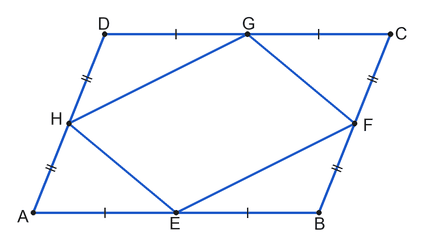
Show that area of quadrilateral EFGH is half of the area of parallelogram ABCD.
Solve with AIWritten solution
Solution:
Concept: A triangle and a parallelogram on the same base and between the same parallels: the triangle is half the parallelogram.
Given: E, F, G, H are the mid-points of AB, BC, CD, DA of parallelogram ABCD.
Step 1 — Split ABCD by HF.
AH = BF (halves of the equal sides AD and BC) and AH ∥ BF, so ABFH is a parallelogram. In the same way, HFCD is a parallelogram.

Step 2 — ΔEFH is half of ABFH.
ΔEFH and parallelogram ABFH stand on the same base HF, and E lies on AB, which is parallel to HF.
Step 3 — ΔGFH is half of HFCD.
ΔGFH and parallelogram HFCD stand on the same base HF, and G lies on DC, which is parallel to HF.
Step 4 — Add.
The two triangles make EFGH, and the two parallelograms make ABCD.
Watch out: Join HF first; without it there is no common base.
Therefore, ar(EFGH) = ½ ar(ABCD). Hence proved.
- 423 marks
Question 42
ABCD is a trapezium with AB parallel to DC. A line parallel to AC intersects AB at X and BC at Y. Prove that area of Δ ADX = area of Δ ACY.
 Solve with AI
Written solution
Solution:
Concept: Triangles (or parallelograms) on the same base and between the same parallels are equal in area. A triangle and a parallelogram on the same base and between the same parallels: the triangle is half the parallelogram.
Given: ABCD is a trapezium with AB ∥ DC; XY ∥ AC with X on AB and Y on BC; join CX.
Step 1 — Move the vertex D to C.
ΔADX and ΔACX stand on the same base AX, and D and C lie on DC, which is parallel to AB.
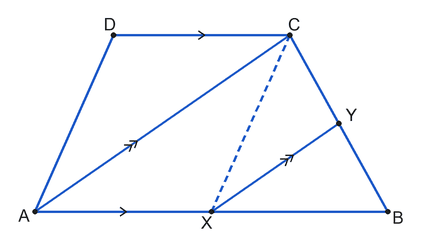
Step 2 — Move the vertex X to Y.
ΔACX and ΔACY stand on the same base AC, and X and Y lie on XY, which is parallel to AC.
Step 3 — Combine.
The two steps link ΔADX to ΔACY.
Watch out: The base changes from AX to AC between the two steps.
Therefore, ar(ΔADX) = ar(ΔACY). Hence proved.
What Class 9 Maths Ch 16 covers
The sections of the chapter, in the order the book takes them. Every question above comes from one of these.
- 01Figures Between the Same Parallels
- 02Parallelograms on the Same Base and Between Same Parallels
- 03Triangle and Parallelogram on the Same Base and Parallels
- 04Triangles on the Same Base and Between the Same Parallels
- 05Triangles with the Same Vertex and Bases Along a Line
More ways to study this chapter
The same chapter asked three other ways. Practise it, revise it, and see what the board has set on Ch 16 before.
Class 9 Maths Ch 16 questions students ask
How many questions are there in Class 9 Maths Ch 16?
42 questions. Every one is solved step by step on this page.
Are these Class 9 Maths solutions free?
Yes. Every question and its full working is free to read, with no account needed.
Can I download the Class 9 Maths Ch 16 solutions as a PDF?
There is no PDF to download. Every solution is on this page instead, which means it is searchable, always the current syllabus, and readable on a phone. Use your browser's print option if you want it on paper.