
Question 363 marksMedium
The medians of a triangle ABC intersect each other at point G.
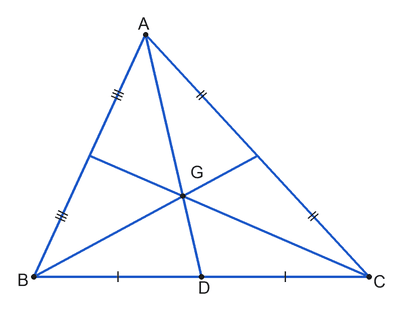
If one of its medians is AD, prove that :
(i) Area (Δ ABD) = 3 × Area (Δ BGD)
(ii) Area (Δ ACD) = 3 × Area (CGD)
(iii) Area (Δ BGC) = × Area (Δ ABC)
Confirming your payment
Sign up now and get 250 free tokens.
Area Theorems · Question 36 of 42
The medians of a triangle ABC intersect each other at point G.
If one of its medians is AD, prove that :
(i) Area (Δ ABD) = 3 × Area (Δ BGD)
(ii) Area (Δ ACD) = 3 × Area (CGD)
(iii) Area (Δ BGC) = × Area (Δ ABC)
Solution:
Concept: The three medians of a triangle meet at the centroid G. Each median of a small triangle at G halves it, so the six small triangles have equal areas.
Given: The medians AD, BE and CF of ΔABC meet at G.
Step 1 — Name the six parts.
GD is a median of ΔGBC, GE of ΔGCA and GF of ΔGAB, so the small triangles pair up.

Call these areas , and in that order.
Step 2 — Use the median AD.
AD halves ΔABC: ΔABD has parts , , and ΔACD has parts , , .
So .
Step 3 — Use the median BE.
BE halves ΔABC: ΔBCE has parts , , and ΔBAE has parts , , .
So . All six parts are equal, and ar(ΔABC) = .
Step 4 — Part (i).
ΔABD is three of the six parts, and ΔBGD is one of them.
Step 5 — Part (ii).
ΔACD is three of the six parts, and ΔCGD is one of them.
Step 6 — Part (iii).
ΔBGC is two of the six parts.
Watch out: A median of the whole triangle halves the whole triangle; GD halves only the small triangle GBC.
Therefore, (i) ar(ΔABD) = 3 ar(ΔBGD), (ii) ar(ΔACD) = 3 ar(ΔCGD), (iii) ar(ΔBGC) = ⅓ ar(ΔABC). Hence proved.