Solution:
Concept: Triangles (or parallelograms) on the same base and between the same parallels are equal in area. A triangle and a parallelogram on the same base and between the same parallels: the triangle is half the parallelogram. The area of a parallelogram is base × height.
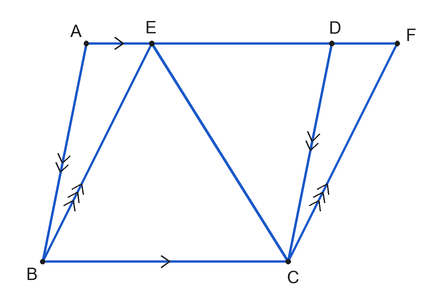
Given: ABCD and BCFE are parallelograms; ar(ΔEBC) = 480 cm², AB = 30 cm, BC = 40 cm.
Step 1 — Part (i): parallelogram ABCD.
ΔEBC and parallelogram ABCD are on the same base BC and between the same parallels BC and AF, so the triangle is half the parallelogram.
ar(ABCD)=2×ar(△EBC)
ar(ABCD)=2×480=960
So it is 960 cm².
Step 2 — Part (ii): parallelogram BCFE.
Parallelograms ABCD and BCFE are on the same base BC and between the same parallels, so they are equal.
ar(BCFE)=ar(ABCD)
So it is 960 cm².
Step 3 — Part (iii): the altitude from A on CD.
Take CD as the base; CD equals AB, which is 30 cm. Since area = base × height, the height h is the area divided by the base.
h=30960=32
So the altitude is 32 cm.
Step 4 — Part (iv): triangle ECF.
The diagonal EC halves parallelogram BCFE.
ar(△ECF)=21×ar(BCFE)
ar(△ECF)=21×960=480
So it is 480 cm².
Watch out: The altitude on CD uses the base CD = 30 cm, not BC = 40 cm.
Therefore, (i) 960 cm², (ii) 960 cm², (iii) 32 cm, (iv) 480 cm².