Solution:
Concept: Congruent triangles have equal areas, and the area of a triangle is ½ × base × height.
Step 1 — Part (i): use congruence.
Let ABCD be a parallelogram with diagonal AC. AB = CD and BC = DA (opposite sides), and AC is common. So ΔABC ≅ ΔCDA by SSS.

Congruent triangles have equal areas.
ar(△ABC)=ar(△CDA)
Step 2 — Part (ii): same height.
Let the two triangles have bases b1 and b2 and the same height h. Divide one area by the other; the ½ and the h cancel.
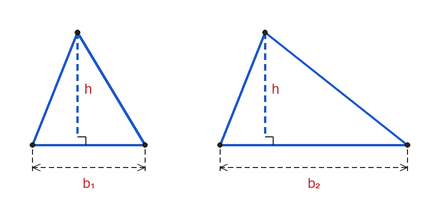
ar2ar1=21b2h21b1h=b2b1
Step 3 — Part (iii): same base.
Let the two triangles have the same base b and heights h1 and h2. Now the ½ and the b cancel.
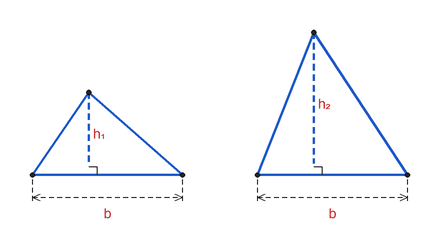
ar2ar1=21bh221bh1=h2h1
Watch out: In (ii) the heights must be equal, and in (iii) the bases must be equal, before anything cancels.
Therefore, (i) a diagonal divides a parallelogram into two triangles of equal area; (ii) ar₁ : ar₂ = b₁ : b₂; (iii) ar₁ : ar₂ = h₁ : h₂. Hence proved.
