
Question 73 marksMedium
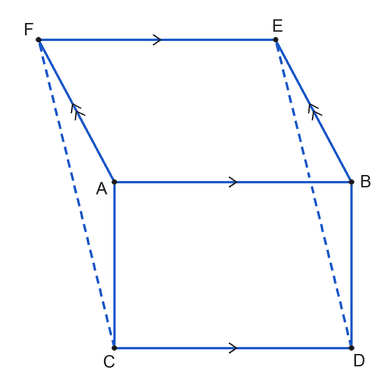
The given figure shows a rectangle ABDC and a parallelogram ABEF;drawn on opposite sides of AB. Prove that :
(i) quadrilateral CDEF is a parallelogram;
(ii) Area of quad. CDEF
= Area of rect. ABDC
- Area of //gm. ABEF.
Confirming your payment
Sign up now and get 250 free tokens.
Area Theorems · Question 7 of 42
The given figure shows a rectangle ABDC and a parallelogram ABEF;drawn on opposite sides of AB. Prove that :
(i) quadrilateral CDEF is a parallelogram;
(ii) Area of quad. CDEF
= Area of rect. ABDC
Solution:
Concept: A quadrilateral with one pair of opposite sides equal and parallel is a parallelogram. Congruent triangles have equal areas.
Given: ABDC is a rectangle and ABEF a parallelogram, drawn on opposite sides of AB.
Step 1 — Show that CD and FE are equal and parallel.
In rectangle ABDC, CD = AB and CD ∥ AB. In parallelogram ABEF, FE = AB and FE ∥ AB.
Step 2 — Conclude part (i).
Lines parallel to the same line are parallel to each other, so CD ∥ FE, and both equal AB, so CD = FE. One pair of opposite sides of CDEF is equal and parallel, so CDEF is a parallelogram.
Step 3 — Show that ΔACF ≅ ΔBDE.
Compare the two side triangles, side by side.
AC = BD (opposite sides of the rectangle).
AF = BE (opposite sides of parallelogram ABEF).
CF = DE (opposite sides of parallelogram CDEF, from part (i)).
So ΔACF ≅ ΔBDE by SSS, and congruent triangles have equal areas.
Step 4 — Build CDEF from the pieces.
CDEF is made of the rectangle, the parallelogram and ΔACF on the left, without ΔBDE on the right (which lies outside CDEF).
Watch out: The triangle gained (ACF) and the triangle lost (BDE) cancel only because they are congruent; say why.
Therefore, (i) CDEF is a parallelogram, and (ii) ar(CDEF) = ar(ABDC) + ar(ABEF). Hence proved.