
Question 323 marksMedium
In the given figure, the diagonals AC and BD intersect at point O. If OB = OD and AB//DC, prove that :
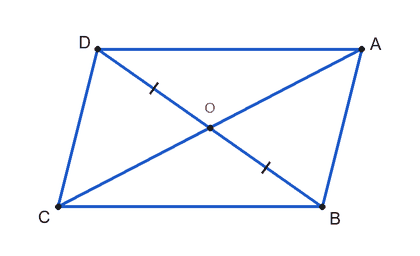
(i) Area (Δ DOC) = Area (Δ AOB).
(ii) Area (Δ DCB) = Area (Δ ACB).
(iii) ABCD is a parallelogram.
Confirming your payment
Sign up now and get 250 free tokens.
Area Theorems · Question 32 of 42
In the given figure, the diagonals AC and BD intersect at point O. If OB = OD and AB//DC, prove that :
(i) Area (Δ DOC) = Area (Δ AOB).
(ii) Area (Δ DCB) = Area (Δ ACB).
(iii) ABCD is a parallelogram.
Solution:
Concept: Congruent triangles have equal areas. A quadrilateral whose diagonals bisect each other is a parallelogram.
Given: The diagonals AC and BD meet at O; OB = OD and AB ∥ DC.
Step 1 — Part (i): ΔAOB ≅ ΔCOD.
Compare the two triangles at O.
OB = OD (given).
∠AOB = ∠COD (vertically opposite angles).
∠OBA = ∠ODC (alternate angles, AB ∥ DC).
So ΔAOB ≅ ΔCOD by ASA, and their areas are equal.
Step 2 — Part (ii): add ΔBOC.
Add ar(ΔBOC) to both sides of the result of part (i).
Step 3 — Part (iii): the diagonals bisect each other.
From the congruence in part (i), OA = OC; also, OB = OD is given; so the diagonals AC and BD bisect each other, and ABCD is a parallelogram.
Watch out: OA = OC is not given; it comes from the congruent triangles.
Therefore, (i) ar(ΔDOC) = ar(ΔAOB), (ii) ar(ΔDCB) = ar(ΔACB), (iii) ABCD is a parallelogram. Hence proved.