
Opening your dashboard
Class 9 Maths Chapter 16 Area Theorems: Practice Questions
40 questions on Chapter 16, each worked through on its own page with the AI tutor. Class 9 Maths, ICSE 2026-27.
40 questions
1–5 marks · Mixed difficulty
- 11 mark
Question 1
Bloom's level: Remember
Which of the following statements is always true?
- 21 mark
Question 2
Bloom's level: Remember
A triangle and a parallelogram are on the same base and between the same parallels. The area of the triangle is :
- 31 mark
Question 3
Bloom's level: Remember
Two figures are said to be between the same parallels when :
- 41 mark
Question 4
Bloom's level: Understand
A parallelogram PQRS, a rectangle EFGH and a triangle LMN are drawn between the same parallels, with their bases on the lower line.
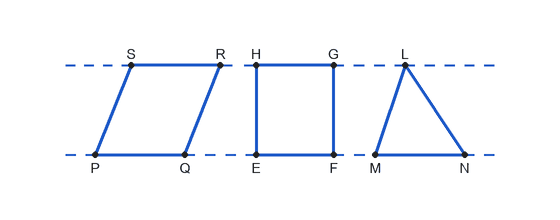
Which quantity must be the same for all three figures?
- 51 mark
Question 5
Bloom's level: Understand
Parallelograms ABCD and ABEF are on the same base AB and between the same parallels. Which of the following must be true?
- 61 mark
Question 6
Bloom's level: Understand
and are on the same base BC, on the same side of it, and have equal areas. Then :
- 71 mark
Question 7
Bloom's level: Apply
The area of parallelogram ABCD is 64 cm². P is any point on side CD.
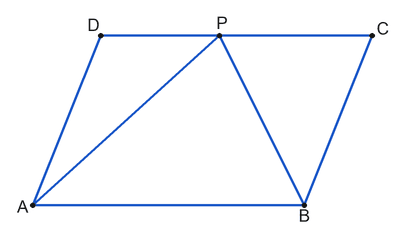
The area of is :
- 81 mark
Question 8
Bloom's level: Apply
In , D is a point on BC such that BD = 4 cm and DC = 6 cm.
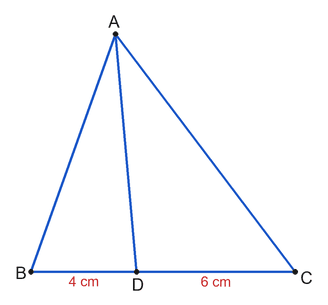
If the area of is 45 cm², the area of is :
- 91 mark
Question 9
Bloom's level: Apply
A parallelogram and a rectangle stand on the same base of 9 cm and between the same parallels. The other side of the rectangle is 5 cm.
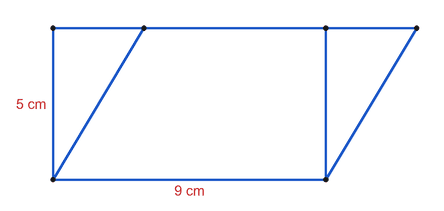
The area of the parallelogram is :
- 101 mark
Question 10
Bloom's level: Understand
Assertion (A) : and on the same base AB and between the same parallels AB and CD are equal in area.
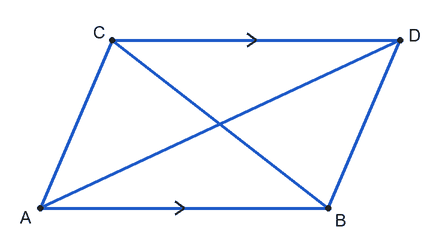
Reason (R) : Congruent figures are equal in area.
- 111 mark
Question 11
Bloom's level: Analyse
Assertion (A) : In , D is a point on BC such that BD = 2 DC. Then area() = 2 × area().
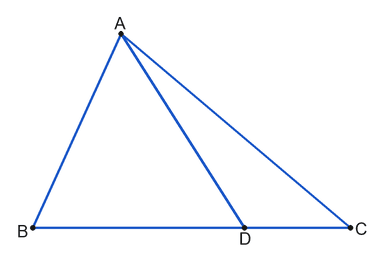
Reason (R) : Triangles with the same vertex and bases along the same straight line have areas in the ratio of their bases.
- 121 mark
Question 12
Bloom's level: Evaluate
Assertion (A) : A rectangle and a parallelogram (not a rectangle) on the same base and between the same parallels have equal perimeters.
Reason (R) : A rectangle and a parallelogram on the same base and between the same parallels have equal areas.
- 131 mark
Question 13
Bloom's level: Remember
Write the formulae for the area of a parallelogram and the area of a triangle.
- 142 marks
Question 14
Bloom's level: Understand
"Congruent figures are always equal in area, but the converse is not always true." Explain this statement with an example.
- 152 marks
Question 15
Bloom's level: Understand
and parallelogram ABDE are on the same base AB and between the same parallels AB and ED.
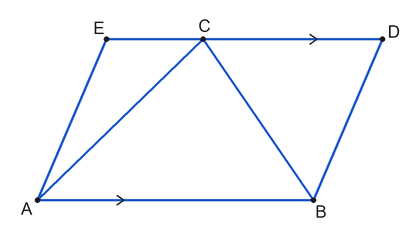
Explain briefly why area() = area(parallelogram ABDE).
- 162 marks
Question 16
Bloom's level: Understand
and are on the same base QR, with P and S on the same side of QR. Their areas are equal.
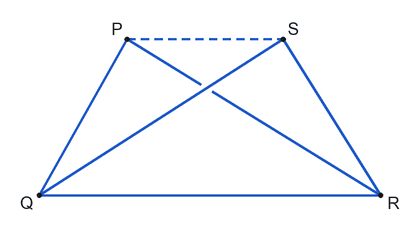
Explain why PS must be parallel to QR.
- 172 marks
Question 17
Bloom's level: Apply
In , points D and E lie on BC such that BD : DE : EC = 1 : 2 : 3.

If the area of is 72 cm², find the areas of , and .
- 182 marks
Question 18
Bloom's level: Apply
ABCD is a parallelogram with AB = 12 cm. E is a point on side DC, and the area of is 42 cm².
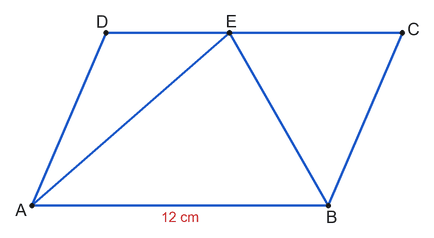
Find the area of the parallelogram and the distance between AB and DC.
- 192 marks
Question 19
Bloom's level: Apply
ABCD is a rectangle with AB = 8 cm and BC = 5 cm. ABEF is a parallelogram on the same base AB with E and F on the line DC, and AF = 6.5 cm.
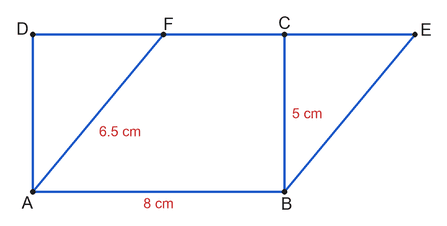
Find the area of ABEF and compare the perimeters of the two figures.
- 202 marks
Question 20
Bloom's level: Analyse
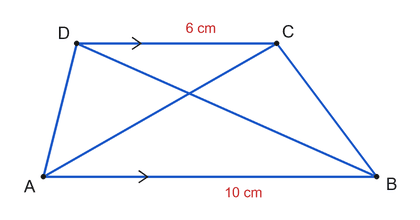
In the given trapezium ABCD, AB ∥ DC, AB = 10 cm, DC = 6 cm and the distance between AB and DC is 4 cm. Find the areas of , , and . Which pairs are equal, and why?
- 212 marks
Question 21
Bloom's level: Analyse
In the given figure, the area of is 60 cm², D is a point on BC such that BD : DC = 2 : 1, and E is the mid-point of AD. Find the area of and of .

- 222 marks
Question 22
Bloom's level: Evaluate
Ankit says: "A triangle and a rectangle on equal bases and between the same parallels have the same height, so they must have the same area." Is he right? Justify.
- 233 marks
Question 23
Bloom's level: Apply
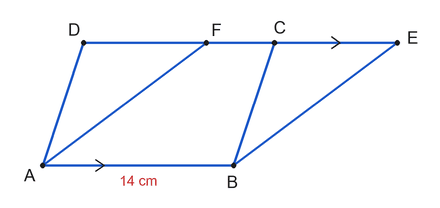
In the given figure, ABCD and ABEF are parallelograms on the same base AB = 14 cm, between the parallels AB and DE. The distance between these parallels is 9 cm, and BE = 15 cm. Find :
(i) the area of parallelogram ABCD;
(ii) the area of parallelogram ABEF;
(iii) the altitude of parallelogram ABEF corresponding to the side BE.
- 244 marks
Question 24
Bloom's level: Apply
The area of parallelogram ABCD is 96 cm². E is a point on side DC and F is a point on side AD.
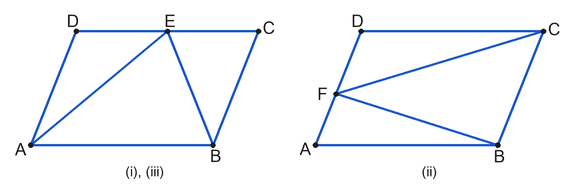
Find, giving reasons :
(i) the area of ;
(ii) the area of ;
(iii) the area of , if E is the mid-point of DC.
- 254 marks
Question 25
Bloom's level: Analyse
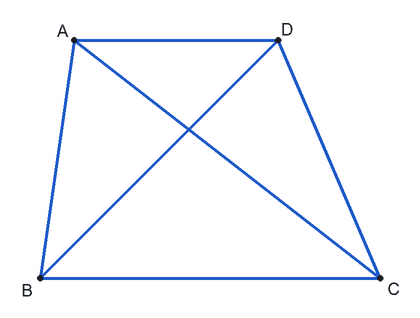
In the given figure, and stand on the same base BC = 10 cm, with A and D on the same side of BC. Each triangle has area 35 cm², and AD = 6 cm.
(i) Find the altitude of each triangle on BC.
(ii) Show that AD ∥ BC.
(iii) Find the area of quadrilateral ABCD, and show that and are equal in area.
- 264 marks
Question 26
Bloom's level: Evaluate
A triangular field ABC is to be divided among three brothers into three plots of equal area.
(a) Ravi suggests marking points D and E on BC so that BD = DE = EC, and joining AD and AE. Will the three plots have equal areas? Justify.
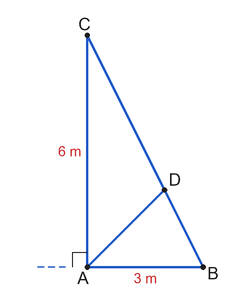
(b) Meena says that for two brothers it is enough to draw the bisector of . Test her claim on the field in the figure, which is right-angled at A with AB = 3 m and AC = 6 m; the bisector AD meets BC at D, which is 2 m from AB and 2 m from AC.
- 274 marks
Question 27
Bloom's level: Apply
Case study: A farmer owns a field ABCD in the shape of a parallelogram. Side AB = 40 m runs along a straight road, and the opposite fence DC is parallel to the road at a distance of 25 m. The slanting side AD is 30 m long.
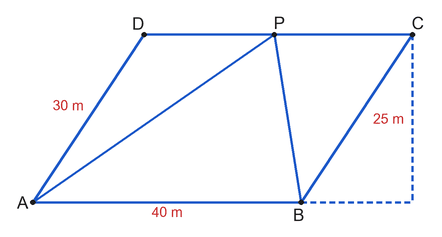
(a) Find the area of the field.
(b) A neighbour offers a rectangular field on the same base AB and between the same road and fence line. Will the farmer gain or lose any land? Which field needs less fencing, and by how much?
(c) The farmer gives his son the triangular part ABP, where P is any point on the fence DC. Find its area, and explain why the position of P does not matter.
- 285 marks
Question 28
Bloom's level: Analyse
Case study: A triangular park ABC has its side BC = 80 m along a road and an area of 2000 m². A straight path joins the gate A to a point D on BC, where BD = 30 m and DC = 50 m. A lamp post E stands at the mid-point of the path AD.

(a) Find the areas of the two parts and into which the path divides the park.
(b) The lamp lights up the triangular region EBC. Find its area.
(c) The park authority wants to move D along BC so that the part ADC is three times the part ABD. Find the new length BD.
- 294 marks
Question 29
Bloom's level: Create
has base BC = 8 cm and height 5 cm.

(a) Describe where the third vertex of every triangle on the base BC with the same area as must lie. Design three such triangles and state one way in which they differ from one another.
(b) Design a triangle with a base of 4 cm on the line BC that has the same area as , and a parallelogram on the base BC with the same area. Give the height needed in each case.
- 305 marks
Question 30
Bloom's level: Create
Parallelogram ABCD has AB = 10 cm and area 60 cm².
(a) Plan how to draw a triangle of area 30 cm² on the base AB. Where can its third vertex be?
(b) Plan two different ways to draw a triangle of area 60 cm² whose base lies along the line AB.
(c) Plan a rectangle of area 60 cm² on the base AB. Give its dimensions and explain, using a theorem of the chapter, why its area equals that of ABCD.
- 311 mark
Question 31
is a square of side 7 cm. is a parallelogram on the same base and between the same parallels as the square, with and on the line .
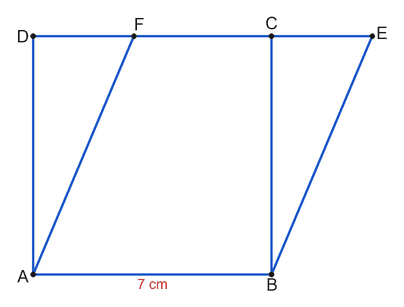
Which of the following cannot be the length of the side ?
- 321 mark
Question 32
Parallelograms and are on the same base and between the same parallels. The area of is cm and the area of is cm. The area of is :
- 331 mark
Question 33
In , is the mid-point of , is the mid-point of and is the mid-point of .

If the area of is 96 cm, the area of is :
- 342 marks
Question 34
The area of parallelogram is 126 cm and the distance between the sides and is 9 cm. is any point on the side .

(i) Find the length of .
(ii) Find the area of , giving the reason.
- 353 marks
Question 35
is a trapezium with . Its diagonals and meet at .
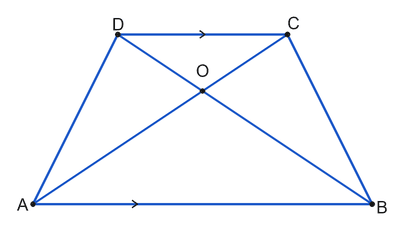
Prove that :
(i) Show that .
(ii) Hence prove the result.
- 362 marks
Question 36
and are on the same base and on the same side of it, and .
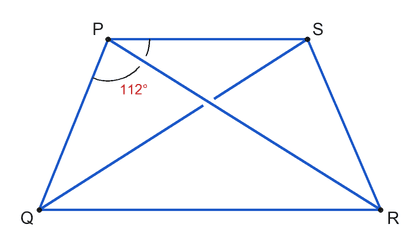
(i) Prove that .
(ii) If , find .
- 373 marks
Question 37
and are the mid-points of the sides and of .
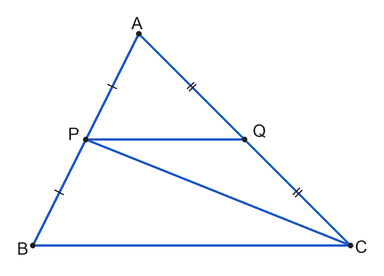
(i) Prove that .
(ii) Prove that .
(iii) If cm, find the area of the quadrilateral .
- 384 marks
Question 38
In the figure, is a parallelogram with cm, and the distance between and is 5 cm. is a point on with cm and cm.
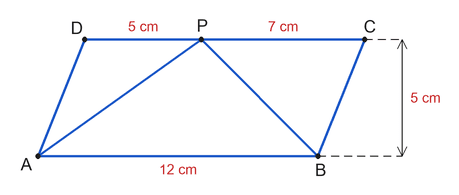
(i) Find the area of the parallelogram .
(ii) Find the area of , giving the reason.
(iii) Find the areas of and , and show that their sum is equal to .
- 394 marks
Question 39
In the figure, parallelograms and are on the same base and between the same parallels and . The points , , , lie in this order on the line .

(i) Prove that .
(ii) Prove that .
(iii) Hence prove that .
- 404 marks
Question 40
is a trapezium with , , , and the distance between and is . The diagonal divides the trapezium into and .
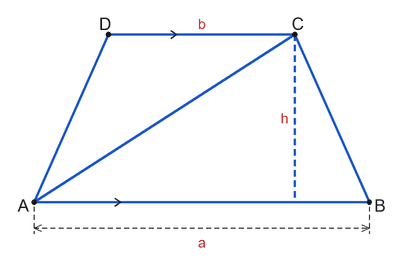
(i) Write the area of in terms of and .
(ii) Write the area of in terms of and .
(iii) Hence show that the area of the trapezium is .
(iv) Find the area when cm, cm and cm.