
Opening your dashboard
Class 9 Maths Chapter 16 Area Theorems: Competency-Based Questions (CBQ)
40 questions on Chapter 16, each worked through on its own page with the AI tutor. Class 9 Maths, ICSE 2026-27.
40 questions
1–5 marks · Mixed difficulty
- 11 mark
Question 1
Competency: Understanding
A rectangular photo frame is made of four wooden strips joined by loose hinges at the corners. Ravi pushes the top strip sideways. The frame leans over and becomes a parallelogram. The bottom strip does not move, and no strip changes its length.
What happens to the area enclosed by the frame?
- 21 mark
Question 2
Competency: Application
A triangular school flag ABC is made of three pieces of cloth. Two straight seams run from the corner A to the points D and E on the side BC.
On BC, BD cm, DE cm and EC cm. The middle piece ADE is white.
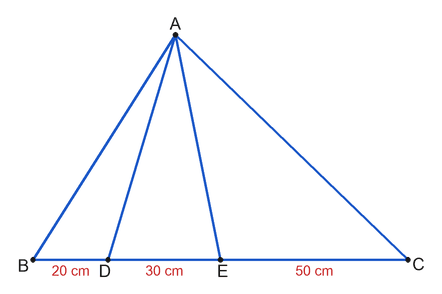
What fraction of the cloth in the flag is white?
- 31 mark
Question 3
Competency: Application
A window has the shape of a parallelogram. Two thin bars are fixed along its two diagonals, so the glass is in four triangular panes.
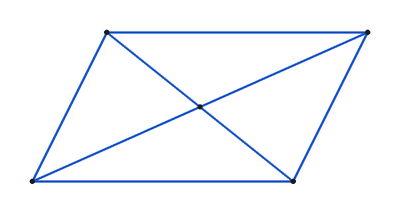
The total area of the glass is m². Which statement about the four panes is correct?
- 41 mark
Question 4
Competency: Analysis
A gardener fixes two pegs A and B, 4 m apart, on a straight line . He wants a triangular flower bed with AB as one side. The third peg can go at P, Q or R. These three points lie on a line , which is parallel to and 3 m away from it.

Which position of the third peg gives the flower bed of the greatest area?
- 51 mark
Question 5
Competency: Evaluation
Assertion (A): A straight fence put along a median of a triangular plot divides the plot into two parts of equal area.
Reason (R): A median of a triangle always divides it into two congruent triangles.
- 61 mark
Question 6
Competency: Understanding
A tile is a rectangle 30 cm long and 20 cm wide. A worker cuts a right-angled triangle off the left end of the tile. He slides this piece along and joins it to the right end. The new tile is a parallelogram with the same 30 cm base.
The area of the new tile is
- 72 marks
Question 7
Competency: Evaluation
Meera owns a triangular plot ABC. The side BC lies along a canal. The corner A lies on a straight road, and the road is parallel to the canal.
The council wants to shift the corner post from A to a point P, 12 m further along the same road.
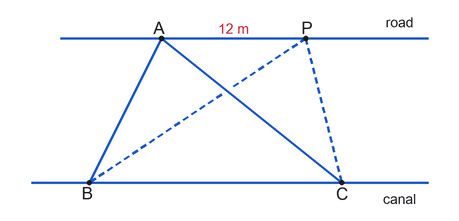
The council says, "Your plot will be exactly as big as before." Meera says, "My plot will become smaller, because it will lean over."
Who is right? Give a reason. State one measurement of the plot that will change.
- 82 marks
Question 8
Competency: Analysis
A triangular plot ABC has an area of 1,200 m². Its side BC is 64 m long and lies along a road.
The owner wants to put one straight fence from A to a point D on BC. The part ABD is for her daughter and the part ADC is for her son. Their areas must be in the ratio .
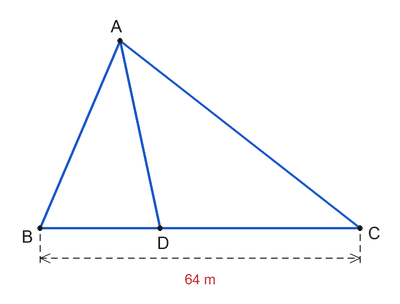
How far from B must the point D be? Find the area of each part.
- 92 marks
Question 9
Competency: Understanding
In the figure, the lines and are parallel. ABCD is a parallelogram, and AB PQ.
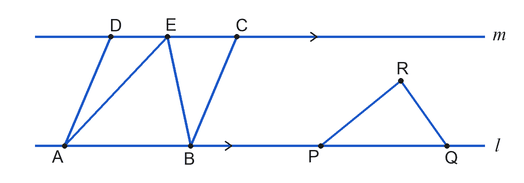
(a) Name the triangle that is on the same base as parallelogram ABCD and between the same parallels as it.
(b) The area of parallelogram ABCD is 30 cm². Arjun says, "Then and both have an area of 15 cm²." For which triangle is he right, and why is he wrong for the other?
- 102 marks
Question 10
Competency: Application
A cloth banner has the shape of a parallelogram ABCD. A triangle ABP, with P on the side DC, is printed in colour.
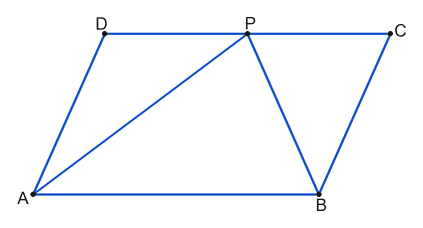
The rest of the banner is printed in black and white.
Colour printing costs ₹ 40 per square metre. Black and white printing costs ₹ 15 per square metre. The total printing bill is ₹ 660.
Find the area of the banner.
- 113 marks
Question 11
Competency: Analysis
A field ABCD is a trapezium with AB parallel to DC. Two straight paths along the diagonals AC and BD cross at O and divide the field into four triangular parts.
Wheat grows in the part AOB, which has an area of 90 m². Mustard grows in the part AOD, which has an area of 60 m².

(a) Find the area of the part BOC. Give a reason.
(b) Find the ratio OB : OD, and use it to find the area of the part DOC.
(c) Find the area of the whole field.
- 123 marks
Question 12
Competency: Creativity
Frame a word problem about a triangular plot of land that is divided into two parts by one straight fence from a corner to the opposite side.
Your problem must give the lengths of the two parts of that side and the area of the whole plot. Its answer must be: "The two parts have areas of 240 m² and 360 m²."
Write your problem and then solve it.
- 133 marks
Question 13
Competency: Analysis & Evaluation
A courtyard ABCD has the shape of a parallelogram. Its area is 96 m². A lamp post stands at a point P inside it. Straight lines of bricks join P to the four corners and divide the courtyard into four triangular parts.
The part PAB has an area of 30 m² and the part PBC has an area of 14 m².
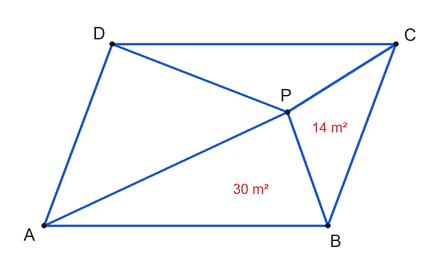
(a) Find the area of the part PDC. Give reasons.
(b) The mason says, "The part PDA is opposite the part PBC, so its area must also be 14 m²." Is he right? Find the area of the part PDA.
- 144 marks
Question 14
Competency: Application & Analysis
Case study — A design on a floor panel
A rectangular floor panel ABCD has AB cm and BC cm. E is a point on the side DC with DE cm. The lines AE and BE divide the panel into three triangles. is coloured blue. and are left white.
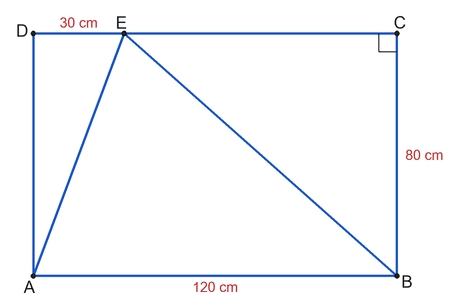
(a) Find the area of the blue triangle. Give a reason.
(b) Find the areas of the two white triangles. Show that these areas are in the ratio DE : EC.
(c) The designer now slides E along DC. Which of the three areas does not change? How far from D must E be so that the area of is exactly twice the area of ?
- 155 marks
Question 15
Competency: Analysis & Evaluation
Case study — Sharing the family field
A field ABCD is a parallelogram. The side AB is 90 m long and lies along a road. The side DC lies along another road, parallel to the first and 40 m away from it. The field is to be shared equally by three children, using two straight fences.
The eldest child suggests this plan: mark M, the mid-point of DC, and put fences along MA and MB.
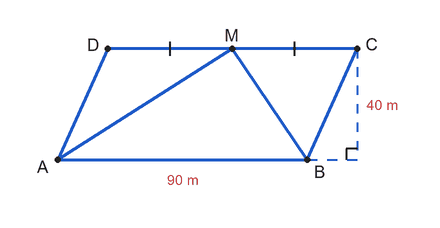
(a) Find the area of the field and the area each child should get.
(b) Find the areas of the three parts in the eldest child's plan. Is the plan fair?
(c) The youngest child suggests a different plan: a fence from A to a point P on DC, and a fence from P to a point Q on AB. Find DP and AQ so that and are each one-third of the field. Show that the third part, QBCP, is then also one-third of the field.
- 161 mark
Question 16
Competency: Application
Two parallelogram-shaped plots lie between the same two parallel roads, and . The plot ABCD has its base AB m on road . The plot EFGH has its base EF m on road .

The area of EFGH is 90 m². The area of ABCD is
- 171 mark
Question 17
Competency: Evaluation
Assertion (A): Two triangles on the same base and with equal areas must be congruent.
Reason (R): Triangles on the same base and between the same parallels are equal in area.
- 181 mark
Question 18
Competency: Application
A spotlight at the point A shines on a straight stage edge PS. The light that falls on the part PQ m makes a lit triangle APQ of area 36 m². Another lit triangle ARS stands on the part RS m of the same edge. (Hypothetical data.)

The area of the triangle ARS is
- 191 mark
Question 19
Competency: Analysis
A lawn ABCD is a parallelogram. P is the mid-point of the side BC, and two paths PA and PD are made.

The flower bed ABP has an area of 15 m². The area of the whole lawn is
- 201 mark
Question 20
Competency: Application
A floor ABCD is a parallelogram with AB m. A second floor ABEF is another parallelogram on the same base AB. Both floors lie between the same two parallel walls, which are 3 m apart.
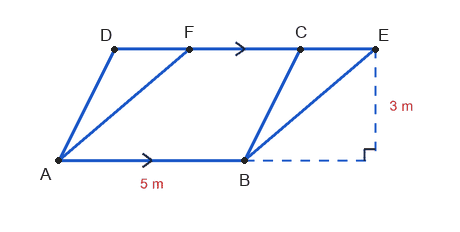
Tiles of size 0.5 m 0.5 m are cut as needed to cover the floor ABEF, and every cut piece is used, so nothing is wasted. How many tiles are needed for ABEF?
- 211 mark
Question 21
Competency: Understanding
A square courtyard has each side 6 m long. A rectangular courtyard is 9 m long and 4 m wide. Which statement is correct?
- 221 mark
Question 22
Competency: Evaluation
Assertion (A): Two triangles drawn between the same two parallel lines, with equal bases on one of the lines, are equal in area.
Reason (R): Triangles with equal bases and equal heights have equal areas.
- 231 mark
Question 23
Competency: Analysis
In the triangular plot ABC, the point E lies on AC so that AE : EC , and D is the mid-point of BC. Fences BE and ED are put up.

The area of the whole plot is 90 m². The area of the part BDE is
- 241 mark
Question 24
Competency: Analysis & Evaluation
ABCD is a parallelogram of area 100 cm². Its diagonals meet at O. P is any point on the side AB, and Q is any point on the diagonal AC. Which of these statements is not correct?
- 251 mark
Question 25
Competency: Analysis
A garden ABCD is a trapezium with AB parallel to DC, AB m and DC m. A straight path along the diagonal BD divides it into a flower bed ABD and a lawn BCD.
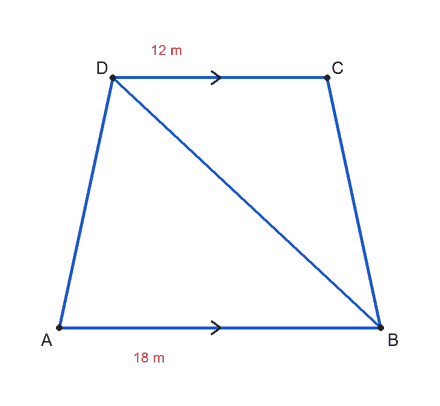
The lawn BCD has an area of 84 m². The area of the flower bed ABD is
- 262 marks
Question 26
Competency: Application & Analysis
A car park has a straight kerb and a painted line parallel to it, 5 m away. Parking slots are marked between the kerb and the line, side by side with no gaps, along 60 m of the kerb. (Hypothetical data.)
In plan X, each slot is a rectangle that takes 2.5 m of the kerb. In plan Y, each slot is a slanting parallelogram that takes 3 m of the kerb.
(a) Find the area of one slot in each plan.
(b) Find the total area of all the slots in each plan. Explain the result using a theorem of this chapter.
- 272 marks
Question 27
Competency: Analysis
A triangular banner and a parallelogram-shaped banner have the same base of 12 m and lie between the same two parallel lines. The parallelogram banner has 54 m² more cloth than the triangular banner.
Find the distance between the two parallel lines.
- 282 marks
Question 28
Competency: Application
A triangular lawn ABC has a point D on the side BC, with BD m and DC m. The part ABD is covered with grass turf at ₹ 60 per m², and the bill for it is ₹ 18,000. (Hypothetical data.)
Find the area of the whole lawn, and the cost of covering the part ADC with turf at the same rate.
- 292 marks
Question 29
Competency: Evaluation
A parallelogram ABDE and a triangle ABC stand on the same base AB cm, on the same side of AB. The side ED of the parallelogram is 6 cm from AB, and the corner C of the triangle is 9 cm from AB.
Riya says: "The triangle and the parallelogram are on the same base, so the area of the triangle is half the area of the parallelogram, which is 30 cm²." Find the mistake in her claim, and find the correct areas of both figures.
- 302 marks
Question 30
Competency: Application
A floor tile is a rhombus ABCD. Its diagonals AC cm and BD cm meet at O, and each side of the tile is 10 cm long.

(a) The diagonal BD divides the tile into the triangles ABD and CBD. Use these triangles to find the area of the tile.
(b) Find the distance between the opposite sides AB and DC.
- 312 marks
Question 31
Competency: Application & Analysis
A shop front has two straight horizontal frame bars, 30 cm apart. A triangular glass panel ABC has its side BC cm on the lower bar and its corner A on the upper bar.

The designer replaces it with a panel DBC on the same side BC, with D on the upper bar and DB DC.
(a) Find the area of the new panel DBC, and give a reason why it equals the area of ABC.
(b) Find where D must be on the upper bar, and find the length DB.
- 323 marks
Question 32
Competency: Analysis & Evaluation
A parallelogram ABCD has AB cm and AD cm.
(a) Find its area when it is a rectangle.
(b) The parallelogram is now drawn with the same sides so that the distance between AB and DC is 4.8 cm. Find its area.
(c) Can the area ever be 70 cm² with these side lengths? Explain, using the length of the slanting side AD.
- 333 marks
Question 33
Competency: Application
On a map drawn to the scale 1 cm : 20 m, an estate ABCD is a parallelogram with AB cm, and the distance between AB and DC is 4 cm. A pond on the estate is the triangle ABP, where P is a point on DC.
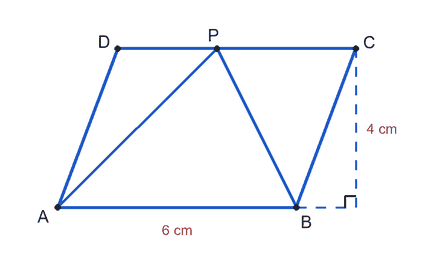
(a) Find the area of the pond on the map, giving a reason.
(b) Find the real area of the pond and of the whole estate, in m².
(c) Find the real area of the estate outside the pond, in hectares (1 hectare m²).
- 343 marks
Question 34
Competency: Analysis
In the figure, BC cm. The points P, Q, R and S are 8 cm above, 8 cm below, 6 cm above and 10 cm above the line BC, as shown by the dashed perpendiculars.
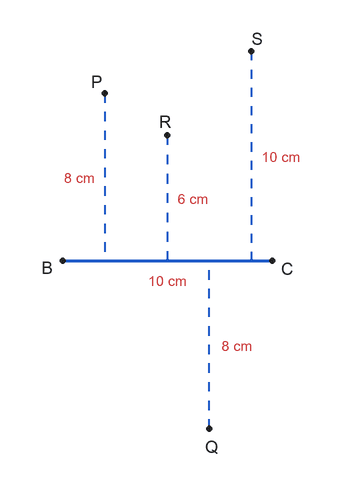
(a) Find the areas of the triangles PBC, QBC, RBC and SBC.
(b) Which two triangles are equal in area?
(c) P and Q are on opposite sides of BC, so they are not between the same parallels with BC. Explain why their triangles still have equal areas.
- 353 marks
Question 35
Competency: Creativity
Tanya has a card in the shape of a parallelogram ABCD with AB cm, and the distance between AB and DC is 8 cm. She wants to make one straight cut and put the two pieces together again, without overlap, as a triangle of the same area.
Design the cut: say where it goes and how the cut-off piece is moved. Name the triangle formed, find its base and height, and use a theorem of this chapter to show that its area equals the area of the card. Then describe a second cut that also works.
- 363 marks
Question 36
Competency: Analysis
ABCD is a parallelogram of area 120 cm². Its diagonals meet at O. P is a point on AO, and PB and PD are joined.

The area of the triangle APB is 22 cm².
(a) Find the area of the triangle ABC.
(b) Show that the area of the triangle APD is also 22 cm².
(c) Find the area of the triangle PBC.
- 375 marks
Question 37
Competency: Application & Analysis
Case study — Straightening a bent fence
Two farms lie side by side between two straight parallel roads that are 60 m apart. The fence between the farms is bent: it runs from a point P on the north road to a point Q, and then from Q to a point R on the south road. The farmers agree to replace it with one straight fence PS, with S on the south road, chosen so that QS is parallel to PR. The bend Q lies to the east of the line PR, and the triangle PQR has an area of 600 m². (Hypothetical data.)
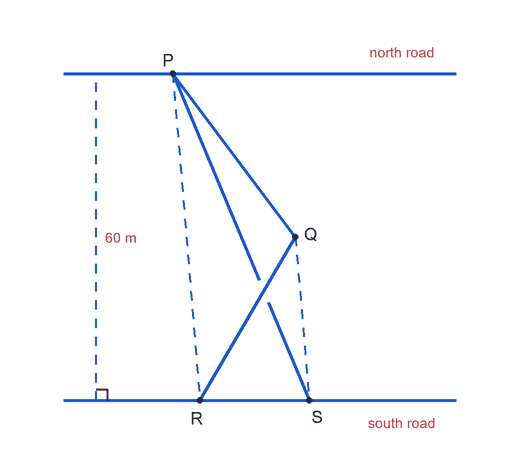
(a) Name the two triangles that are on the base PR and between the parallel lines PR and QS, and say why their areas are equal.
(b) Show that the west farm has the same area with the new fence PS as it had with the old fence PQR.
(c) Find the distance RS along the south road. The point S is 25 m east of the point of the south road directly south of P. Find the length of the new fence PS.
- 384 marks
Question 38
Competency: Analysis
Case study — Beds in a triangular park
A triangular park ABC has its base BC m along a road. A gardener marks the points D, E and F on BC, in the order B, D, E, F, C, and makes paths AD, AE and AF. She records the area of the triangle ABC and of the triangles formed on the base starting at B. (Hypothetical data.)

Triangle ABD ABE ABF ABC Area (m²) 120 300 540 720 (a) Write the ratio of the areas of the triangles ABD : ABE : ABF : ABC in its simplest form.
(b) Find the lengths BD, BE and BF.
(c) Find the areas of the triangles ADE and AFC, and the lengths DE and FC.
- 394 marks
Question 39
Competency: Analysis & Evaluation
Case study — Choosing a plot
A developer marks plots between a straight road and a railway line that runs parallel to it. Every plot has one side, its frontage, on the road, and its opposite side or opposite corner on the railway line. (Hypothetical data.)
Plot Shape Frontage on the road (m) Area (m²) P rectangle 20 600 Q parallelogram, not a rectangle 20 ? R triangle 36 ? S triangle ? 450 (a) Find the distance between the road and the railway line, and the area of plot Q. Give a reason.
(b) Find the area of plot R and the frontage of plot S.
(c) A buyer wants a plot of at least 540 m² with as short a frontage as possible. Find the least frontage needed for a parallelogram plot and for a triangular plot, and advise the buyer.
- 405 marks
Question 40
Competency: Analysis & Evaluation
Case study — A fair fence for two brothers
Two brothers inherit a plot ABCD. The diagonals AC and BD meet at O, and surveyors find that O is the mid-point of BD, with BD m. The corner A is 90 m from the line BD and the corner C is 60 m from it. (Hypothetical data.)

The elder brother says: "Divide the plot by a fence along AC." The younger brother says: "Divide it by a fence along BD."
(a) Find the areas of the triangles AOB, AOD, COB and COD. Give a reason for each pair that is equal.
(b) Show that a fence along AC divides the plot into two parts of equal area, and find that area.
(c) Find the areas of the two parts if the fence is along BD. Which part is larger, and what is the difference in the values of the two parts at ₹ 60 per m²?