Solution:
Concept: A triangle and a parallelogram on the same base and between the same parallels: the triangle is half the parallelogram. NM divides ABCD into two equal parallelograms.
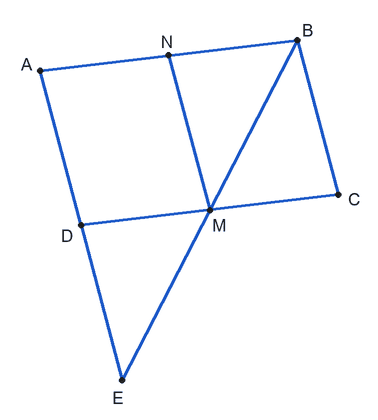
Given: ABCD is a parallelogram with area 48 cm²; M and N are the mid-points of DC and AB; BM produced meets AD produced at E (as in the figure).
Step 1 — Find the base and parallels of ΔBEC.
ΔBEC has base BC, and its vertex E lies on AD produced. AD is parallel to BC, so ΔBEC and parallelogram ABCD are on the same base BC and between the same parallels.
ar(△BEC)=21×ar(ABCD)
ar(△BEC)=21×48=24
Step 2 — Split ABCD by NM.
N and M are the mid-points of AB and DC, so AN, BN, DM and CM are all equal (halves of the equal sides AB and DC), and NM ∥ BC. NM cuts ABCD into two parallelograms with equal bases and the same height.
ar(BNMC)=21×ar(ABCD)=ar(ANMD)
ar(BNMC)=21×48=24
Step 3 — Compare.
The area of BNMC is 24 cm², which equals the area of ΔBEC.
ar(BNMC)=ar(△BEC)
Watch out: E is outside the parallelogram, but it still lies on the line AD, which is all the theorem needs.
Therefore, (i) ar(ΔBEC) = 24 cm², and (ii) parallelogram BNMC (and equally ANMD) has the same area as ΔBEC.