
Question 393 marksMedium
In the following figure, BD is parallel to CA, E is mid-point of CA and BD = CA.
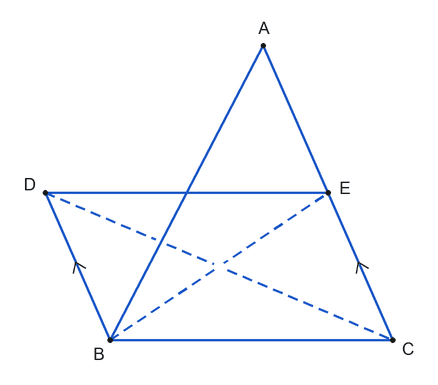
Prove that : ar.(Δ ABC) = 2 × ar.(Δ DBC)
Confirming your payment
Sign up now and get 250 free tokens.
Area Theorems · Question 39 of 42
In the following figure, BD is parallel to CA, E is mid-point of CA and BD = CA.
Prove that : ar.(Δ ABC) = 2 × ar.(Δ DBC)
Solution:
Concept: Triangles (or parallelograms) on the same base and between the same parallels are equal in area. A triangle and a parallelogram on the same base and between the same parallels: the triangle is half the parallelogram. A median of a triangle divides it into two triangles of equal area, because the two bases are equal and the height from the vertex is the same.
Given: BD ∥ CA, E is the mid-point of CA and BD = ½ CA.
Step 1 — BCED is a parallelogram.
BD is half of CA, so BD = CE; also BD ∥ CE (CE is part of CA). One pair of opposite sides of BCED is equal and parallel, so BCED is a parallelogram, and DE ∥ BC.
Step 2 — Move the vertex D to E.
ΔDBC and ΔEBC stand on the same base BC, and D and E lie on DE, which is parallel to BC.
Step 3 — Use the median BE.
E is the mid-point of CA, so BE is a median of ΔABC and halves it.
Step 4 — Combine.
Put the two results together.
Watch out: First show DE ∥ BC; it is not given, it comes from the parallelogram BCED.
Therefore, ar(ΔABC) = 2 × ar(ΔDBC). Hence proved.