
Question 303 marksMedium
ABCD is a parallelogram in which BC is produced to E such that CE = BC and AE intersects CD at F.
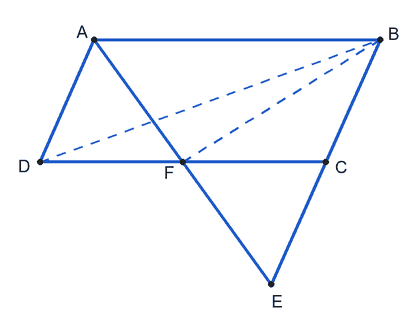
If ar.(Δ DFB) = 30 cm²; find the area of parallelogram
Confirming your payment
Sign up now and get 250 free tokens.
Area Theorems · Question 30 of 42
ABCD is a parallelogram in which BC is produced to E such that CE = BC and AE intersects CD at F.
If ar.(Δ DFB) = 30 cm²; find the area of parallelogram
Solution:
Concept: Congruent triangles have equal areas; a median halves a triangle; a diagonal halves a parallelogram.
Given: ABCD is a parallelogram; BC is produced to E with CE = BC; AE meets CD at F; ar(ΔDFB) = 30 cm².
Step 1 — Show that ΔADF ≅ ΔECF.
Compare the two triangles at F.
AD = BC (opposite sides of the parallelogram), and BC = CE (given), so AD = CE.
∠DAF = ∠CEF (alternate angles, AD ∥ BE).
∠AFD = ∠EFC (vertically opposite angles).
So ΔADF ≅ ΔECF by AAS, and DF = CF: F is the mid-point of DC.
Step 2 — Use the median BF.
F is the mid-point of DC, so BF is a median of ΔBDC and halves it.
Step 3 — Use the diagonal BD.
The diagonal BD halves the parallelogram.
Watch out: F being the mid-point of DC is the key; it comes from the congruence, not from the figure.
Therefore, the area of parallelogram ABCD is 120 cm².