
Opening your dashboard
Class 12 Physics Chapter 20: Interference of Light Solutions
73 textbook questions with step-by-step answers, free to read, for ISC 2026-27.
Get talked through Ch 20, not just shown the answer
Reading a finished solution is not the same as being able to do it. The AI tutor takes one question at a time and works it with you, in your own words, until you can.
- Ask it out loud, in your own words
- It gives you the next step, not the answer
- Stuck on part (ii)? Start there
73 questions with solutions
1–5 marks · Mixed difficulty
The first 51 solutions are on this page. This chapter is a long one, so the rest open on their own page to keep this one quick to load.
- 11 mark
Question 1
The phenomenon of interference is shown by
Solve with AIAnswer
(A) Longitudinal mechanical waves only
(B) Transverse mechanical wave only
(C) Electromagnetic waves only
- Correct
(D) All the above types of waves
Answer: (D) All the above types of waves
Concept: Interference follows from the principle of superposition, which holds for every kind of wave.
Step 1 — Why every wave interferes. When two waves of the same kind overlap, the resultant displacement is the sum of the two displacements. This is true for longitudinal waves (sound), transverse mechanical waves (waves on a string or water surface) and electromagnetic waves (light, radio).
Step 2 — Check the other options. Each other option names only one type of wave:
- (A) This leaves out transverse and electromagnetic waves; ripples on water and light also interfere.
- (B) This leaves out sound, which shows interference as beats and loud and soft spots.
- (C) This leaves out mechanical waves; sound and water waves interfere too.
Therefore, the answer is (D).
- 21 mark
Question 2
Two coherent sources of light can be obtained by
Solve with AIAnswer
(A) Two different lamps
(B) Two different lamps but of the same power
(C) Two different lamps of same power and having the same colour
- Correct
(D) None of the above
Answer: (D) None of the above
Concept: Coherent sources keep a constant phase difference. In practice they are made by dividing light from a single source into two parts (as in Young's double slit, Lloyd's mirror or Fresnel's biprism).
Step 1 — Independent lamps. Atoms in each lamp emit light at random, so the phase of one lamp changes at random with respect to the other.
Step 2 — Power and colour do not help. Having the same power gives similar intensity, and the same colour gives the same wavelength, but neither fixes the phase difference.
Step 3 — Check the other options. None of the three arrangements uses a single source:
- (A) Two independent lamps have a randomly changing phase difference.
- (B) Equal power still leaves the phases of the two lamps random.
- (C) Equal power and colour still leave the phases random, so the lamps are not coherent.
Therefore, the answer is (D).
- 31 mark
Question 3
Which of the following is false for interference of light?
Solve with AIAnswer
(A) Coherence of the sources is an essential condition for interference
(B) The minima of the interference pattern need not be of zero intensity
(C) Interference simply redistributes light energy, without destroying any of it
- Correct
(D) The minima of the interference pattern must always be of zero intensity
Answer: (D) The minima of the interference pattern must always be of zero intensity
Concept: The minimum intensity is , which is zero only when the two waves have equal intensity.
Step 1 — Test the statement about minima. If the two slits give unequal intensities, for example and , the minima are not completely dark. So the word "always" makes this statement false.
Step 2 — Check the other options. The other three statements are true:
- (A) This is true: without coherent sources the pattern changes at random and no steady fringes are seen.
- (B) This is true, as Step 1 shows for unequal intensities.
- (C) This is true: energy taken from the dark fringes appears in the bright ones.
Therefore, the false statement is (D).
- 41 mark
Question 4
For constructive interference to take place between two monochromatic light waves of wavelength , the path difference should be
Solve with AIAnswer
(A)
(B)
- Correct
(C)
(D)
Answer: (C)
Concept: Two waves reinforce when crest meets crest, that is, when the phase difference is a whole multiple of .
Step 1 — Convert phase to path. A path difference gives a phase difference . Setting this equal to gives the condition
Step 2 — Check the other options. Each other path difference gives a different result:
- (A) An odd multiple of gives a phase difference of an odd multiple of , which is neither a maximum nor a minimum.
- (B) An odd multiple of gives destructive interference.
- (D) This is again an odd multiple of , the condition for a dark fringe.
Therefore, the answer is (C).
- 51 mark
Question 5
The ratio of intensities of two waves is 9:1. They are producing interference. The ratio of maximum and minimum intensities will be
Solve with AIAnswer
(A) 10 : 8
(B) 9 : 1
- Correct
(C) 4 : 1
(D) 2 : 1
Answer: (C) 4 : 1
Concept: Intensity is proportional to amplitude squared, and
Step 1 — Ratio of amplitudes. Take the square root of the intensity ratio:
Step 2 — Ratio of maximum to minimum. Put and :
Step 3 — Check the other options. Each other option comes from a slip:
- (A) This adds and subtracts the intensities (9 + 1 and 9 − 1) instead of the amplitudes.
- (B) This just repeats the ratio of the two intensities, ignoring interference.
- (D) This is the square root of the right answer, the ratio of resultant amplitudes .
Therefore, the answer is (C).
- 61 mark
Question 6
The principle of superposition is basic to the phenomenon of
Solve with AIAnswer
(A) Total internal reflection
- Correct
(B) Interference
(C) Reflection
(D) Refraction
(E) Polarisation
Answer: (B) Interference
Concept: The principle of superposition says that when two or more waves overlap, the resultant displacement at any point is the vector sum of the separate displacements.
Step 1 — Link to interference. Interference is exactly this adding of two overlapping waves: where they add in phase the light is bright and where they are out of phase it is dark.
Step 2 — Check the other options. The other phenomena concern a single wave:
- (A) This is complete reflection at a boundary with a less dense medium when the angle of incidence exceeds the critical angle; it involves one wave, not the adding of two.
- (C) This is the bouncing back of a wave from a surface.
- (D) This is the bending of a wave on entering another medium.
- (E) This concerns the direction of vibration of a transverse wave.
Therefore, the answer is (B).
- 71 mark
Question 7
If the amplitude ratio of two sources producing interference is 3 : 5, the ratio of intensities at maxima and minima is
Solve with AIAnswer
(A) 25 : 16
(B) 5 : 3
- Correct
(C) 16 : 1
(D) 25 : 9
Answer: (C) 16 : 1
Concept: At a maximum the amplitudes add and at a minimum they subtract; intensity is proportional to amplitude squared.
Step 1 — Write the ratio. The amplitudes are and ; since is larger, the minimum uses :
Step 2 — Substitute. Put in the numbers:
Step 3 — Check the other options. Each other option comes from a slip:
- (A) This ratio would need maximum and minimum amplitudes of 5 and 4, but they are 3 + 5 = 8 and 5 − 3 = 2.
- (B) This is the amplitude ratio turned over, not a ratio of intensities.
- (D) This is the ratio of the separate intensities , without interference.
Therefore, the answer is (C).
- 81 mark
Question 8
Two identical light waves, propagating in the same direction, have a phase difference . After they superpose, the intensity of the resulting wave will be proportional to
Solve with AIAnswer
(A)
(B)
- Correct
(C)
(D)
Answer: (C)
Concept: For two waves of amplitudes , and phase difference the resultant amplitude is given by , and the intensity is proportional to .
Step 1 — Use equal amplitudes. The waves are identical, so both amplitudes are equal; call each one :
Step 2 — Use the half-angle identity. Since ,
Step 3 — Intensity. The intensity is proportional to , so it is proportional to .
Step 4 — Check the other options. Each other option fails:
- (A) This can be negative (for near ), but an intensity can never be negative.
- (B) This is proportional to the resultant amplitude, not to its square.
- (D) This would give a maximum at , where the identical waves actually cancel.
Therefore, the answer is (C).
- 91 mark
Question 9
As a result of interference of two coherent sources of light, energy is
Solve with AIAnswer
(A) Increased
- Correct
(B) Redistributed and the distribution does not vary with time
(C) Decreased
(D) Redistributed and the distribution changes with time
Answer: (B) Redistributed and the distribution does not vary with time
Concept: Interference conserves energy; it only moves energy from the dark fringes to the bright fringes. With coherent sources the phase difference at each point is constant.
Step 1 — Energy is redistributed. The average intensity on the screen equals the sum of the two separate intensities, so no energy is created or lost.
Step 2 — The pattern is steady. Because the sources are coherent, the phase difference at every point stays constant, so the bright and dark fringes stay in the same places.
Step 3 — Check the other options. Each other option breaks one of these facts:
- (A) Creating energy would break the law of conservation of energy.
- (C) Destroying energy would also break that law; the dark fringes are balanced by brighter bright fringes.
- (D) A pattern that changes with time comes from incoherent sources, not coherent ones.
Therefore, the answer is (B).
- 101 mark
Question 10
Soap bubble appears coloured due to the phenomenon of
Solve with AIAnswer
- Correct
(A) Interference
(B) Diffraction
(C) Dispersion
(D) Reflection
Answer: (A) Interference
Concept: In a thin film, light reflected from the top surface and light reflected from the bottom surface overlap and interfere.
Step 1 — Why colours appear. The path difference between the two reflected beams depends on the film thickness. For a given thickness some wavelengths interfere constructively (bright) and others destructively, so the film shows colours that change as its thickness changes.
Step 2 — Check the other options. Each other option is a different effect:
- (B) This is the bending of light round small obstacles; it does not explain colours that depend on film thickness.
- (C) This is splitting by refraction, as in a prism; a thin film barely deviates light.
- (D) This only gives the two beams; the colours come from their interference.
Therefore, the answer is (A).
- 111 mark
Question 11
What is the main condition to produce interference of light?
Solve with AIWritten solution
Solution:
Concept: Two sources are coherent when they emit light of the same frequency (wavelength) with a phase difference that stays constant with time.
Step 1 — What a steady pattern needs. For the bright and dark fringes to stay in fixed places, the phase difference between the two waves at every point must not change with time.
Step 2 — State the condition. This is possible only if the two waves come from coherent sources.
Therefore, the two sources must be coherent.
- 121 mark
Question 12
What are coherent sources?
Solve with AIWritten solution
Solution:
Concept: Two sources are coherent when they emit light of the same frequency (wavelength) with a phase difference that stays constant with time.
Step 1 — Definition. Coherent sources are a pair of sources that emit light waves of the same frequency (and wavelength), travelling in the same direction, with a constant (or zero) phase difference between them.
Step 2 — How they are obtained. In practice both are derived from a single source, for example the two slits and lit by one slit in Young's experiment.
Note: equal amplitudes are not needed for coherence; they are needed only for the dark fringes to be completely dark.
Therefore, coherent sources emit waves of the same frequency with a constant phase difference.
- 131 mark
Question 13
Can two independent sources of light be coherent?
Solve with AIWritten solution
Solution:
Concept: Two sources are coherent when they emit light of the same frequency (wavelength) with a phase difference that stays constant with time.
Step 1 — How independent sources emit. In an ordinary source, atoms emit light in short random bursts. Two independent sources therefore have a phase difference that changes at random many millions of times a second.
Therefore, no: two independent sources of light cannot be coherent, because the phase difference between them does not remain constant with time.
- 141 mark
Question 14
Why should we have narrow sources to produce good interference?
Solve with AIWritten solution
Solution:
Concept: A wide source can be thought of as many narrow sources placed side by side, each producing its own fringe pattern.
Step 1 — A wide source. The fringe patterns from the different parts of a wide source are shifted slightly with respect to each other.
Step 2 — Effect on contrast. The bright fringes of one pattern fall on the dark fringes of another, so the patterns overlap and the fringes become blurred.
Therefore, the sources should be narrow so that only one clear pattern is formed and the fringes have good contrast.
- 151 mark
Question 15
State the condition for (i) constructive interference and
(ii) destructive interference.
Solve with AIWritten solution
Solution:
Concept: A path difference between two waves gives a phase difference . Waves reinforce when they arrive in phase and cancel when they arrive in opposite phase.
Step 1 — Part (i): constructive interference. The waves arrive in phase when the phase difference is , that is, when the path difference is a whole number of wavelengths:
Step 2 — Part (ii): destructive interference. The waves arrive in opposite phase when the phase difference is , that is, when the path difference is an odd number of half wavelengths:
Therefore, constructive interference needs a path difference of and destructive interference needs .
- 161 mark
Question 16
What is fringe width or bandwidth?
Solve with AIWritten solution
Solution:
Concept: In an interference pattern bright and dark fringes alternate at equal spacing.
Step 1 — Definition. The fringe width (bandwidth) is the distance between the centres of two consecutive bright fringes, or of two consecutive dark fringes.
Step 2 — Formula. In Young's double-slit experiment it is , where is the wavelength, the slit-to-screen distance and the slit separation.
Therefore, fringe width is the distance between two consecutive bright (or dark) fringes, .
- 171 mark
Question 17
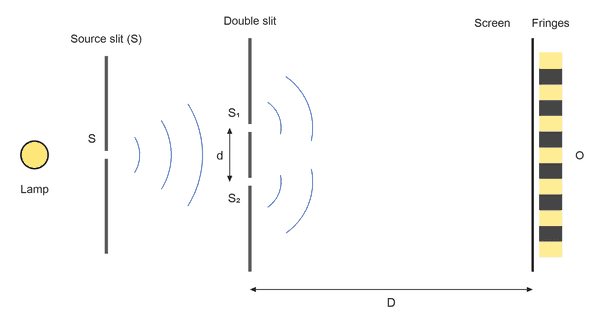
If the separation between two slits is decreased in Young's double-slit experiment, keeping the screen position fixed, what will happen to the fringe width?
 Solve with AI
Written solution
Solution:
Concept: In Young's double-slit experiment the fringe width (distance between two neighbouring bright or dark fringes) is
where is the wavelength of light, is the distance from the slits to the screen and is the distance between the two slits.
Step 1 — Apply the formula. With and fixed, is inversely proportional to . A smaller therefore gives a larger .
Therefore, the fringe width increases.
- 181 mark
Question 18
Why is interference pattern not detected, when two coherent sources are far apart?
Solve with AIWritten solution
Solution:
Concept: In Young's double-slit experiment the fringe width (distance between two neighbouring bright or dark fringes) is
where is the wavelength of light, is the distance from the slits to the screen and is the distance between the two slits.
Step 1 — Large separation. When the sources are far apart, is large, so becomes extremely small.
Step 2 — What the eye sees. The fringes are then so close together that the eye (or an instrument) cannot separate them, and the screen looks uniformly lit.
Therefore, the pattern is not detected because the fringe width becomes too small to resolve.
- 191 mark
Question 19
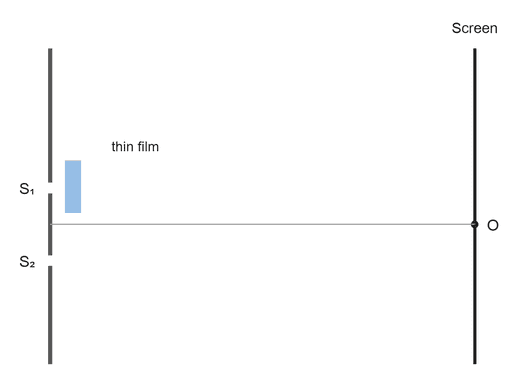
What happens when a thin transparent film is placed just in front of one of the two slits in Young's double-slit experiment?
 Solve with AI
Written solution
Solution:
Concept: Light takes longer to cross a film of thickness and refractive index than the same thickness of air; the film adds an extra optical path of to the ray through it.
Step 1 — Extra path through . The film in front of adds an extra path to every ray from .
Step 2 — New position of zero path difference. The central bright fringe is where the two total paths are equal. To make up for the extra path from , the geometric path from must now be shorter than that from . This happens at a point on the side of , as the figure shows.
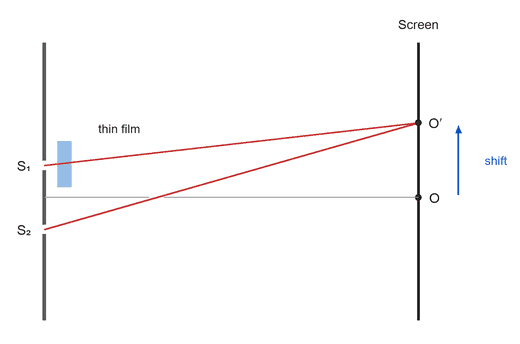
Step 3 — Size of the shift. The whole pattern shifts towards the side of the covered slit by , and the fringe width stays the same.
Therefore, the whole fringe pattern shifts towards the slit covered by the film, without any change in fringe width.
- 201 mark
Question 20
Does interference of light give information about the transverse nature of light?
Solve with AIWritten solution
Solution:
Concept: Interference follows from the superposition of waves, and all waves obey superposition.
Step 1 — Which waves interfere. Both longitudinal waves (such as sound) and transverse waves (such as waves on a string) show interference.
Therefore, no: interference shows that light is a wave, but not whether it is transverse or longitudinal (polarisation shows that light is transverse).
- 211 mark
Question 21
What changes in interference pattern in Young's double-slit experiment will be observed when (i) the distance between the slits is reduced and
(ii) the apparatus is immersed in water?
Solve with AIWritten solution
Solution:
Concept: In Young's double-slit experiment the fringe width (distance between two neighbouring bright or dark fringes) is
where is the wavelength of light, is the distance from the slits to the screen and is the distance between the two slits.
Step 1 — Part (i): smaller slit distance. is inversely proportional to , so reducing increases the fringe width.
Step 2 — Part (ii): in water. The wavelength in water is , so the fringe width becomes
With the fringe width decreases by the factor .
Therefore, (i) the fringe width increases, and (ii) the fringe width decreases by a factor .
- 221 mark
Question 22
Which phenomena establish the wave nature of light?
Solve with AIWritten solution
Solution:
Concept: A phenomenon shows wave nature when it can be explained only by waves, not by a stream of particles.
Step 1 — Interference and diffraction. Bright and dark fringes (interference) and the bending of light round small obstacles (diffraction) can be explained only by the superposition of waves.
Step 2 — Polarisation. Polarisation shows that light is a wave and, further, that it is a transverse wave.
Therefore, interference, diffraction and polarisation establish the wave nature of light.
- 231 mark
Question 23
Two slits in Young's double-slit experiment are illuminated by two different sodium lamps emitting light of same wavelength. Do you observe any interference pattern on the screen?
Solve with AIWritten solution
Solution:
Concept: Two sources are coherent when they emit light of the same frequency (wavelength) with a phase difference that stays constant with time.
Step 1 — Two lamps. Two separate sodium lamps give the same wavelength, but each emits in random bursts, so the phase difference between them changes continuously with time.
Step 2 — Result. The fringes would shift so fast that only uniform illumination is seen.
Therefore, no steady interference pattern is observed, because two different sodium lamps are not coherent sources.
- 241 mark
Question 24
Why is interference pattern not detected, when the two coherent sources are far apart?
Solve with AIWritten solution
Solution:
Concept: In Young's double-slit experiment the fringe width (distance between two neighbouring bright or dark fringes) is
where is the wavelength of light, is the distance from the slits to the screen and is the distance between the two slits.
Step 1 — Effect of large . Since is inversely proportional to , increasing makes smaller.
Step 2 — When is very large. The fringe width becomes so small that the fringes cannot be seen separately, and the screen looks uniformly lit.
Therefore, the pattern is not detected because the fringe width is too small to be seen.
- 251 mark
Question 25
No interference pattern is detected when two coherent sources are infinitely close to each other. Why?
Solve with AIWritten solution
Solution:
Concept: In Young's double-slit experiment the fringe width (distance between two neighbouring bright or dark fringes) is
where is the wavelength of light, is the distance from the slits to the screen and is the distance between the two slits.
Step 1 — Effect of very small . Since is inversely proportional to , a very, very small makes very large.
Step 2 — What is seen. A single fringe may then be wider than the whole screen, so no alternation of bright and dark bands can be seen.
Therefore, no pattern is seen because the fringe width becomes so large that even one fringe can cover the whole screen.
- 261 mark
Question 26
What is the main condition to produce interference of light?
Solve with AIWritten solution
Solution:
Concept: Two sources are coherent when they emit light of the same frequency (wavelength) with a phase difference that stays constant with time.
Step 1 — Why coherence is needed. Only coherent sources keep a constant phase difference, so the bright and dark fringes stay in fixed places and can be observed.
Therefore, the main condition is that the two sources must be coherent.
- 271 mark
Question 27
In Young's double-slit experiment, the intensity of central maximum is . What will be the intensity at the same place if one slit is closed?
Solve with AIWritten solution
Solution:
Concept: Intensity is proportional to the square of the amplitude.
Step 1 — Both slits open. At the central maximum each slit sends amplitude , the waves arrive in phase, and the resultant amplitude is . So
Step 2 — One slit closed. Only amplitude reaches the point, so the new intensity is
Step 3 — Compare. Divide the two results:
Therefore, the amplitude becomes half and the intensity becomes ; there is no interference pattern any more.
- 281 mark
Question 28
What will be the effect on the fringes, if Young's double-slit experiment set up is immersed in water?
Solve with AIWritten solution
Solution:
Concept: In Young's double-slit experiment the fringe width (distance between two neighbouring bright or dark fringes) is
where is the wavelength of light, is the distance from the slits to the screen and is the distance between the two slits.
Step 1 — Wavelength in water. In water of refractive index the wavelength becomes .
Step 2 — New fringe width. Since and do not change, the fringe width becomes
Therefore, the fringe width decreases, so the fringes come closer together.
- 291 mark
Question 29
What is the phase difference corresponding to path difference of two waves reaching a point?
Solve with AIWritten solution
Solution:
Concept: Phase difference and path difference are related by .
Step 1 — Substitute. Put :
Therefore, the phase difference is radian.
- 301 mark
Question 30
Bubbles of colourless soap solution appear coloured in sunlight. Why?
Solve with AIWritten solution
Solution:
Concept: In a thin film, light reflected from the top surface and light reflected from the bottom surface interfere.
Step 1 — Two reflected beams. Sunlight is reflected from both surfaces of the thin soap film (rays 1 and 2 in the figure), and the two beams have a path difference that depends on the film's thickness :
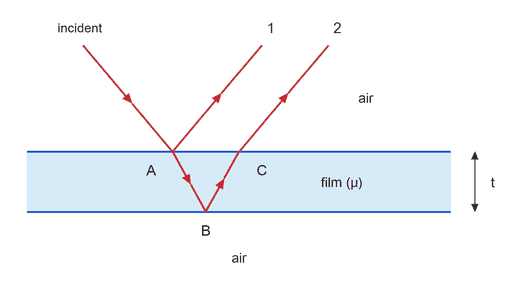
Step 2 — Colours. For each thickness some wavelengths interfere constructively and look bright while others cancel, so the film looks coloured.
Therefore, the bubbles appear coloured due to interference of light in the thin film.
- 312 marks
Question 31
Explain the principle of superposition of waves.
Solve with AIWritten solution
Solution:
Concept: When waves overlap, each wave travels on as if the others were not there; the medium's displacement is the combined effect.
Step 1 — Statement. When two or more waves travel through the same region at the same time, the resultant displacement at any point at any instant is the vector sum of the displacements due to the individual waves.
Step 2 — In symbols. If and are the displacements due to the two waves, the resultant displacement is
Step 3 — Consequence. Where crest meets crest the displacements add and the disturbance is large (constructive interference); where crest meets trough they subtract and the disturbance is small or zero (destructive interference).
Therefore, the resultant displacement at any point is the vector sum of the displacements due to the individual waves; this principle explains interference.
- 322 marks
Question 32
What is interference?
Solve with AIWritten solution
Solution:
Concept: Interference follows from the principle of superposition applied to two coherent waves.
Step 1 — Definition. When two coherent light waves superpose, the light energy is redistributed: at some points the intensity is maximum and at others it is minimum (possibly zero).
Step 2 — What is seen. This gives alternate bright and dark bands called interference fringes.
Therefore, interference is the modification in the distribution of light energy due to the superposition of two or more coherent waves.
- 332 marks
Question 33
Can two lighted candles act as coherent sources? Give reasons.
Solve with AIWritten solution
Solution:
Concept: Two sources are coherent when they emit light of the same frequency (wavelength) with a phase difference that stays constant with time.
Step 1 — Emission from a candle. Light from a candle flame comes from many atoms emitting short random bursts, so its phase changes at random.
Step 2 — Two candles. The phase difference between two candles therefore changes many millions of times a second.
Therefore, no: two lighted candles are not coherent sources, because the phase difference between them does not stay constant.
- 342 marks
Question 34
Draw a diagram to show the waves emitted by (i) a coherent source and
(ii) an incoherent source.
Solve with AIWritten solution
Solution:
Concept: Two sources are coherent when they emit light of the same frequency (wavelength) with a phase difference that stays constant with time.
Step 1 — Coherent sources. Waves from two coherent sources are continuous, have the same wavelength and keep the same phase difference all along, as in panel (i) of the figure.
Step 2 — Incoherent sources. Each incoherent source emits short wave trains whose phase jumps at random; the phase difference between the two sources keeps changing, as in panel (ii).

Therefore, waves from coherent sources keep a constant phase difference, while waves from incoherent sources change their phase difference at random.
- 352 marks
Question 35
Obtain the relation connecting path difference and phase difference.
Solve with AIWritten solution
Solution:
Concept: As a wave travels one wavelength , its phase changes by radian.
Step 1 — Use a proportion. A path of corresponds to a phase change of , so a path of 1 unit corresponds to a phase change of .
Step 2 — For a path difference . Multiply by :
Therefore, phase difference path difference.
- 362 marks
Question 36
Write down the condition for the (i) maximum intensity and
(ii) minimum intensity due to interference of light emitted by coherent sources.
Solve with AIWritten solution
Solution:
Concept: The phase difference is ; the intensity is maximum when the waves are in phase and minimum when they are in opposite phase.
Step 1 — Part (i): maximum intensity. The waves are in phase when , so the path difference must be
Step 2 — Part (ii): minimum intensity. The waves are in opposite phase when , so the path difference must be
This is the same as , with
Therefore, maximum intensity needs a path difference and minimum intensity needs .
- 372 marks
Question 37
Does the phenomenon of interference obey the law of conservation of energy? Explain.
Solve with AIWritten solution
Solution:
Concept: In interference, energy is redistributed between bright and dark fringes, never created or destroyed.
Step 1 — Without interference. If each slit sends amplitude , the two separate intensities add to
Step 2 — Bright and dark points. At a bright point the amplitude is , so the intensity is . At a dark point the intensity is .
Step 3 — Average over the pattern. The intensity varies as , where is the phase difference, and the average of over a whole fringe is , so the average intensity is half the maximum:
Step 4 — Compare. The average intensity equals the total intensity supplied by the two slits; the energy missing at the dark fringes appears at the bright fringes.
Therefore, yes: interference obeys the law of conservation of energy.
- 382 marks
Question 38
Define fringe width. How can you increase the fringe width?
Solve with AIWritten solution
Solution:
Concept: In Young's experiment bright and dark fringes are equally spaced.
Step 1 — Definition. Fringe width is the distance between two consecutive bright fringes or two consecutive dark fringes. It is
where is the wavelength, the slit-to-screen distance and the slit separation.
Step 2 — How to increase it. From the formula, increases if (i) a longer wavelength is used, (ii) the screen is moved farther from the slits (larger ), or (iii) the slits are brought closer together (smaller ).
Therefore, fringe width is the distance between consecutive bright (or dark) fringes, and it is increased by increasing or , or decreasing .
- 392 marks
Question 39
In Young's double-slit experiment, if the slit is illuminated with white light. Explain the nature of the fringes observed.
Solve with AIWritten solution
Solution:
Concept: White light contains all wavelengths from violet to red, and each wavelength forms its own pattern with fringe width .
Step 1 — The centre. At the central point the path difference is zero for every colour, so all colours are bright there and the central fringe is white.
Step 2 — Next to the centre. Violet and blue have the smallest , so their first bright fringes lie nearest the centre; red has the largest , so its first bright fringe lies farthest out. Each fringe beside the centre is therefore coloured, bluish on the inner edge and reddish on the outer edge.
Step 3 — Farther out. After a few fringes the bright fringes of different colours overlap at every point, so the colours mix and the screen looks almost uniformly white.
Therefore, a white central fringe is seen with a few coloured fringes on each side (blue nearer, red farther), followed by nearly uniform white light.
- 402 marks
Question 40
What are the conditions for sustained interference?
Solve with AIWritten solution
Solution:
Concept: Sustained interference means a pattern of bright and dark fringes that stays steady in time and is clearly visible.
Step 1 — Coherent sources. The two sources must be coherent: same frequency and a constant phase difference.
Step 2 — Monochromatic light. The light should be of a single wavelength, otherwise the patterns of different colours overlap.
Step 3 — Nearly equal amplitudes. The two waves should have equal (or nearly equal) amplitudes so that the dark fringes are really dark and the contrast is good.
Step 4 — Narrow sources, close together. The sources should be narrow, and the distance between them small compared with the distance to the screen, so that the fringe width is large enough to be seen.
Therefore, the sources must be coherent, monochromatic, narrow and close together, and give waves of nearly equal amplitude.
- 412 marks
Question 41
Write down an expression for the angular fringe width.
Solve with AIWritten solution
Solution:
Concept: The angular fringe width is the angle that one fringe width subtends at the slits.
Step 1 — Divide by the distance. A fringe of width at distance subtends a small angle at the slits, as the figure shows:
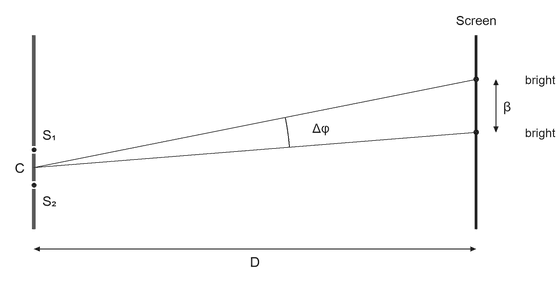
For a small angle, the angle in radian is the arc divided by the radius:
Step 2 — Substitute . Put :
Therefore, the angular fringe width is radian.
- 422 marks
Question 42
In Young's experiment the widths of the two slits are in the ratio 1:4. What is the ratio of the amplitudes of the two light waves?
Solve with AIWritten solution
Solution:
Concept: The intensity of light from a slit is proportional to the slit width, and the intensity is proportional to the square of the amplitude.
Step 1 — Intensity ratio. The widths are in the ratio , so
Step 2 — Amplitude ratio. Since , the squares of the amplitudes are in the same ratio:
Therefore, the ratio of the amplitudes is 1 : 2.
- 432 marks
Question 43
By observing the interference pattern, can we make any conclusion regarding the nature of light wave?
Solve with AIWritten solution
Solution:
Concept: Interference is a property of all waves, both longitudinal and transverse.
Step 1 — What interference proves. The fringes show that light is a wave.
Step 2 — What it cannot tell. Longitudinal waves (sound) and transverse waves (string waves) both produce interference, so the pattern cannot tell us which kind light is.
Therefore, we cannot decide from interference whether light is longitudinal or transverse; only its wave nature is shown.
- 442 marks
Question 44
In Young's double-slit experiment, what is the effect of following operations on interference fringes?
(i) The screen moved away from the plane of the slits.
(ii) The monochromatic source is replaced by another monochromatic source of smaller wavelength.
(iii) The monochromatic source is replaced by a source of white light.
(iv) The width of the source slit is made wider.
(v) The separation between the two slits is increased.
(vi) The distance between the source slit and the plane of the two slits is increased.
(vii) The width of each of the two slits is of the order of wavelength of light source.
Solve with AIWritten solution
Solution:
Concept: In Young's double-slit experiment the fringe width (distance between two neighbouring bright or dark fringes) is
where is the wavelength of light, is the distance from the slits to the screen and is the distance between the two slits.
Step 1 — Part (i): screen moved away. increases, so increases and the fringes spread out. The angular width does not change.
Step 2 — Part (ii): smaller wavelength. is proportional to , so decreases.
Step 3 — Part (iii): white light. The central fringe is white. Each fringe beside it is coloured, blue nearer the centre and red farther away. After a few fringes the colours overlap and no clear fringes are seen.
Step 4 — Part (iv): wider source slit. Different parts of a wide source slit form patterns shifted from one another. As the slit is widened the fringes become less sharp; when its width and its distance from the double slit no longer satisfy , the patterns overlap and no clear fringes are seen.
Step 5 — Part (v): larger slit separation. is inversely proportional to , so decreases.
Step 6 — Part (vi): source slit moved farther away. The fringe width does not depend on this distance, so is unchanged. The source slit now looks narrower as seen from the double slit (the condition is satisfied better), so the fringes become sharper, though slightly less bright.
Note: the book's printed answer for (vi) is that no distinct fringe pattern is seen; that happens when the source slit is brought too close to the double slit. Moving it farther away makes the fringes sharper.
Step 7 — Part (vii): slit widths of the order of . Each slit then diffracts light through a large angle. The interference fringes are spread over a wide region, and their brightness follows the broad diffraction pattern of each slit.
Therefore, (i) increases, (ii) decreases, (iii) a white central fringe with a few coloured fringes is seen, (iv) the fringes blur and finally vanish, (v) decreases, (vi) is unchanged and the fringes become sharper, (vii) diffraction from each slit spreads the pattern over a wide region.
- 452 marks
Question 45
Widths of two slits in Young's experiment are in the ratio 4:1. What is the ratio of the amplitude of light waves from them?
Solve with AIWritten solution
Solution:
Concept: Intensity is proportional to slit width, and intensity is proportional to amplitude squared.
Step 1 — Intensity ratio. The widths are in the ratio , so
Step 2 — Amplitude ratio. Since , the squares of the amplitudes are in the same ratio:
Therefore, the ratio of the amplitudes is 2 : 1.
- 462 marks
Question 46
What is the ratio of slit widths when amplitudes of light waves from them have a ratio ?
Solve with AIWritten solution
Solution:
Concept: Slit width is proportional to the intensity of light through it, and intensity is proportional to amplitude squared.
Step 1 — Intensity ratio. Square the amplitude ratio:
Step 2 — Width ratio. The widths are in the same ratio as the intensities, so .
Therefore, the ratio of the slit widths is 2 : 1.
- 472 marks
Question 47
How would the angular separation of interference fringes in Young's double-slit experiment change when the distance of separation between slits and screen is doubled?
Solve with AIWritten solution
Solution:
Concept: The angular separation of the fringes is the angle that one fringe width subtends at the slits, :
Step 1 — Substitute . We substitute into this expression:
Step 2 — Effect of doubling . cancels out, so does not depend on . (The linear fringe width doubles, but so does .)
Therefore, the angular separation remains the same.
- 482 marks
Question 48
What are coherent sources of light? Why no interference pattern is observed when two coherent sources are (i) too close and
(ii) very far apart?
Solve with AIWritten solution
Solution:
Concept: Two sources are coherent when they emit light of the same frequency (wavelength) with a phase difference that stays constant with time.
Step 1 — Definition. Coherent sources emit light of the same frequency with a constant phase difference; they are obtained from one source, for example the two slits of Young's experiment.
Step 2 — Fringe width formula. The fringe width is , where is the distance between the sources.
Step 3 — Part (i): too close. When is very small, becomes very large; a single fringe may cover the whole screen, so no pattern of bands is seen.
Step 4 — Part (ii): very far apart. When is very large, becomes very small; the fringes are too close to be seen separately, so the screen looks uniformly lit.
Therefore, coherent sources keep a constant phase difference; when they are too close the fringes are too wide, and when they are too far apart the fringes are too narrow to be seen.
- 492 marks
Question 49
Show that the maximum intensity in interference pattern is four times the intensity due to each slit.
Solve with AIWritten solution
Solution:
Concept: For two coherent waves of intensities and with phase difference , the resultant intensity is
Step 1 — Equal slits. Let each slit give the same intensity :
Step 2 — Condition for maximum. is largest (equal to 1) when , that is, where constructive interference takes place.
Step 3 — Maximum intensity. Put :
Therefore, the maximum intensity is four times the intensity due to each slit.
- 502 marks
Question 50
In Young's double-slit experiment, suppose one of the slits is covered so that it transmits half the light intensity of the other. What change will be observed in the interference pattern?
Solve with AIWritten solution
Solution:
Concept: The resultant intensity is ; it is maximum for and minimum for .
Step 1 — Before covering. With both slits giving intensity , the maxima are and the minima are (completely dark).
Step 2 — After covering: the maxima. Now one slit gives and the other gives . Put zero phase difference into the formula:
Step 3 — After covering: the minima. Put , so :
Step 4 — Describe the change. The bright fringes become less bright and the dark fringes are no longer completely dark, so the contrast between them decreases. The fringe width does not change.
Therefore, the maxima fall to about and the minima rise to about : the fringes become less distinct, with the same fringe width.
- 512 marks
Question 51
Can a pair of coherent sources be obtained from one incoherent source?
Solve with AIWritten solution
Solution:
Concept: Two sources are coherent when they emit light of the same frequency (wavelength) with a phase difference that stays constant with time.
Step 1 — Divide one source. Light from a single source (itself incoherent) is divided into two parts by the two slits and in Young's experiment:
Step 2 — Why they are coherent. Any random change of phase at reaches and at the same time, so the phase difference between and stays constant.
Therefore, yes: in Young's double-slit experiment is an incoherent source and and obtained from it are coherent sources.
- 522 marks
Question 52
What will happen to the fringe width in Young's double-slit experiment when the distance of the screen from the double slit is doubled and in distance between the two slits is halved?
- 533 marks
Question 53
In Young's double-slit experiment, what is meant by fringe width or fringe separation? State two ways of increasing the fringe width without changing the source of light.
- 543 marks
Question 54
In Young's double-slit experiment, show that where the terms have their usual meaning.
- 553 marks
Question 55
In Young's double-slit experiment, show graphically how the intensity of light varies with distance.
- 563 marks
Question 56
Draw a neat labelled diagram of Young's double-slit experiment. Show that the angular fringe width , where is the distance between the slits (either or bright or dark fringe).
- 575 marks
Question 57
(a) What are coherent sources?
(b) Explain how coherent sources are produced by (i) reflection and (ii) refraction with suitable diagram?
(c) Describe Young's double-slit experiment and explain the formation of fringes.
- 585 marks
Question 58
(a) Derive an expression for the resultant intensity at a point on a screen, due to the interference of light from coherent sources, in double-slit experiment.
(b) Write down the expression for (i) maximum intensity and (ii) minimum intensity.
(c) Explain the variation of intensity with phase difference using a suitable diagram.
- 595 marks
Question 59
(a) Define fringe width or bandwidth.
(b) Derive an expression for the fringe width in double-slit experiment.
(c) Show that the bright fringes and dark fringes are of the same width.
- 603 marks
Question 60
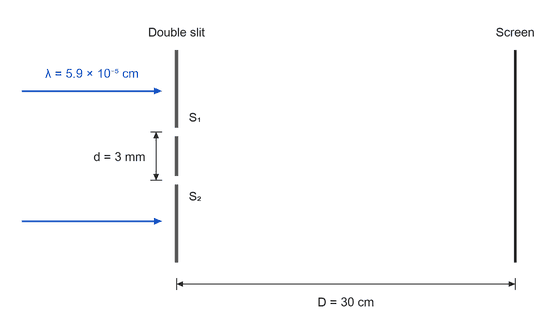
Two straight and narrow parallel slits 3 mm apart are illuminated by a monochromatic light of wavelength cm. Fringes are obtained on a screen 30 cm away from the slits. Calculate the fringe width. Comment on the shape of the fringes.
- 613 marks
Question 61
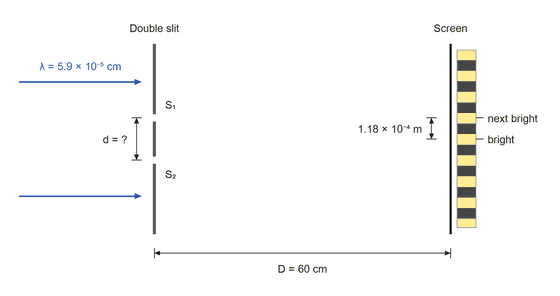
Two straight and narrow parallel slits are illuminated by a monochromatic light of wavelength cm. Fringes are obtained on a 60 cm distant screen from the slits. If the fringe width is m, what is the distance between the coherent sources?
- 623 marks
Question 62
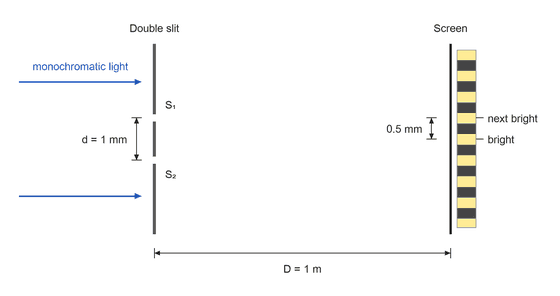
In Young's double-slit experiment, the distance between the slits and the screen is 1 m. The fringe separation on a screen is 0.5 mm and the distance between the slits is 1 mm. Find the wavelength of the light used.
- 633 marks
Question 63
Using light of wavelength 589.3 nm, 50 fringes were observed in the field of view, in Young's double-slit experiment. How many fringes will be observed if light of wavelength 435.8 nm is used?
- 643 marks
Question 64
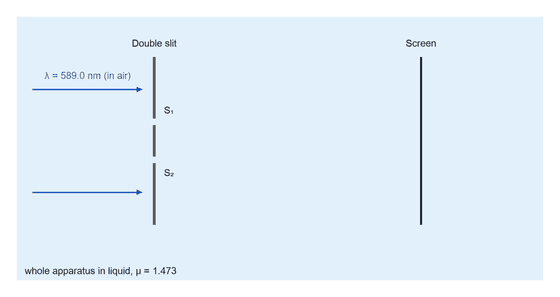
In Young's double-slit experiment, the fringe width of the fringes with light of wavelength 589.0 nm is 0.31 mm. Find the fringe width if the entire apparatus is immersed in a liquid of refractive index 1.473.
- 653 marks
Question 65
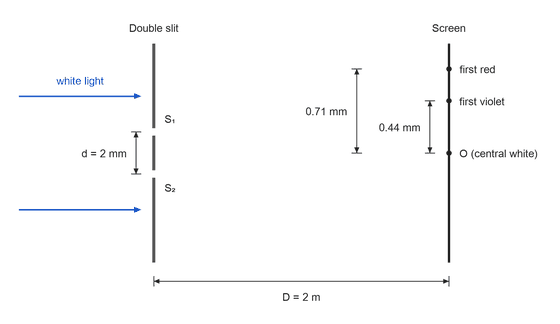
In Young's double-slit experiment white light is used. The slit separation is 2 mm and the distance between the coherent sources and the screen is 2 m. The first violet and red fringes are formed at 0.44 mm and 0.71 mm away from the central white fringe. Find the wavelengths of the violet and the red light.
- 663 marks
Question 66
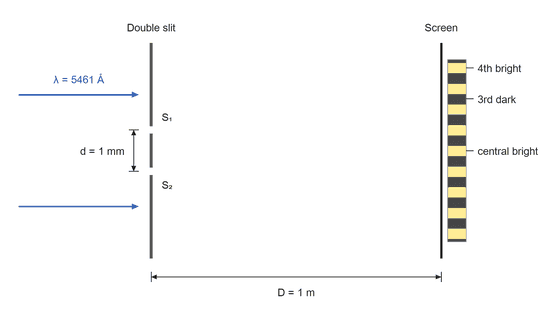
In Young's double-slit experiment, the slit separation is 1 mm and the distance between the slits and the screen is 1 m. Interference fringes are seen using light of wavelength 5461 Å. (i) Find the distance of the third dark fringe from the central fringe. (ii) Calculate the distance of the fourth bright fringe from the central fringe.
- 673 marks
Question 67
In Young's double-slit experiment, the distance between the two slits is halved and the distance of the screen from the double slits is made three times. How will the fringe width change?
- 683 marks
Question 68
In a double-slit experiment using sodium yellow light, the interference fringes are 0.15° apart. Find the angular separation if the whole apparatus immersed in a liquid of refractive index 1.47.
- 693 marks
Question 69
In Young's double-slit experiment, the wavelength of light used is 5461 Å. How many fringes can be seen in a width of 1.5 cm, if the screen is at a distance of 1.5 m from the source? Given that the slit width is 1.5 mm.

- 703 marks
Question 70
In Young's double-slit experiment, the bandwidth on a screen is doubled when the screen is moved through 1 m. The wavelength of light used is 5461 Å and the distance between the slits is 0.2 mm. Calculate the bandwidth.

- 713 marks
Question 71
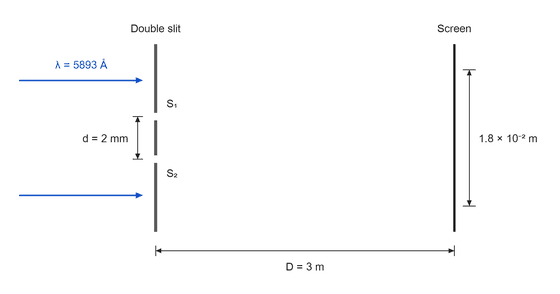
In Young's double-slit experiment, interference fringes were observed using light of wavelength 5893 Å. The slit separation was 2 mm and the fringes were seen on a screen kept at a distance of 3 m from the slits. If the fringe pattern was spread over a length of m, find the number of fringes.
- 723 marks
Question 72
Two coherent sources whose intensity ratio is 100 : 1 produce interference fringes. Find the ratio of maximum to minimum intensity of the fringe system.
- 733 marks
Question 73
In an interference pattern, the ratio of maximum to minimum intensity is 36 : 1. Find the ratio between the amplitude and intensities of the two interfering waves.
What Class 12 Physics Ch 20 covers
The sections of the chapter, in the order the book takes them. Every question above comes from one of these.
- 01Interference and Coherent Sources
- 02Young's Double-Slit Experiment
- 03Theory of Interference and Intensity
- 04Fringe Width
- 05Conditions for Sustained Interference
- 06Interference in Thin Films
More ways to study this chapter
The same chapter asked three other ways. Practise it, revise it, and see what the board has set on Ch 20 before.
- Competency-Based Questions (CBQ)Case study questions: a situation, and the part of the chapter that answers it.43questionsOpen
- Previous Year QuestionsQuestions that have actually appeared in board papers, each tagged with its year.12questionsOpen
- Practice QuestionsExtra questions per chapter, for when one attempt at a method is not enough.113questionsOpen
Ch 20 in past ISC papers
The same chapter as the board has actually asked it. These are worded differently from the textbook exercise, which is the point of reading them.
- 13 marks
Board paper question 1
Laser light of wavelength is incident on a pair of slits which are separated by . If the screen is kept away from the two slits, calculate:
(i) fringe separation i.e. fringe width.
(ii) distance of bright fringe from the centre of the interference pattern.
Solve with AIWritten solution
Solution:
Key idea: In Young's double slit experiment the fringe width is , where is the wavelength, the distance from the slits to the screen and the separation of the slits. The th bright fringe is at a distance from the centre.
Step 1 — Write the data in SI units.
We convert every length to metres (a nanometre is , a millimetre and a centimetre ).
Step 2 — Part (i): calculate the fringe width.
We substitute the values into the formula for .
This is .
Step 3 — Part (ii): find the distance of the 10th bright fringe.
Bright fringes are one fringe width apart, counting from the central bright fringe (), so the 10th bright fringe is from the centre.
This is .
Therefore, (i) the fringe width is 2.8 × 10⁻⁴ m (0.28 mm); (ii) the 10th bright fringe is 2.8 × 10⁻³ m (2.8 mm) from the centre of the pattern.
- 24 marks
Board paper question 2
In Young's double slit experiment, show that:
where the terms have their usual meaning.
Solve with AIWritten solution
Solution:
Key idea: Light from two coherent slits reaches a point on the screen by two paths of different length. The point is bright when the path difference is a whole number of wavelengths and dark when it is an odd number of half wavelengths. Neighbouring bright (or dark) fringes are therefore equally spaced, and their spacing is the fringe width .
Step 1 — Describe the arrangement.
Two narrow slits and , a distance apart, are lit by the same monochromatic source of wavelength , so they act as coherent sources. A screen is placed at a distance from the slits, with much larger than . The point O on the screen is equidistant from and . We find the path difference at a point P on the screen a distance from O.
Step 2 — Find the path difference.
We draw perpendicular to . Because the screen is far away, , so the path difference is the short length . The angle between and equals the angle that the light going to P makes with the central line through O (the figure is not to scale; is drawn much larger than it really is).
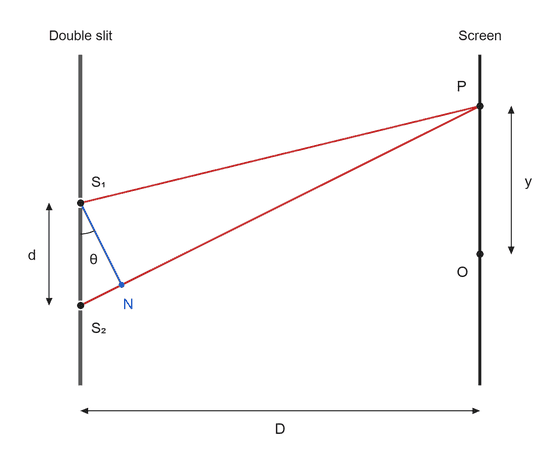
In the right triangle the hypotenuse is .
Step 3 — Replace the angle by distances on the screen.
The angle is very small, so , and is the height of P divided by the distance .
Step 4 — Locate the bright fringes.
The point P is bright when the waves arrive in phase. This happens when the path difference is a whole number of wavelengths.
Here is , and we put .
Step 5 — Locate the dark fringes.
The point P is dark when the path difference is an odd number of half wavelengths.
Here is , and the same steps give the positions of the dark fringes.
Step 6 — Find the fringe width.
The fringe width is the distance between two neighbouring bright fringes (or two neighbouring dark fringes).
For the dark fringes, gives the same value, so bright and dark fringes are equally wide and evenly spaced.
Therefore, the fringe width in Young's double slit experiment is β = λD/d.
- 31 mark
Board paper question 3
How is fringe width of an interference pattern in Young's double slit experiment affected if the two slits are brought closer to each other ?
Solve with AIWritten solution
Solution:
Key idea: The fringe width in Young's double slit experiment is , so it is inversely proportional to the slit separation .
Step 1 — Read the formula.
With the wavelength and the screen distance unchanged, varies as .
Step 2 — Apply the change.
Bringing the slits closer makes smaller, so becomes larger. For example, halving doubles the fringe width.
Therefore, the fringe width increases (in inverse proportion to the slit separation) when the slits are brought closer.
- 43 marks
Board paper question 4
In Young's double slit experiment using monochromatic light of wavelength , bright fringe is at a distance of from the center of the pattern. If the screen is at a distance of from the plane of the two slits, calculate :
(i) Distance between the two slits.
(ii) Fringe width i.e., fringe separation.
Solve with AIWritten solution
Solution:
Key idea: In Young's double slit experiment the th bright fringe is at a distance from the centre, and the fringe width is , so .
Step 1 — Write the data in SI units.
We convert every length to metres (a nanometre is , a millimetre and a centimetre ).
Step 2 — Part (i): find the distance between the slits.
We rearrange the position of the 5th bright fringe for , using .
This is .
Step 3 — Part (ii): find the fringe width.
The 5th bright fringe is five fringe widths from the centre, so we divide its distance by 5.
This is . As a check, with gives the same value.
Therefore, (i) the slits are 5.0 × 10⁻³ m (5 mm) apart; (ii) the fringe width is 9.6 × 10⁻⁵ m (0.096 mm).
- 51 mark
Board paper question 5
Define coherent sources of light.
Solve with AIWritten solution
Solution:
Key idea: A steady interference pattern needs two sources whose waves keep the same phase relation with each other all the time.
Step 1 — State what the sources must share.
The two sources must give light of the same frequency (wavelength), and the phase difference between their waves must stay constant with time.
Step 2 — Note how they are obtained.
In practice coherent sources are obtained from one source, for example the two slits of Young's experiment lit by the same narrow slit, or a source and its image in a mirror.
Therefore, coherent sources of light are two sources that emit light of the same frequency with a constant (zero or fixed) phase difference between them.
- 63 marks
Board paper question 6
(i) In Young's double slit experiment, show graphically how intensity of light varies with distance.
(ii) In Fraunhofer diffraction, how is the angular width of the central bright fringe affected when slit sepration is increased?
Solve with AIWritten solution
Solution:
Key idea: In Young's experiment the intensity at a point a distance from the centre is , where is the intensity from each slit alone and is the fringe width. In single-slit (Fraunhofer) diffraction the central bright fringe has an angular width , where is the width of the slit.
Step 1 — Part (i): describe how the intensity varies.
At the centre () the path difference is zero, so the intensity is a maximum, . It falls to zero half a fringe width away, rises again to at , and so on. All the bright fringes have the same maximum intensity , all the dark fringes have zero intensity, and the maxima are equally spaced, one fringe width apart.
Step 2 — Part (i): draw the graph.
The graph of intensity against distance from the centre is a curve with equal peaks.
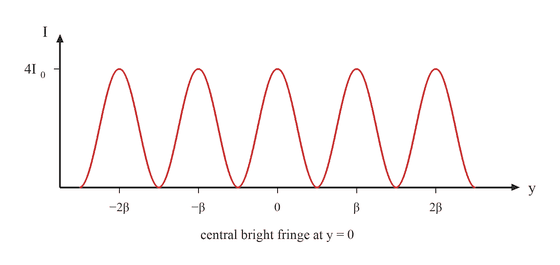
Step 3 — Part (ii): read what the paper means.
The paper prints "slit sepration"; a single-slit Fraunhofer pattern has only one slit, so we take it to mean the width of the slit.
Step 4 — Part (ii): find the effect on the angular width.
The first minima on either side of the centre are at , so for small angles the angular width of the central bright fringe is
It is inversely proportional to . A wider slit gives a narrower central bright fringe.
Therefore, (i) the intensity varies as a cos² curve with equal maxima 4I₀, zero minima and a constant spacing β, as in the graph; (ii) when the slit is made wider, the angular width of the central bright fringe decreases (2λ/a, inversely proportional to the slit width).
All 12 board paper questions for this chapter, solved the same way.
Class 12 Physics Ch 20 questions students ask
How many questions are there in Class 12 Physics Ch 20?
73 questions. Every one is solved step by step on this page.
Are these Class 12 Physics solutions free?
Yes. Every question and its full working is free to read, with no account needed.
Can I download the Class 12 Physics Ch 20 solutions as a PDF?
There is no PDF to download. Every solution is on this page instead, which means it is searchable, always the current syllabus, and readable on a phone. Use your browser's print option if you want it on paper.