Solution:
Key idea: In Young's experiment the intensity at a point a distance y from the centre is I=4I0cos2(βπy), where I0 is the intensity from each slit alone and β is the fringe width. In single-slit (Fraunhofer) diffraction the central bright fringe has an angular width a2λ, where a is the width of the slit.
Step 1 — Part (i): describe how the intensity varies.
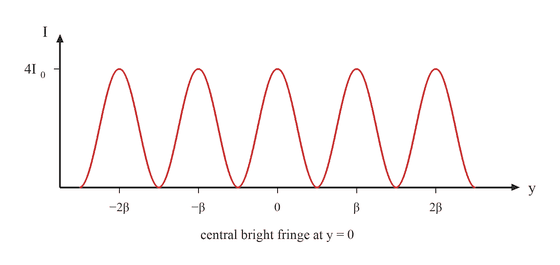
At the centre (y=0) the path difference is zero, so the intensity is a maximum, 4I0. It falls to zero half a fringe width away, rises again to 4I0 at y=β, and so on. All the bright fringes have the same maximum intensity 4I0, all the dark fringes have zero intensity, and the maxima are equally spaced, one fringe width apart.
Step 2 — Part (i): draw the graph.
The graph of intensity I against distance y from the centre is a cos2 curve with equal peaks.
Step 3 — Part (ii): read what the paper means.
The paper prints "slit sepration"; a single-slit Fraunhofer pattern has only one slit, so we take it to mean the width a of the slit.
Step 4 — Part (ii): find the effect on the angular width.
The first minima on either side of the centre are at sinθ=±aλ, so for small angles the angular width of the central bright fringe is
2θ=a2λ
It is inversely proportional to a. A wider slit gives a narrower central bright fringe.
Therefore, (i) the intensity varies as a cos² curve with equal maxima 4I₀, zero minima and a constant spacing β, as in the graph; (ii) when the slit is made wider, the angular width of the central bright fringe decreases (2λ/a, inversely proportional to the slit width).
