
Opening your dashboard
Class 12 Physics Chapter 20 Interference of Light: Previous Year Questions
12 questions on Chapter 20, each solved step by step. Class 12 Physics, ICSE 2026-27.
12 questions with solutions
1–4 marks · Mixed difficulty
- 13 marks
Question 1
Laser light of wavelength is incident on a pair of slits which are separated by . If the screen is kept away from the two slits, calculate:
(i) fringe separation i.e. fringe width.
(ii) distance of bright fringe from the centre of the interference pattern.
Solve with AIWritten solution
Solution:
Key idea: In Young's double slit experiment the fringe width is , where is the wavelength, the distance from the slits to the screen and the separation of the slits. The th bright fringe is at a distance from the centre.
Step 1 — Write the data in SI units.
We convert every length to metres (a nanometre is , a millimetre and a centimetre ).
Step 2 — Part (i): calculate the fringe width.
We substitute the values into the formula for .
This is .
Step 3 — Part (ii): find the distance of the 10th bright fringe.
Bright fringes are one fringe width apart, counting from the central bright fringe (), so the 10th bright fringe is from the centre.
This is .
Therefore, (i) the fringe width is 2.8 × 10⁻⁴ m (0.28 mm); (ii) the 10th bright fringe is 2.8 × 10⁻³ m (2.8 mm) from the centre of the pattern.
- 24 marks
Question 2
In Young's double slit experiment, show that:
where the terms have their usual meaning.
Solve with AIWritten solution
Solution:
Key idea: Light from two coherent slits reaches a point on the screen by two paths of different length. The point is bright when the path difference is a whole number of wavelengths and dark when it is an odd number of half wavelengths. Neighbouring bright (or dark) fringes are therefore equally spaced, and their spacing is the fringe width .
Step 1 — Describe the arrangement.
Two narrow slits and , a distance apart, are lit by the same monochromatic source of wavelength , so they act as coherent sources. A screen is placed at a distance from the slits, with much larger than . The point O on the screen is equidistant from and . We find the path difference at a point P on the screen a distance from O.
Step 2 — Find the path difference.
We draw perpendicular to . Because the screen is far away, , so the path difference is the short length . The angle between and equals the angle that the light going to P makes with the central line through O (the figure is not to scale; is drawn much larger than it really is).
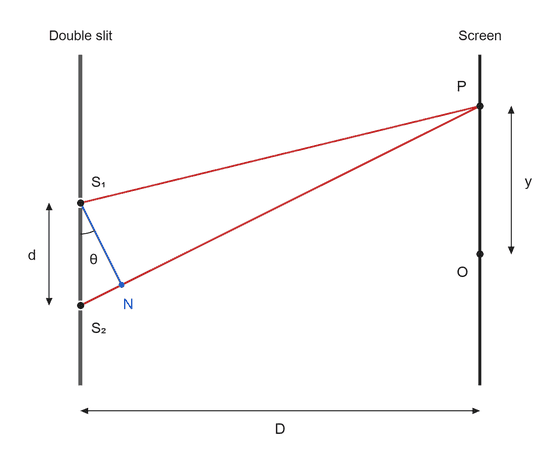
In the right triangle the hypotenuse is .
Step 3 — Replace the angle by distances on the screen.
The angle is very small, so , and is the height of P divided by the distance .
Step 4 — Locate the bright fringes.
The point P is bright when the waves arrive in phase. This happens when the path difference is a whole number of wavelengths.
Here is , and we put .
Step 5 — Locate the dark fringes.
The point P is dark when the path difference is an odd number of half wavelengths.
Here is , and the same steps give the positions of the dark fringes.
Step 6 — Find the fringe width.
The fringe width is the distance between two neighbouring bright fringes (or two neighbouring dark fringes).
For the dark fringes, gives the same value, so bright and dark fringes are equally wide and evenly spaced.
Therefore, the fringe width in Young's double slit experiment is β = λD/d.
- 31 mark
Question 3
How is fringe width of an interference pattern in Young's double slit experiment affected if the two slits are brought closer to each other ?
Solve with AIWritten solution
Solution:
Key idea: The fringe width in Young's double slit experiment is , so it is inversely proportional to the slit separation .
Step 1 — Read the formula.
With the wavelength and the screen distance unchanged, varies as .
Step 2 — Apply the change.
Bringing the slits closer makes smaller, so becomes larger. For example, halving doubles the fringe width.
Therefore, the fringe width increases (in inverse proportion to the slit separation) when the slits are brought closer.
- 43 marks
Question 4
In Young's double slit experiment using monochromatic light of wavelength , bright fringe is at a distance of from the center of the pattern. If the screen is at a distance of from the plane of the two slits, calculate :
(i) Distance between the two slits.
(ii) Fringe width i.e., fringe separation.
Solve with AIWritten solution
Solution:
Key idea: In Young's double slit experiment the th bright fringe is at a distance from the centre, and the fringe width is , so .
Step 1 — Write the data in SI units.
We convert every length to metres (a nanometre is , a millimetre and a centimetre ).
Step 2 — Part (i): find the distance between the slits.
We rearrange the position of the 5th bright fringe for , using .
This is .
Step 3 — Part (ii): find the fringe width.
The 5th bright fringe is five fringe widths from the centre, so we divide its distance by 5.
This is . As a check, with gives the same value.
Therefore, (i) the slits are 5.0 × 10⁻³ m (5 mm) apart; (ii) the fringe width is 9.6 × 10⁻⁵ m (0.096 mm).
- 51 mark
Question 5
Define coherent sources of light.
Solve with AIWritten solution
Solution:
Key idea: A steady interference pattern needs two sources whose waves keep the same phase relation with each other all the time.
Step 1 — State what the sources must share.
The two sources must give light of the same frequency (wavelength), and the phase difference between their waves must stay constant with time.
Step 2 — Note how they are obtained.
In practice coherent sources are obtained from one source, for example the two slits of Young's experiment lit by the same narrow slit, or a source and its image in a mirror.
Therefore, coherent sources of light are two sources that emit light of the same frequency with a constant (zero or fixed) phase difference between them.
- 63 marks
Question 6
(i) In Young's double slit experiment, show graphically how intensity of light varies with distance.
(ii) In Fraunhofer diffraction, how is the angular width of the central bright fringe affected when slit sepration is increased?
Solve with AIWritten solution
Solution:
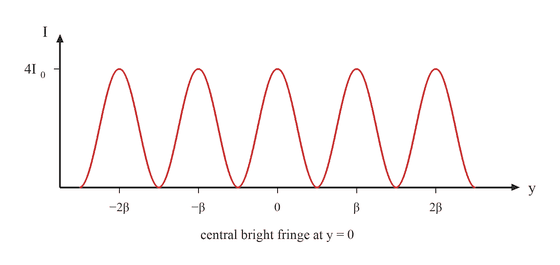
Key idea: In Young's experiment the intensity at a point a distance from the centre is , where is the intensity from each slit alone and is the fringe width. In single-slit (Fraunhofer) diffraction the central bright fringe has an angular width , where is the width of the slit.
Step 1 — Part (i): describe how the intensity varies.
At the centre () the path difference is zero, so the intensity is a maximum, . It falls to zero half a fringe width away, rises again to at , and so on. All the bright fringes have the same maximum intensity , all the dark fringes have zero intensity, and the maxima are equally spaced, one fringe width apart.
Step 2 — Part (i): draw the graph.
The graph of intensity against distance from the centre is a curve with equal peaks.
Step 3 — Part (ii): read what the paper means.
The paper prints "slit sepration"; a single-slit Fraunhofer pattern has only one slit, so we take it to mean the width of the slit.
Step 4 — Part (ii): find the effect on the angular width.
The first minima on either side of the centre are at , so for small angles the angular width of the central bright fringe is
It is inversely proportional to . A wider slit gives a narrower central bright fringe.
Therefore, (i) the intensity varies as a cos² curve with equal maxima 4I₀, zero minima and a constant spacing β, as in the graph; (ii) when the slit is made wider, the angular width of the central bright fringe decreases (2λ/a, inversely proportional to the slit width).
- 71 mark
Question 7
What should be the path difference between two waves reaching a point for obtaining constructive interference in Young's double slit experiment?
Solve with AIWritten solution
Solution:
Key idea: Two waves reinforce each other (constructive interference) when they arrive in phase, that is when one wave is ahead of the other by a whole number of wavelengths.
Step 1 — Link phase and path difference.
A path difference of one wavelength produces a phase difference of , which is the same as being in phase.
Step 2 — State the condition.
So the waves meet crest on crest when the path difference is
with
Therefore, for constructive interference the path difference must be a whole number of wavelengths, Δ = nλ, where n is 0, 1, 2, ….
- 83 marks
Question 8
In Young's double slit experiment, the screen is kept at a distance of 1.2m from the plane of the slits. The two slits are separated by 5mm and illuminated with monochromatic light having wavelength 600nm. Calculate:
(i) Fringe width i.e. fringe separation of the interference pattern.
(ii) Distance of bright fringe from the center of the pattern.
Solve with AIWritten solution
Solution:
Key idea: In Young's double slit experiment the fringe width is , and the th bright fringe is at from the centre of the pattern.
Step 1 — Write the data in SI units.
We convert every length to metres (a nanometre is , a millimetre and a centimetre ).
Step 2 — Part (i): calculate the fringe width.
We substitute into .
This is .
Step 3 — Part (ii): find the distance of the 10th bright fringe.
Counting from the central bright fringe (), the 10th bright fringe is ten fringe widths from the centre.
This is .
Therefore, (i) the fringe width is 1.44 × 10⁻⁴ m (0.144 mm); (ii) the 10th bright fringe is 1.44 × 10⁻³ m (1.44 mm) from the centre.
- 93 marks
Question 9
(i) What is the essential condition for obtaining a sustained interference?
(ii) In Young's double slit experiment, the distance of the 4th bright fringe from the centre of the interference pattern is . The distance between the slits and the screen is and the wavelength of light used is . Calculate the distance between the two slits.
Solve with AIWritten solution
Solution:
Key idea: A sustained (steady) interference pattern is seen only when the two sources are coherent. In Young's experiment the th bright fringe is at from the centre.
Step 1 — Part (i): state the essential condition.
The two sources must be coherent: they must emit light of the same frequency (wavelength) with a constant phase difference between them. If the phase difference changed at random, the bright and dark fringes would shift millions of times a second and the eye would see only uniform illumination.
Step 2 — Part (ii): write the data in SI units.
We convert every length to metres (a nanometre is , a millimetre and a centimetre ).
Step 3 — Part (ii): solve for the slit separation.
We rearrange the position of the 4th bright fringe for , with .
This is .
Therefore, (i) the two sources must be coherent (same frequency, constant phase difference); (ii) the slits are 2.0 × 10⁻³ m (2 mm) apart.
- 103 marks
Question 10
In Young's double slit experiment, show that:
Where the terms have their usual meaning.
Solve with AIWritten solution
Solution:
Key idea: Light from two coherent slits reaches a point on the screen by two paths of different length. A whole number of wavelengths of path difference gives a bright fringe, and an odd number of half wavelengths gives a dark fringe; the spacing of neighbouring fringes is the fringe width .
Step 1 — Describe the arrangement.
Two narrow slits and , a distance apart, are lit by the same monochromatic source of wavelength , so they act as coherent sources. A screen is placed at a distance from the slits, with much larger than . The point O on the screen is equidistant from and . We find the path difference at a point P on the screen a distance from O.
Step 2 — Find the path difference.
We draw perpendicular to . Because the screen is far away, , so the path difference is the short length . The angle between and equals the angle that the light going to P makes with the central line through O (the figure is not to scale; is drawn much larger than it really is).
In the right triangle the hypotenuse is .
Step 3 — Replace the angle by distances on the screen.
The angle is very small, so , and is the height of P divided by the distance .
Step 4 — Locate the bright fringes.
The point P is bright when the waves arrive in phase. This happens when the path difference is a whole number of wavelengths.
Here is , and we put .
Step 5 — Locate the dark fringes.
The point P is dark when the path difference is an odd number of half wavelengths.
Here is , and the same steps give the positions of the dark fringes.
Step 6 — Find the fringe width.
The fringe width is the distance between two neighbouring bright fringes (or two neighbouring dark fringes).
For the dark fringes, gives the same value, so bright and dark fringes are equally wide and evenly spaced.
Therefore, the fringe width is β = λD/d, where λ is the wavelength, D the distance of the screen from the slits and d the separation of the slits.
- 113 marks
Question 11
Two identical rectangular slits apart are illuminated with a monochromatic light of wavelength . The screen is kept away from the slits.
(i) Calculate the distance between the bright fringe (band) on one side and the bright fringe on the other side of the central bright band.
(ii) What will be the change in the interference pattern if the given light is replaced with monochromatic light of wavelength ?
Solve with AIWritten solution
Solution:
Key idea: In Young's double slit experiment the fringe width is .
Bright fringes lie on both sides of the central bright band, the th one at a distance from the centre.
Step 1 — Write the data in SI units.
We convert every length to metres (a nanometre is , a millimetre and a centimetre ).
Step 2 — Find the fringe width.
We substitute into .
Step 3 — Part (i): add the distances on the two sides.
The 5th bright fringe on one side is from the centre, and the 3rd bright fringe on the other side is from the centre. They are on opposite sides, so their distances add.
This is about .
Step 4 — Part (ii): find the new fringe width.
Only the wavelength changes, to .
Step 5 — Part (ii): describe the change in the pattern.
The fringe width falls from to . Because is proportional to , it becomes of its old value.
So the fringes become narrower and closer together, more fringes fit into the same region of the screen, and the central bright band stays at the centre. The colour of the fringes changes with the new wavelength, from orange to blue-green. The same pair of fringes as in part (i), eight new fringe widths apart, would now be only apart.
Therefore, (i) the 5th bright fringe on one side and the 3rd bright fringe on the other side are 1.152 × 10⁻³ m (about 1.15 mm) apart; (ii) with 500 nm light the fringe width decreases from 0.144 mm to 0.12 mm, so the fringes become narrower and closer together.
- 121 mark
Question 12
Given below are two statements marked, Assertion and Reason. Read the two statements and choose the correct option.
Assertion: In Young's double slit experiment, the first bright band for blue light is closer to the centre than the first bright band for green light.
Reason: Blue light has a longer wavelength than green light.
Solve with AIAnswer
(A) Both Assertion and Reason are true and Reason is the correct explanation for Assertion.
(B) Both Assertion and Reason are true but Reason is not the correct explanation for Assertion.
- Correct
(C) Assertion is true and Reason is false.
(D) Assertion is false and Reason is true.
Answer: (C) Assertion is true and Reason is false.
Key idea: In Young's double slit experiment the first bright band on either side of the centre is at a distance , which is proportional to the wavelength of the light.
Step 1 — Judge the Assertion.
Blue light has a shorter wavelength (about ) than green light (about ). With the same slits and screen, is smaller for blue light, so its first bright band is closer to the centre. The Assertion is true.
Step 2 — Judge the Reason.
The Reason says blue light has a longer wavelength than green light. This is the wrong way round: in the visible spectrum blue lies between violet and green, on the short-wavelength side of green. The Reason is false.
Step 3 — Choose the option.
A true Assertion with a false Reason matches option (C).
Why the others are wrong:
- (A) The Reason is false, so it cannot be a true statement, let alone the correct explanation.
- (B) This also needs the Reason to be true, but blue light has a shorter wavelength than green.
- (D) The Assertion is true, not false, because a shorter wavelength gives a smaller value of .
Therefore, the Assertion is true and the Reason is false, option (C).