
Question 24 marksAsked 2016Medium
In Young's double slit experiment, show that:
where the terms have their usual meaning.
Confirming your payment
Sign up now and get 250 free tokens.
Previous Year Questions · Question 2 of 12
In Young's double slit experiment, show that:
where the terms have their usual meaning.
Solution:
Key idea: Light from two coherent slits reaches a point on the screen by two paths of different length. The point is bright when the path difference is a whole number of wavelengths and dark when it is an odd number of half wavelengths. Neighbouring bright (or dark) fringes are therefore equally spaced, and their spacing is the fringe width .
Step 1 — Describe the arrangement.
Two narrow slits and , a distance apart, are lit by the same monochromatic source of wavelength , so they act as coherent sources. A screen is placed at a distance from the slits, with much larger than . The point O on the screen is equidistant from and . We find the path difference at a point P on the screen a distance from O.
Step 2 — Find the path difference.
We draw perpendicular to . Because the screen is far away, , so the path difference is the short length . The angle between and equals the angle that the light going to P makes with the central line through O (the figure is not to scale; is drawn much larger than it really is).
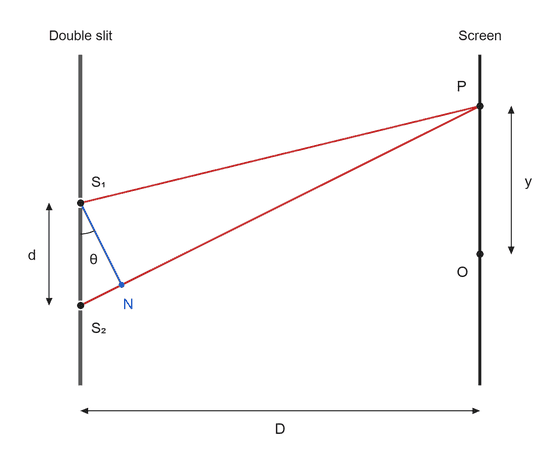
In the right triangle the hypotenuse is .
Step 3 — Replace the angle by distances on the screen.
The angle is very small, so , and is the height of P divided by the distance .
Step 4 — Locate the bright fringes.
The point P is bright when the waves arrive in phase. This happens when the path difference is a whole number of wavelengths.
Here is , and we put .
Step 5 — Locate the dark fringes.
The point P is dark when the path difference is an odd number of half wavelengths.
Here is , and the same steps give the positions of the dark fringes.
Step 6 — Find the fringe width.
The fringe width is the distance between two neighbouring bright fringes (or two neighbouring dark fringes).
For the dark fringes, gives the same value, so bright and dark fringes are equally wide and evenly spaced.
Therefore, the fringe width in Young's double slit experiment is β = λD/d.