
Question 595 marksMedium
(a) Define fringe width or bandwidth.
(b) Derive an expression for the fringe width in double-slit experiment.
(c) Show that the bright fringes and dark fringes are of the same width.
Confirming your payment
Sign up now and get 250 free tokens.
Interference of Light · Question 59 of 73
(a) Define fringe width or bandwidth.
(b) Derive an expression for the fringe width in double-slit experiment.
(c) Show that the bright fringes and dark fringes are of the same width.
Solution:
Concept: In Young's experiment two narrow slits and , a distance apart, act as coherent sources. A point P on a screen at distance is bright when the path difference is and dark when it is .
Step 1 — Part (a): definition. Fringe width (bandwidth) is the distance between the centres of two consecutive bright fringes, or of two consecutive dark fringes.
Step 2 — Part (b): set up the figure. In the figure, and are the two slits, a distance apart, and C is the mid-point between them. O is the point on the screen opposite C, and P is a point at height above O. The screen is at distance from the slits.
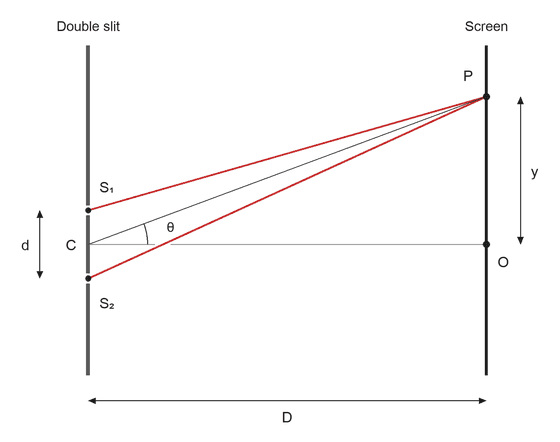
Step 3 — Write the two path lengths. By Pythagoras' theorem, is at height and at depth from the line CO, so
Step 4 — Subtract. Subtracting the second equation from the first, the , and terms cancel:
Step 5 — Factorise. Write the left side as a product:
Step 6 — Use and . In practice is about 1 m while and are a few millimetres, so . The path difference is therefore
Step 7 — Positions of bright fringes. P is bright when :
Step 8 — Fringe width. The distance between the th and th bright fringes is
Step 9 — Part (c): dark fringes. P is dark when :
Step 10 — Part (c): width of a dark fringe. The spacing of neighbouring dark fringes is
Step 11 — Compare. , so a bright fringe and a dark fringe are equally wide; each bright fringe lies midway between two dark fringes.
Therefore, the fringe width is , and bright and dark fringes have the same width.