(a) Derive an expression for the resultant intensity at a point on a screen, due to the interference of light from…
Question 585 marksHard
(a) Derive an expression for the resultant intensity at a point on a screen, due to the interference of light from coherent sources, in double-slit experiment.
(b) Write down the expression for (i) maximum intensity and (ii) minimum intensity.
(c) Explain the variation of intensity with phase difference using a suitable diagram.
Solution:
Concept: By the principle of superposition, the displacements of the two waves at a point add. The intensity is proportional to the square of the resultant amplitude.
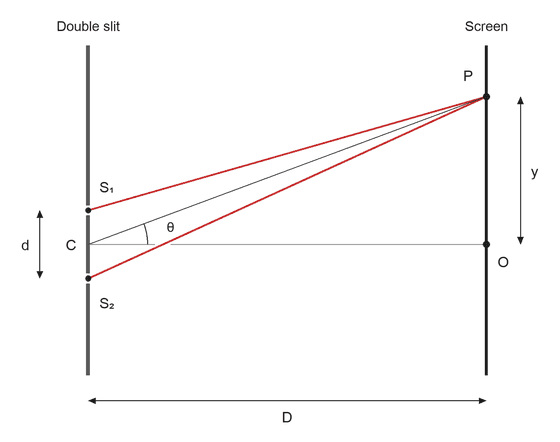
Step 1 — Part (a): the two waves. Let the waves from S1 and S2 reach a point P on the screen (see the figure) with amplitudes a1 and a2 and a phase difference ϕ:
y1=a1sinωty2=a2sin(ωt+ϕ)
Step 2 — Add the displacements. Expand sin(ωt+ϕ) and add:
Step 5 — Resultant intensity. Intensity is proportional to amplitude squared (I1∝a12, I2∝a22), so
I=I1+I2+2I1I2cosϕ
Step 6 — Part (b)(i): maximum intensity.I is maximum when cosϕ equals 1, which happens for phase differences 0,2π,4π,… (path difference nλ):
Imax=I1+I2+2I1I2Imax=(I1+I2)2
Step 7 — Part (b)(ii): minimum intensity.I is minimum when cosϕ equals −1, which happens for phase differences π,3π,… (path difference (2n−1)2λ):
Imin=I1+I2−2I1I2Imin=(I1−I2)2
Step 8 — Part (c): equal intensities. For two equal slits each intensity is I0, and the formula becomes
I=2I0(1+cosϕ)I=4I0cos22ϕ
Step 9 — Part (c): describe the graph. As the phase difference grows from zero, I falls from 4I0 to zero at a phase difference of π, then rises again to 4I0 at 2π, and so on. The average value 2I0 is just the sum of the two separate intensities, so energy is only redistributed:
Therefore, I=I1+I2+2I1I2cosϕ, with Imax=(I1+I2)2 and Imin=(I1−I2)2; for equal slits I=4I0cos22ϕ, varying between 4I0 and zero.