
Question 575 marksMedium
(a) What are coherent sources?
(b) Explain how coherent sources are produced by (i) reflection and (ii) refraction with suitable diagram?
(c) Describe Young's double-slit experiment and explain the formation of fringes.
Confirming your payment
Sign up now and get 250 free tokens.
Interference of Light · Question 57 of 73
(a) What are coherent sources?
(b) Explain how coherent sources are produced by (i) reflection and (ii) refraction with suitable diagram?
(c) Describe Young's double-slit experiment and explain the formation of fringes.
Solution:
Concept: Two sources are coherent when they emit light of the same frequency (wavelength) with a phase difference that stays constant with time.
Step 1 — Part (a): coherent sources. Coherent sources are two sources that emit light waves of the same frequency (and wavelength) with a phase difference that remains constant with time. They are obtained by dividing light from one source into two parts, so that any random phase change of the source reaches both parts together.
Step 2 — Part (b)(i): by reflection, Lloyd's mirror. A narrow slit S is placed close to, and parallel to, a plane mirror (light falls on it at grazing incidence). Part of the light reaches the screen directly from S; another part is reflected by the mirror and seems to come from the virtual image of S. S and act as two coherent sources a distance apart, and fringes are seen in the region where the direct and reflected beams overlap:

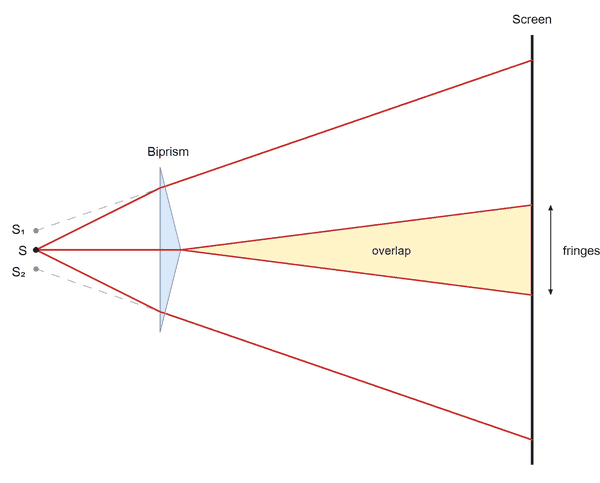
Step 3 — Part (b)(ii): by refraction, Fresnel's biprism. A biprism is two thin prisms joined base to base, with a very obtuse angle (about 179°) at its central ridge, where the two thin prisms meet base to base. Light from a slit S falls on it. The upper half bends its light towards the base (downwards), so that light seems to come from a virtual source ; the lower half bends its light upwards, seeming to come from . and are coherent virtual sources, and fringes appear where the two refracted beams overlap. (The angles in the figure are exaggerated.)
Step 4 — Part (c): apparatus. In Young's experiment, monochromatic light from a lamp falls on a narrow slit S. The light from S falls on two narrow parallel slits and , placed close together and equidistant from S. A screen is placed at a distance (about 1 m) from the slits:
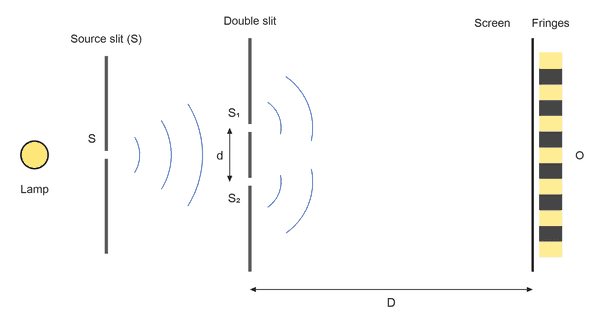
Step 5 — Part (c): why and are coherent. The same wavefront from S reaches and together, so the waves leaving them have the same frequency and a constant phase difference.
Step 6 — Part (c): formation of fringes. The waves from and overlap on the screen. At a point where the path difference is the waves arrive in phase and the point is bright; where it is they arrive in opposite phase and the point is dark. The centre O is equidistant from and , so it is bright. Alternate bright and dark bands, parallel to the slits and equally spaced by , are formed on the screen.
Therefore, coherent sources have a constant phase difference; they are produced by reflection (Lloyd's mirror) or refraction (Fresnel's biprism), and in Young's experiment the coherent slits and give equally spaced bright and dark fringes.