
Opening your dashboard
Class 12 Physics Chapter 20 Interference of Light: Practice Questions
113 questions on Chapter 20, each worked through on its own page with the AI tutor. Class 12 Physics, ICSE 2026-27.
113 questions
1–4 marks · Mixed difficulty
- 11 mark
Question 1
Coherent sources can be obtained from one source either by dividing its wavefront or by dividing its amplitude. In which arrangement are the two coherent beams produced by division of amplitude?
- 23 marks
Question 2
(Hypothetical data.) A laser beam of wavelength is split into two beams. Before the two beams meet again, one of them is delayed by more than the other because it travels a longer path in air. Take the speed of light as .
(i) Find the extra path travelled by the delayed beam.
(ii) Find the phase difference between the two beams where they meet.
(iii) State whether that point is bright or dark.
- 31 mark
Question 3
(Hypothetical data.) Light of wavelength from two coherent sources that are in phase reaches a point P. The path from one source to P is longer than the path from the other source. The phase difference between the two waves at P is
- 43 marks
Question 4
(Hypothetical data.) Two tiny beads and , apart, are lit by one tunable laser beam that reaches both at the same instant. Each bead scatters light in all directions, so they act as coherent point sources that are in phase. A small detector is placed far beyond on the line produced, so the two waves reaching it have nearly equal amplitudes.

(i) Light of wavelength is used. Is the detector at a bright point or a dark point?
(ii) The laser is now tuned through the visible range, from to . Find every wavelength in this range for which the detector is at a dark point.
(iii) Would moving the detector farther along the same line change your answers? Explain.
- 51 mark
Question 5
Two coherent sources and emit light of the same wavelength and equal amplitude, but is always exactly half a cycle (a phase difference of ) behind . P is a point on the perpendicular bisector of .

At P there is
- 63 marks
Question 6
(Hypothetical data.) Light of wavelength from a laser falls on a partly silvered glass plate P. Part of the light is reflected up to a fixed mirror , and part passes through to a movable mirror . Both beams return along their own paths, are recombined at P and fall on a detector. At the start, the detector reads a maximum.

(i) Why do the two returning beams give a steady interference effect at the detector?
(ii) is moved directly away from P. By how much does the path difference between the two beams change?
(iii) How many times does the detector reading pass through a minimum during this movement, and what does it read at the end?
- 73 marks
Question 7
(Hypothetical data.) In a Lloyd's mirror arrangement, a narrow slit S lit by light of wavelength is above the surface of a long, flat plate of black glass. The screen is from S and touches the far end of the plate at O. Light reaches the screen both directly from S and after reflection at the plate. Light reflected at the surface of an optically denser medium, such as glass, undergoes a phase change of .

(i) The reflected light seems to come from a second source S′. Where is S′, and what is the separation of the two coherent sources?
(ii) The direct and reflected paths to O are equal, yet O is found to be dark. Use the phase change on reflection to explain why.
(iii) Find the height of the first bright fringe above O.
- 81 mark
Question 8
Two coherent point sources and , in phase, send out light of wavelength . Consider only points P in a plane that contains and .

The points P for which (the first-order maximum on the side of ) lie on
- 91 mark
Question 9
(Hypothetical data.) In a Young's double-slit experiment, a red laser beam is used with no source slit. The slits are apart and the screen is away. O is the point of the screen opposite the mid-point of the slits. The beam is not quite normal to the slits: it travels slightly upwards, at to the axis.

The central (zero-order) bright fringe is formed
- 103 marks
Question 10
(Hypothetical data.) In Young's experiment, the source slit S and the two slits and are long, narrow slits that are normally set parallel to one another, as in (a). In one set-up, S is in front of the double slit, the screen is beyond it, and the bright fringes are apart. The source slit is long.
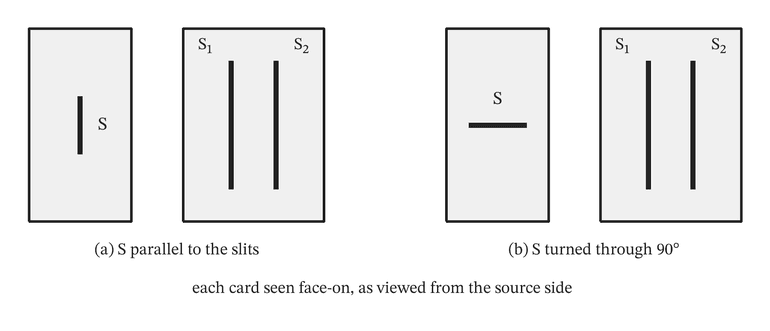
(i) Explain why the length of S does not blur the fringes when S is parallel to and .
(ii) S is now turned through , as in (b), so that its length lies across the slits, in the direction from to . Each point of S forms its own fringe pattern. How far apart on the screen are the central fringes formed by light from the two ends of S?
(iii) Hence explain what is seen on the screen in arrangement (b).
- 112 marks
Question 11
In a school laboratory, Young's experiment done with a sodium lamp needs a narrow single slit placed in front of the double slit. When a laser pointer is used instead, the fringes appear even without the single slit.
(i) Explain why the single slit is needed with the sodium lamp but not with the laser.
(ii) State one safety precaution for students using the laser pointer.
- 122 marks
Question 12
In Young's double-slit experiment with monochromatic light, all the bright fringes look alike, so a student cannot tell which one is the central (zero-order) fringe.
(i) How can white light be used to identify the zero-order fringe?
(ii) Explain why this method works.
- 131 mark
Question 13
(Hypothetical data.) In a Young's double-slit experiment, the slits and are apart and the screen is away. Light of wavelength is used. P is the point on the screen directly opposite , so P is from the centre O.
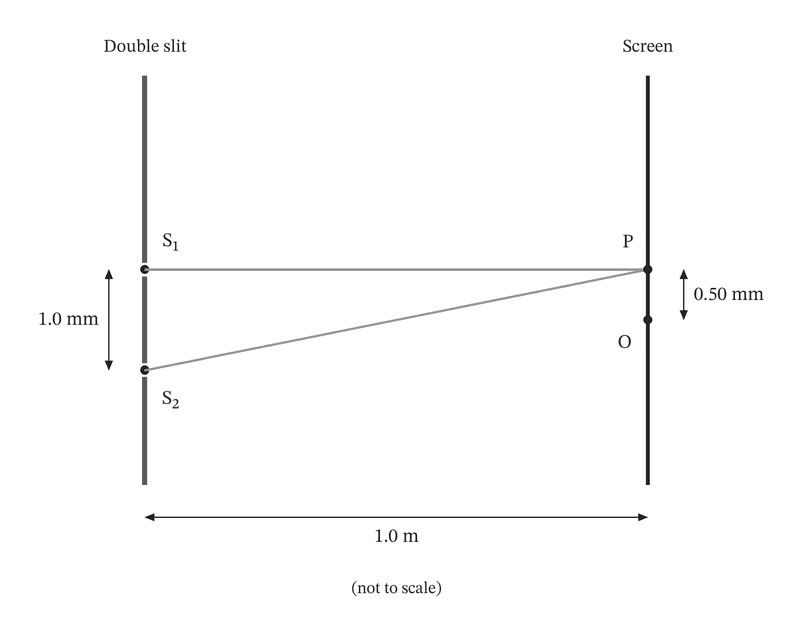
At P there is
- 141 mark
Question 14
Two coherent light waves of amplitudes 7 units and 8 units meet at a point with a phase difference of . The amplitude of the resultant wave is
- 152 marks
Question 15
Two light waves reaching a point are described by and , with displacements in arbitrary units.
(i) Find the amplitude of the resultant wave and its phase angle relative to .
(ii) By what factor is the intensity of the resultant greater than the intensity of alone?
- 161 mark
Question 16
In a Young's double-slit experiment the two slits are identical, and each slit alone gives an intensity near the centre of the screen. With both slits open, the intensity falls from its maximum at the centre. The smallest path difference at which the intensity has fallen to is
- 173 marks
Question 17
(Hypothetical data.) A light sensor is placed on the screen of a double-slit experiment. With only slit A open, the sensor reads 16 units everywhere near the centre; with only slit B open, it reads 1 unit. Both slits are then opened.
Find the sensor reading
(i) at a bright fringe,
(ii) at a dark fringe, and
(iii) at a point where the waves from the two slits differ in phase by .
- 181 mark
Question 18
In a double-slit experiment with identical slits, each slit alone gives an intensity on the screen, so the bright fringes have intensity . The lamp is now made brighter, so that each slit alone gives . Nothing else is changed. Near the centre of the screen,
- 193 marks
Question 19
Slits A and B of a double-slit experiment each give an intensity on the screen when open alone.
(i) With both slits open, sketch a graph of the intensity against the phase difference between the two waves, from to . Mark the maximum and minimum intensities.
(ii) Slit B is now narrowed so that, alone, it gives . Sketch the new graph on a separate set of axes over the same range, marking the maximum and minimum intensities.
(iii) State one feature of the graph that does not change.
- 202 marks
Question 20
In a double-slit experiment, slit A alone gives an intensity on the screen and slit B alone gives .
(i) What is the intensity at a dark fringe when both slits are open?
(ii) Slit B is now covered. What is the intensity at the same point? Comment on the result.
- 213 marks
Question 21
(Hypothetical data.) In a double-slit experiment with identical slits, the slits are apart, the screen is away and light of wavelength is used. The intensity at the centre O of the screen is .
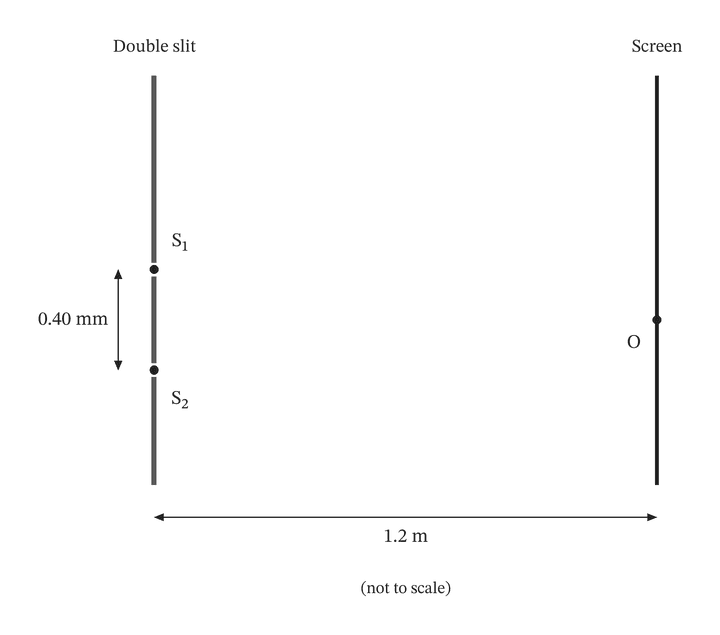
(i) Find the phase difference at the points nearest to O where the intensity has fallen to .
(ii) Find how far these points are from O.
(iii) Hence find the width of the central band within which the intensity is at least .
- 221 mark
Question 22
Two coherent waves of amplitudes and meet at a point with a phase difference of . The intensity there, as a fraction of the maximum intensity that these two waves can produce, is
- 231 mark
Question 23
(Hypothetical data.) A green laser pointer emits light of frequency . Its beam falls on a double slit with slit separation , and the fringes are seen on a wall away. Take . The fringe width on the wall is about
- 243 marks
Question 24
(Hypothetical data.) In a Young's double-slit experiment the slit separation is and the fringes are formed in a plane from the slits. A student views them with a travelling microscope whose readings increase from left to right. She sets the cross-wire on the second dark fringe to the left of the central bright fringe and reads . She then sets it on the third dark fringe to the right of the central bright fringe and reads .

(a) Find the fringe width.
(b) Find the wavelength of the light and suggest what the source is likely to be.
(c) What would the microscope read if the cross-wire were set on the central bright fringe?
- 251 mark
Question 25
In a Young's double-slit experiment, the wavelength and the slit-to-screen distance are kept fixed, and the fringe width is measured for several double slits with different slit separations . Which graph will be a straight line through the origin?
- 264 marks
Question 26
(Hypothetical data.) A student measures the fringe width in a double-slit experiment for different distances between the slits and the screen. The slit separation is .
(m) (mm) (a) Plot a graph of against and draw the best straight line through the origin.
(b) Find the slope of the line and use it to find the wavelength of the light.
(c) Why is the graph method better than working out from one reading?
- 271 mark
Question 27
In a Young's double-slit experiment the fringes are followed far out from the centre of the screen, to large angles . Which statement about the bright fringes there is correct?
- 283 marks
Question 28
(Hypothetical data.) A teacher wants to show Young's fringes to a class using sodium light of wavelength . The fringes must be at least wide to be seen clearly, and the screen can be placed at most from the slits.
(a) What is the largest slit separation she can use?
(b) She uses slits apart with the screen at . Find the fringe width.
(c) Keeping the slits, how close to the slits can the screen be brought before the fringes become narrower than ?
- 291 mark
Question 29
White light (wavelengths to ) is used in a Young's double-slit experiment. On each side of the white central fringe, the bright fringes of order form a coloured band that runs from violet, at , to red, at . Which statement about these coloured bands is correct?
- 301 mark
Question 30
(Hypothetical data.) To find the fringe width accurately, a student measures across a row of consecutive bright fringes, from the centre of the first to the centre of the last, and gets with an uncertainty of . The fringe width, with its uncertainty, is
- 313 marks
Question 31
(Hypothetical data.) The visibility of interference fringes is defined as
A designer wants fringes with a visibility of at least . The two interfering beams have intensities and , with .
(a) Show that .
(b) In one design the stronger beam is twice as intense as the weaker one. Find and say whether the design meets the target.
(c) A filter in one beam makes . Is the visibility good enough? What does this tell you about one of the conditions for good interference?
- 323 marks
Question 32
(Hypothetical data.) The light from a sodium lamp is emitted in short wave trains. Suppose each wave train lasts about , after which the phase changes at random. Take and .
(a) Find the coherence length of this light (the length of one wave train).
(b) About how many wavelengths fit into one wave train?
(c) The beam from this lamp is split into two parts, which are recombined after one part has travelled farther than the other. Will steady fringes be seen? Explain.
- 331 mark
Question 33
In a double-slit experiment with white light, one slit is covered with a red filter and the other with a green filter. What is seen on the screen?
- 342 marks
Question 34
In a Young's double-slit experiment with a sodium lamp, a polaroid sheet is placed over each slit: over and over , as shown.

Describe and explain what is seen on the screen when the transmission axes of and are
(a) parallel to each other;
(b) perpendicular to each other.
- 351 mark
Question 35
One condition for seeing interference fringes clearly is that the screen should be far from the slits, with much larger than the slit separation . The main reason is that a large
- 363 marks
Question 36
(Hypothetical data.) Imagine two ideal, perfectly steady light sources whose frequencies differ by only . They light the two slits of a double-slit arrangement, and at any instant the fringe width on the screen is .
(a) How many times per second does a fixed point on the screen go from bright to dark and back to bright?
(b) How fast does the fringe pattern move across the screen?
(c) Explain why an observer sees no fringes, and name the condition for sustained interference that is broken.
- 371 mark
Question 37
A vertical soap film in a wire loop, seen by reflected white light, shows colours. Just before it bursts, the thinnest part at the top looks black. (Light reflected at the surface of an optically denser medium undergoes a phase change of ; reflection at the surface of a rarer medium causes none. For light falling almost normally on a film of thickness and refractive index , the wave reflected from the lower surface travels an extra path of about .) The best explanation is that
- 383 marks
Question 38
Camera lenses are often coated with a thin layer of magnesium fluoride (refractive index ) to reduce reflection. The lens glass has a refractive index of . The coating is designed for light of wavelength falling almost normally on it. (Light reflected at the surface of an optically denser medium undergoes a phase change of ; reflection at the surface of a rarer medium causes none. For light falling almost normally on a film of thickness and refractive index , the wave reflected from the lower surface travels an extra path of about .)
(a) At which of the two surfaces of the coating is the reflected light given a phase change of ? Explain.
(b) Find the smallest thickness of coating that makes the two reflected waves cancel for .
(c) Coated lenses often look purplish in reflected light. Explain why.
- 393 marks
Question 39
(Hypothetical data.) A soap film of refractive index and uniform thickness is held in air and lit by white light falling almost normally on it. (Light reflected at the surface of an optically denser medium undergoes a phase change of ; reflection at the surface of a rarer medium causes none. For light falling almost normally on a film of thickness and refractive index , the wave reflected from the lower surface travels an extra path of about .) The visible spectrum runs from to .
(a) Which visible wavelength is reflected most strongly? What colour does the film look in reflected light?
(b) Which visible wavelengths are missing from the reflected light?
(c) Will the film look the same colour when seen by the light it transmits? Explain briefly.
- 401 mark
Question 40
A window pane about thick reflects light from both of its surfaces, yet it shows no interference colours in daylight. The main reason is that
- 411 mark
Question 41
A soap film is held in a vertical wire loop. In reflected white light it shows horizontal coloured bands that slowly move downwards as time passes. Which explanation is correct?
- 422 marks
Question 42
(Hypothetical data.) A very thin film of oil (refractive index ), much thinner than the wavelength of light, is spread (a) on water (refractive index ) and (b) on a glass plate (refractive index ). (Light reflected at the surface of an optically denser medium undergoes a phase change of ; reflection at the surface of a rarer medium causes none. For light falling almost normally on a film of thickness and refractive index , the wave reflected from the lower surface travels an extra path of about .) In each case, will the thinnest part of the oil film look dark or bright in reflected white light? Explain.
- 432 marks
Question 43
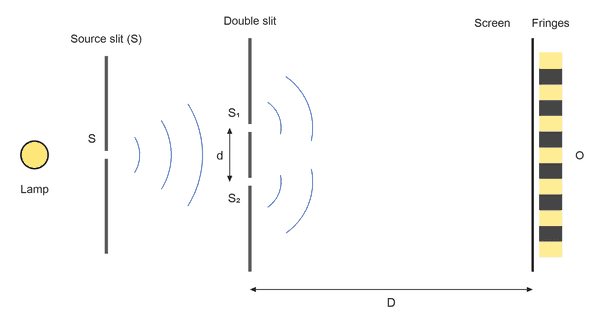
What is the effect on the interference fringes in Young's double-slit experiment when (i) the screen is moved away from the plane of the slits and
(ii) the monochromatic source is replaced by another source of shorter wavelength and keeping other variables constant?
- 442 marks
Question 44
What is the effect on the interference fringes in Young's double-slit experiment when (i) the width of the two slits is increased,
(ii) the monochromatic source is replaced by a source of white light and
(iii) the separation between the two slits is increased, keeping other variables constant in each case?
- 451 mark
Question 45
Give the shape of interference fringes observed in Young's double-slit experiment.
- 462 marks
Question 46
Can interference fringes be produced by two separate lighted candles or electric bulbs? Explain.
- 472 marks
Question 47
Does the phenomenon of interference obey the law of conservation of energy?
- 482 marks
Question 48
How will you increase the fringe width?
- 492 marks
Question 49
Is there any difference between the colours produced by a prism and that produced in a soap film, seen in sunlight?
- 502 marks
Question 50
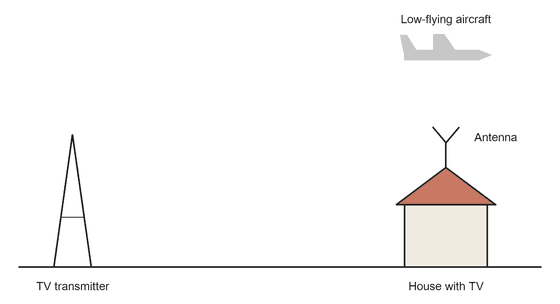
When a low-flying aircraft passes over head, we sometimes notice a slight shaking of the pictures on our TV screen. Suggest a possible explanation.
- 511 mark
Question 51
Young's double-slit experiment is performed in water. What will happen to the interference pattern?
- 523 marks
Question 52
If the two slits in Young's double-slit experiment have width ratio 4 : 1. Deduce the ratio of intensity at maxima and minima in the interference pattern.
- 533 marks
Question 53
Find the ratio of intensities at two points and on a screen in Young's double-slit experiment where waves from and have path difference of and respectively.

- 543 marks
Question 54
In Young's double-slit experiment, the fringe width obtained is 0.6 cm when light of wavelength 4000 Å is used. If the distance between the screen and the slit is reduced to half, what should be the wavelength of light used to obtain the fringes 0.5 cm wide?
- 553 marks
Question 55
In Young's double-slit experiment, the two slits are 0.5 mm apart. The screen is placed 1 m away from the slits. The distance of the 11th fringe from the first fringe is 1.0 cm. Calculate the wavelength of the light used.

- 563 marks
Question 56
In Young's double-slit experiment, the angular width of a fringe formed on distant screen is 0.1° with light of wavelength of 6000 Å. Find the spacing between the slits.
- 573 marks
Question 57
In an interference pattern with two coherent sources, the amplitude of intensity variation is found to be 5% of the average intensity. Deduce the relative intensities of the interfering sources.
- 583 marks
Question 58
For sodium yellow of wavelength 589.3 nm, we get 20th order maximum in a certain region of interference. What will be the order of interference at the same place for (i) mercury 5461 Å and (ii) cadmium 6438 Å?
- 593 marks
Question 59
In Young's double-slit experiment the two slits have a width ratio 1 : 3. Find the ratio of intensity at maximum and minimum in the interference pattern.
- 603 marks
Question 60
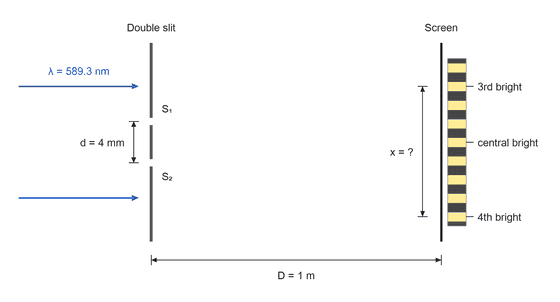
In Young's double-slit experiment, the slits are separated by 4 mm and the screen is kept at a distance of 1 m from the slits. Interference fringes are observed using light of wavelength 589.3 nm. Find the distance between 3rd bright fringe on one side and 4th bright fringe on the other side of the central fringe.
- 613 marks
Question 61
The angular width of the interference fringes in a double-slit experiment using light of wavelength 5500 Å is 0.15°. Find the wavelength for which the width is 5% greater.
- 623 marks
Question 62
Calculate the maximum intensity in the case of interference of identical waves each of intensity if the interference is (i) coherent and (ii) incoherent.
- 632 marks
Question 63
Laser light of wavelength 630 nm incident on a pair of slit produces an interference pattern in which the bright fringes are separated by 8.3 mm. A second light produced an interference pattern in which the bright fringes are separated by 7.6 mm. Find the wavelength of the second light.
- 641 mark
Question 64
What are coherent sources?
- 653 marks
Question 65
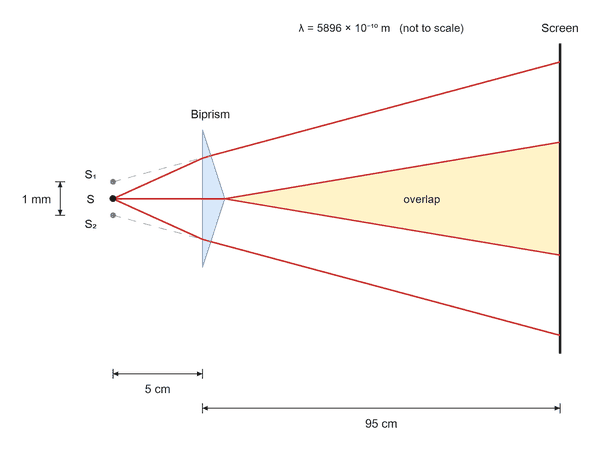
State the most essential condition for observing the interference of light. A narrow slit illuminated by a monochromatic source of wavelength m is placed at a distance of 5 cm from a biprism. The virtual images formed by the biprism are 1 mm apart. Find the fringe width on a screen placed 95 cm in front of the biprism.
- 662 marks
Question 66
What are the necessary conditions for sustained interference?
- 671 mark
Question 67
Define the term coherence for light waves.
- 682 marks
Question 68
Can two monochromatic sources of light be coherent? Give a brief reason.
- 692 marks
Question 69
A two-slit interference experiment is performed with a monochromatic red light and fringe width measured. How is the fringe width affected when the source is replaced by monochromatic blue?
- 702 marks
Question 70
In Young's double-slit experiment, if white light is used in place of monochromatic light, what are observed in the interference pattern?
- 712 marks
Question 71
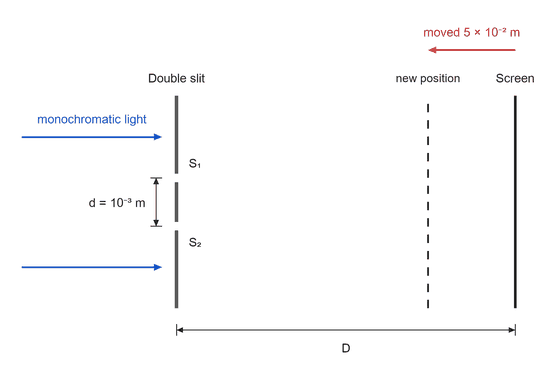
In Young's double-slit experiment using monochromatic light, fringes are obtained on a screen at a distance D from the slits. If the screen is moved m towards the slits, the change in fringe width is m. If the separation between the slits is m, calculate the wavelength of the light used.
- 722 marks
Question 72
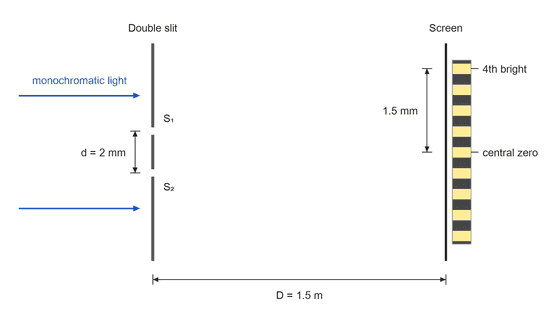
In Young's double-slit experiment, the distance of the 4th bright fringe from the central zero is 1.5 mm. The distance between the slits and the screen is 1.5 m and the distance between the slits is 2 mm. Find the wavelength of light used.
- 732 marks
Question 73
In Young's double-slit experiment, what is meant by fringe width or fringe separation? State two ways to increase the fringe width without changing the source of light.
- 741 mark
Question 74
State one condition for obtaining a sustained interference of light.
- 752 marks
Question 75
In Young's double-slit experiment using monochromatic light of wavelength 700 nm, 10th bright fringe was obtained at a certain point on a screen. Which bright fringe will be obtained at the same point if monochromatic light of wavelength 500 nm is used in place of ?

- 762 marks
Question 76
How is fringe width of an interference pattern in Young's double-slit experiment affected, if the two slits are brought closer to each other?
- 771 mark
Question 77
Define coherent sources of light.
- 782 marks
Question 78
State the path difference between two waves reaching a point for (i) constructive interference and (ii) destructive interference.
- 791 mark
Question 79
To demonstrate the phenomenon of interference, we require two sources which emit radiation
- 801 mark
Question 80
In a wave, the path difference corresponding to a phase difference of is
- 811 mark
Question 81
Two waves are represented by the equations and . The first wave
- 821 mark
Question 82
If an interference pattern has maximum and minimum intensities in 36 : 1 ratio, then what will be the ratio of amplitudes?
(A) 5 : 7
(B) 7 : 4
(C) 4 : 7
(D) 7 : 5
- 831 mark
Question 83
What is the path difference of destructive interference?
- 841 mark
Question 84
What causes change in the colours of the soap or oil films for the given beam of light?
- 851 mark
Question 85
Interference was observed in interference chamber when air was present, now the chamber is evacuated and if the same light is used, a careful observer will see
- 861 mark
Question 86
Two light sources are said to be coherent if they are obtained from
- 871 mark
Question 87
Two slits in Young's experiment have widths in the ratio 1 : 25. The ratio of intensity at the maximum and minimum in the interference pattern, is
- 881 mark
Question 88
In Young's double-slit experiment, the ratio of intensities of bright and dark bands is 16 which means
- 891 mark
Question 89
In Young's experiment, the distance between the slits is reduced to half and the distance between the slit and screen is doubled, then the fringe width
- 901 mark
Question 90
In a certain double-slit experimental arrangement, interference fringes of width 1.0 mm each are observed when light of wavelength 5000 Å is used. Keeping the set up unaltered, if the source is replaced by another source of wavelength 6000 Å, the fringe width will be
- 911 mark
Question 91
In Young's double-slit experiment with slit separation , a monochromatic light of wavelength is used. The angular separation of the fringes is
- 921 mark
Question 92
In Young's double-slit experiment, the intensity of light at a point on the screen where the path difference is is ( being the wavelength of light used). The intensity at a point where the path difference is , will be
- 931 mark
Question 93
In Young's double-slit experiment, the fringe width is found to be 0.4 mm. If the whole apparatus is immersed in water of refractive index 4/3 without disturbing the geometrical arrangement, the new fringe width will be
- 941 mark
Question 94
A mixture of light, consisting of wavelength 590 nm and an unknown wavelength, illuminates Young's double slit and gives rise to two overlapping interference patterns on the screen. The central maximum of both lights coincide. Further, it is observed that the third bright fringe of known light coincides with the 4th bright fringe of the unknown light. From this data, the wavelength of the unknown light is
- 951 mark
Question 95
In Young's double-slit experiment, one of the slit is wider than other, so that amplitude of the light from one slit is double of that from other slit. If be the maximum intensity, the resultant intensity when they interfere at phase difference is given by
- 961 mark
Question 96
In Young's double-slit experiment, the separation between the slits is 2 mm, the wavelength of the light used is 5896 Å and distance between the screen and slits is 100 cm. It is found that the angular width of the fringes is 0.20°. To increases the fringe angular width to 0.21° (with same and ) the separation between the slits need to be changed to
- 971 mark
Question 97
In Young's double-slit experiment with slit separation 0.1 mm, one observes a bright fringe at angle 1/40 radian by using light of wavelength . When the light of wavelength is used, a bright fringe is seen at the same angle in the same set up. Given that and are in visible range (380 nm to 740 nm), their values are
- 981 mark
Question 98
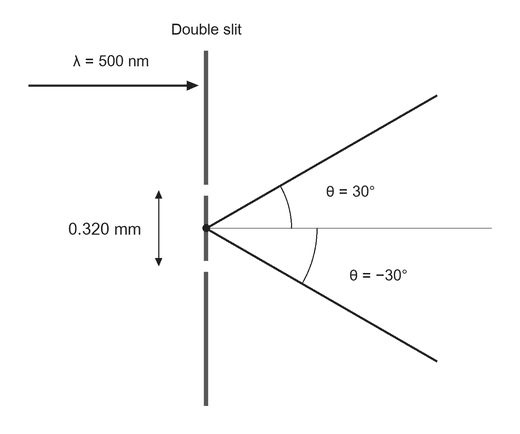
In Young's double-slit experiment, the slits are placed 0.320 mm apart. Light of wavelength nm is incident on the slits. The total number of bright fringes that are observed in the angular range is
- 991 mark
Question 99
In an interference experiment, the ratio of amplitudes of coherent waves is . The ratio of maximum and minimum intensities of fringes will be
- 1001 mark
Question 100
In Young's double-slit experiment, the path difference, at a certain point on the screen between two interfering waves is th of wavelength. The ratio of the intensity at this point to that at the centre of a bright fringe is close to
- 1011 mark
Question 101
In Young's double-slit experiment, the ratio of the slits width is 4 : 1. The ratio of the intensity of maxima to minima, close to the central fringe on the screen, will be
- 1021 mark
Question 102
In Young's double-slit experiment, when light of wavelength 400 nm was used, the angular width of the first minima formed on a screen placed 1 m away, was found to be 0.2°. What will be the angular width of the first minima, if the entire experimental apparatus is immersed in water? ()
- 1031 mark
Question 103
Two coherent sources produces waves of different intensities which interfere. After interference, the ratio of the maximum intensity to the minimum intensity is 16. The intensity of the waves are in the ratio
- 1041 mark
Question 104
In Young's double-slit experiment, light of 500 nm is used to produce an interference pattern. When the distance between the slits is 0.05 mm, the angular width (in degree) of the fringes formed on the distant screen is close to
- 1051 mark
Question 105
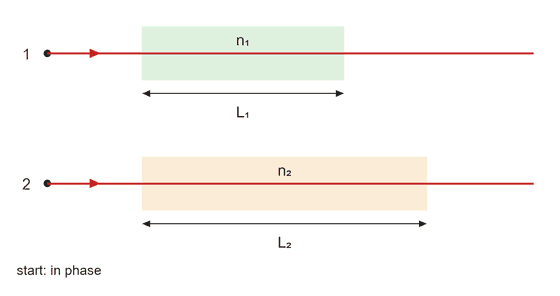
Two light waves having the same wavelength in vacuum are in phase initially. Then the first wave travels a path through a medium of refractive index while the second wave travels a path of length through a medium of refractive index . After this, the phase difference between the two waves is
- 1061 mark
Question 106
Interference fringes are observed on a screen by illumination two thin slits 1 mm apart with a light source ( nm). The distance between the screen and the slits is 100 cm. If a bright fringe is observed on a screen at a distance of 1.27 mm from the central bright fringe, then the path difference between the waves, which are reaching this point from the slits is close to

- 1071 mark
Question 107
In Young's double-slit experiment, 16 fringes are observed in a certain segment of the screen when light of a wavelength 700 nm is used. If the wavelength of light is changed to 400 nm, the number of fringes observed in the same segment of the screen would be
- 1081 mark
Question 108
In Young's double-slit experiment, if the separation between coherent sources is halved and the distance of the screen from the coherent sources is doubled then the fringe width becomes
- 1091 mark
Question 109
In Young's double-slit experiment, two slits are separated by 2 mm and the screen is placed one metre away. When a light of wavelength 500 nm is used, the fringe separation will be
- 1101 mark
Question 110
If the source of light used in Young's double-slit experiment is changed from red to violet
- 1111 mark
Question 111
In Young's double-slit arrangement, the slits are separated by a gap of 0.5 mm and the screen is placed at a distance of 0.5 m from them. The distance between the first and third bright fringe formed when the slits are illuminated by a monochromatic light of 5890 Å is
- 1121 mark
Question 112
The light waves from two coherent sources have same intensity . In interference pattern the intensity of light at minima is zero. What will be the intensity of light at maxima?
- 1131 mark
Question 113
In Young's double-slit experiment, if the source of light changes from orange to blue then