
Question 103 marksMedium
(Hypothetical data.) In Young's experiment, the source slit S and the two slits and are long, narrow slits that are normally set parallel to one another, as in (a). In one set-up, S is in front of the double slit, the screen is beyond it, and the bright fringes are apart. The source slit is long.
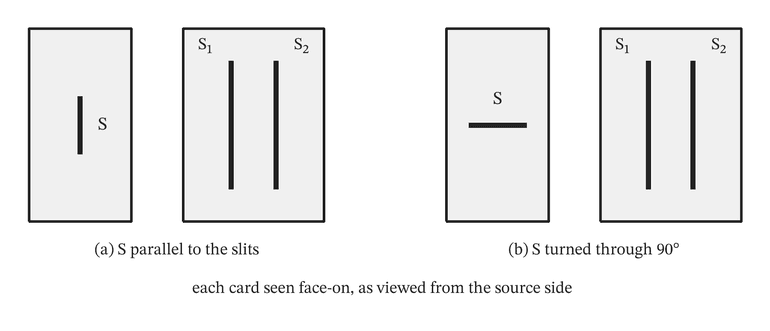
(i) Explain why the length of S does not blur the fringes when S is parallel to and .
(ii) S is now turned through , as in (b), so that its length lies across the slits, in the direction from to . Each point of S forms its own fringe pattern. How far apart on the screen are the central fringes formed by light from the two ends of S?
(iii) Hence explain what is seen on the screen in arrangement (b).