
Opening your dashboard
Class 12 Physics Chapter 20 Interference of Light: Competency-Based Questions (CBQ)
43 questions on Chapter 20, each worked through on its own page with the AI tutor. Class 12 Physics, ICSE 2026-27.
43 questions
1–5 marks · Mixed difficulty
- 13 marks
Question 1
Competency: Application
In a laboratory interferometer, light from a helium–neon laser () is split by a partly silvered glass plate P into two beams. One beam goes to mirror . The other passes through a gas cell, closed by flat glass windows, of internal length to mirror , and comes back through the cell. The two returning beams recombine at P and fall on a detector. The cell is first full of air at room temperature and pressure. As the air is slowly pumped out until the cell is empty, the detector reading goes through complete cycles of bright and dark: fringes pass the detector. (Hypothetical data.)

(a) Write the optical path of the light inside the cell (there and back) when the cell holds air of refractive index , and when it is empty.
(b) Explain why fringes pass the detector while the air is pumped out, and find the refractive index of the air.
(c) Predict how many fringes would pass if the experiment were repeated with a green laser of wavelength . Take the refractive index of air to be the same for both wavelengths.
- 21 mark
Question 2
Competency: Application
At an open-air concert, two loudspeakers driven by the same amplifier play the same steady note. A listener's seat is from one speaker and from the other. Take the speed of sound as and ignore reflections. (Hypothetical data.)
Which of these notes will sound quietest at the seat?
- 31 mark
Question 3
Competency: Analysis & Evaluation
A hologram is recorded by letting light scattered from an object (the object beam) interfere with a second, clean beam (the reference beam) on a photographic plate.
Assertion (A): To record a hologram, the object beam and the reference beam are both taken from the same laser, by splitting its beam.
Reason (R): Laser light is highly directional, so a laser beam spreads out very little.
- 41 mark
Question 4
Competency: Analysis & Evaluation
In an interferometer, a laser beam is split into two beams, each beam is reflected back by a mirror, and the beams are recombined to give fringes on a screen.
Assertion (A): The fringe pattern shifts only when one of the mirrors is moved through at least one whole wavelength.
Reason (R): Moving one mirror through a distance along its beam changes the path difference between the two beams by .
- 51 mark
Question 5
Competency: Analysis & Evaluation
Noise-cancelling headphones pick up outside noise with a small microphone and play an "anti-noise" sound wave into the ear.
Assertion (A): Noise-cancelling headphones can greatly reduce the steady hum of an aircraft engine heard by the wearer.
Reason (R): Sound waves need a material medium, such as air, to travel.
- 63 marks
Question 6
Competency: Application
A ripple tank shows a water-wave version of Young's experiment. Two dippers and , apart, are fixed to one vibrating bar, which moves them up and down together at . The ripples travel at . A small cork floats at the point P, which is from and from . (Hypothetical data.)
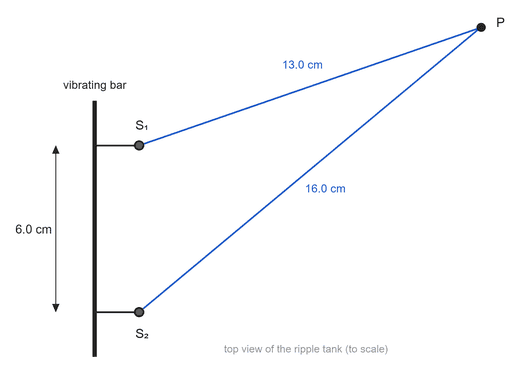
(a) Find the wavelength of the ripples.
(b) Does the cork bob up and down strongly, or does it stay almost still? Explain.
(c) The frequency is raised to , and the ripples are now measured to be long. What does the cork do now?
- 73 marks
Question 7
Competency: Analysis & Evaluation
A student sets up Young's experiment with a lamp, a single source slit S and a double slit whose slits are apart. The source slit is in front of the double slit. She measures the distance from the source slit to the screen as and uses it as . The fringe width she measures is . (Hypothetical data.)
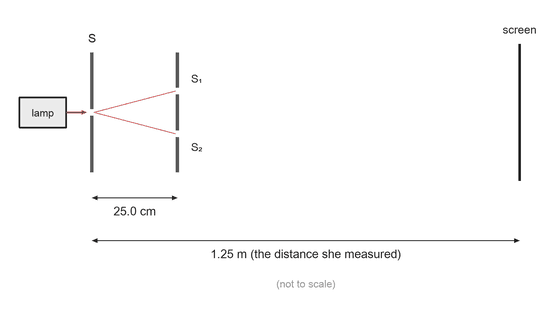
(a) Find the wavelength she obtains.
(b) Which distance should she have used as ? Find the correct wavelength.
(c) Find the percentage error in her result, and suggest which lamp she probably used.
- 81 mark
Question 8
Competency: Analysis & Evaluation
In a classroom demonstration, a red laser beam is widened by a beam expander (a pair of lenses) into a parallel beam about across, which falls normally on a slide carrying a double slit (slits apart). Fringes appear on a wall away, with the central bright fringe at O. The slide is then moved upwards in its own plane, and both slits stay inside the beam. (Hypothetical data.)
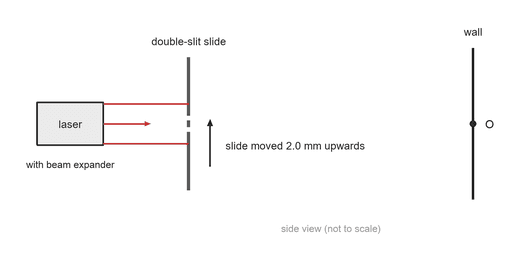
What happens to the fringe pattern on the wall?
- 93 marks
Question 9
Competency: Analysis & Evaluation
Noise-cancelling headphones use a microphone to pick up outside noise, and a small speaker to make an "anti-noise" sound wave of the same frequency that is meant to be exactly half a cycle out of step with the noise at the ear. For two coherent waves of intensities and meeting with a phase difference , the resultant intensity is . (Hypothetical data.)
(a) One headphone makes the anti-noise exactly out of phase () with a steady hum, but with only times the hum's amplitude. What fraction of the hum's intensity is left?
(b) Another headphone matches the amplitude exactly, but its electronics make the anti-noise late. For a hum of frequency , find the phase error this delay causes and the fraction of the hum's intensity that is left.
(c) With the same delay, find the fraction left for a whine of frequency , and comment on the result.
- 103 marks
Question 10
Competency: Analysis & Evaluation
In an optics laboratory, two coherent laser beams of wavelength overlap on a screen and form fringes. A small light sensor (photodiode) is moved slowly across the fringes. Its reading rises to a largest value of and falls to a smallest value of . (Hypothetical data.)
(a) Find the reading the sensor would give with each beam alone.
(b) At a point Q the reading is . Find the smallest possible phase difference, and the corresponding path difference, between the two beams at Q.
(c) The stronger beam is now weakened with a filter until, on its own, it gives the same reading as the weaker beam. Find the new largest and smallest readings, and state how the fringes change.
- 111 mark
Question 11
Competency: Application
In interference lithography, two coherent laser beams overlap on a layer of light-sensitive resist and form straight, equally spaced fringes. On its own, one beam would give an intensity on the resist and the other . The resist is changed only where the intensity is at least ; these strips later become the lines of a fine grating. (Hypothetical data.)
What fraction of each fringe spacing is changed (exposed)?
- 121 mark
Question 12
Competency: Analysis & Evaluation
In Young's experiment with two identical slits, the light from the two slits reaches the screen with equal amplitudes. One slit is then widened so that the amplitude of its light at the screen becomes three times as large, while nothing else changes. (Ignore any other effect of widening the slit.)
Assertion (A): The intensity at a bright fringe becomes three times as large.
Reason (R): The intensity of a wave is proportional to the square of its amplitude.
- 131 mark
Question 13
Competency: Analysis & Evaluation
A double-slit pattern is formed by two identical slits.
Assertion (A): At a point midway between the centre of a bright fringe and the centre of the next dark fringe, the intensity is half the maximum intensity.
Reason (R): The intensity falls linearly with distance from the centre of a bright fringe to the centre of the next dark fringe.
- 143 marks
Question 14
Competency: Application
A teacher shines a red laser pointer () through a double slit with slit separation . The central bright fringe falls at a point C on a classroom wall, from the slits measured along the beam. The wall is not perpendicular to the beam: it makes an angle of with it, as shown in the top view. (Hypothetical data.)
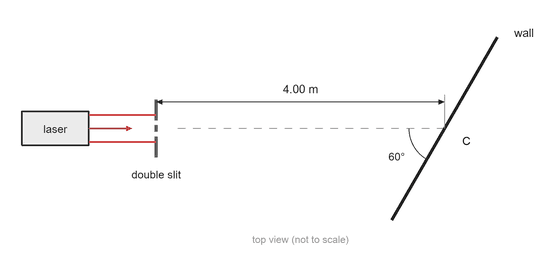
(a) Find the fringe width that would be seen on a screen placed at C perpendicular to the beam.
(b) Find the spacing of the bright fringes measured along the wall near C.
(c) A student measures from C to the tenth bright fringe on the side where the wall is farther from the slits, and from C to the tenth bright fringe on the nearer side. Explain why the two distances differ, and show that their average spacing agrees with (b).
- 153 marks
Question 15
Competency: Application
Radio telescopes such as the Giant Metrewave Radio Telescope near Pune combine the signals of dishes that are kilometres apart, so that a pair of dishes acts like the two slits of Young's experiment. Two dishes, apart on an east–west line, receive radio waves of wavelength from a distant source at an angle from the vertical. The combined signal is strong whenever the extra path to one dish is a whole number of wavelengths. As the Earth turns, the angle of the source changes at about per hour. (Hypothetical data.)
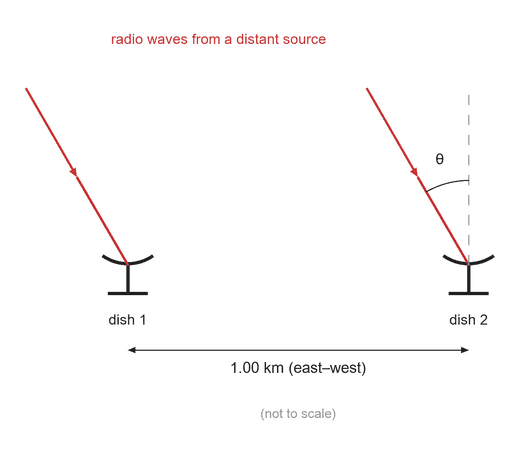
(a) Find the angle, in degrees, between neighbouring directions of strong signal when the source is near the vertical.
(b) How long does the combined signal take to go from one maximum to the next when the source is near the vertical?
(c) How long would this take if the dishes received radio waves of wavelength instead?
- 161 mark
Question 16
Competency: Application
A student uses a green laser pointer () and a double slit with slit separation to estimate how far away a wall is. On the wall she finds that a stretch of contains bright fringes, with a bright fringe centred at each end of the stretch. (Hypothetical data.)
The distance from the slits to the wall is about
- 171 mark
Question 17
Competency: Analysis & Evaluation
Radio astronomers combine the signals of two dishes a distance apart, so that the pair works like the two slits of Young's experiment, with the wavelength of the radio waves in place of that of light.
Assertion (A): Placing the two dishes farther apart lets the pair pick out finer detail in the sky, that is, sources separated by smaller angles.
Reason (R): The angular spacing of the fringes, , becomes smaller as the separation of the dishes increases.
- 183 marks
Question 18
Competency: Application
A Wi-Fi router sends out radio waves of frequency . A large metal cabinet across the room reflects the waves straight back towards the router. A student moves a laptop slowly along the line between the router and the cabinet, and finds that the signal passes through a series of weak spots a few centimetres apart. Take . (Hypothetical data.)
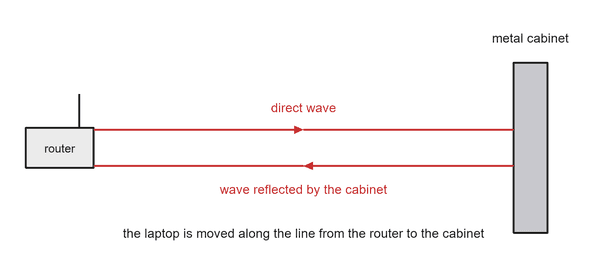
(a) Find the wavelength of the radio waves.
(b) Explain why the weak spots appear, and find the distance between neighbouring weak spots.
(c) A second router nearby uses a different Wi-Fi channel, so its frequency is slightly different. Explain why its waves and those of the first router do not produce fixed weak spots of this kind.
- 191 mark
Question 19
Competency: Application
Holograms are recorded on heavy tables that damp out vibrations. In one set-up the laser light () reflects at normal incidence from a small mirror on its way to the photographic plate. Assume that the recorded fringes are lost if the path difference between the two interfering beams changes by half a wavelength or more during the exposure. (Hypothetical data.)
The largest movement of the mirror along the beam that can be allowed during the exposure is about
- 201 mark
Question 20
Competency: Analysis & Evaluation
Two sources of light of the same frequency illuminate a screen, but the phase difference between them changes at random many millions of times every second.
Assertion (A): No interference fringes are seen on the screen.
Reason (R): The eye or a detector records only the intensity averaged over time, and this average is at every point.
- 214 marks
Question 21
Competency: Analysis & Evaluation
Silicon solar cells are coated with a thin transparent layer of silicon nitride (refractive index about ) to reduce the light they reflect. Silicon itself has a refractive index of about . Sunlight falls almost normally on the cell. A design team wants the reflection to be least for , near the middle of the visible spectrum, and compares two coatings: one thick and one thick. (Hypothetical data.)
(a) Explain why the light reflected at the top of the coating and the light reflected at the silicon surface both undergo a phase change of .
(b) Show that both coatings make the two reflected waves cancel for .
(c) For blue light of wavelength , find the phase difference between the two reflected waves for each coating.
(d) Which coating is better for sunlight, which spreads over a wide range of wavelengths? Give a reason.
- 223 marks
Question 22
Competency: Application
After rain, a thin film of oil (refractive index ) floats on a puddle of water (refractive index ) on a road. At one patch the oil is thick. White light from the sky falls on it, and light reflected from the top and the bottom of the film reaches an observer's eye. Strong reflection of a wavelength (in air) happens when
where and are the refractive index and thickness of the oil and is the angle of refraction inside the oil. (Hypothetical data.)
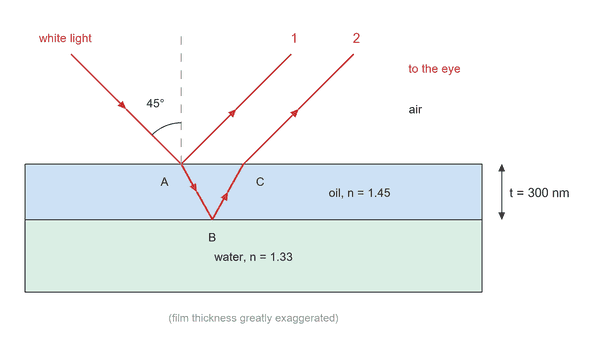
(a) Which visible wavelength ( to ) is reflected most strongly when the patch is seen from directly above?
(b) Which visible wavelength is reflected most strongly when the patch is seen at to the normal, as in the figure?
(c) A cyclist riding past sees the colour of the patch change. Which way does the colour shift as the viewing angle becomes larger? Explain.
- 231 mark
Question 23
Competency: Application
The shiny colours of some beetles come from thin transparent layers in their wing cases. Model one layer as a film of chitin (refractive index ), thick, with air on both sides, lit almost normally by white light. (Hypothetical data.)
The longest wavelength that this layer reflects strongly is
- 241 mark
Question 24
Competency: Application
In a factory, a transparent coating of titanium dioxide (refractive index about ) is deposited slowly on glass (refractive index ). A laser beam () falls normally on the growing coating, and the reflected intensity is recorded. As the coating thickens, the reflected intensity rises and falls again and again. (Hypothetical data.)
By how much does the thickness of the coating grow between two successive maxima of the reflected intensity?
- 251 mark
Question 25
Competency: Analysis & Evaluation
Spectacle lenses are often given an anti-reflection coating, so that the two waves reflected from the top and bottom of the coating cancel.
Assertion (A): A lens with an anti-reflection coating transmits more light than the same lens without the coating.
Reason (R): When the reflected waves cancel by destructive interference, their energy is destroyed.
- 263 marks
Question 26
(Hypothetical data.) In a Young's double-slit experiment, the narrow source slit S is in front of the double slit, whose slits and are apart. The screen is beyond the double slit, and O is the point of the screen on the axis (the line through the mid-point of , perpendicular to the slits). By mistake, S is fixed above the axis, on the side of .
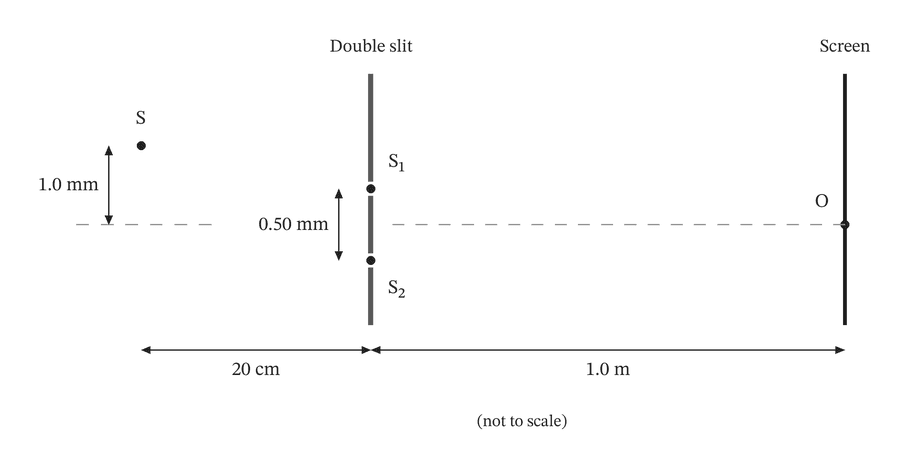
(i) Find the path difference .
(ii) Find where the central (zero-order) bright fringe is formed on the screen.
(iii) Does the spacing of the fringes change? Give a reason.
- 273 marks
Question 27
(Hypothetical data.) In a Young's double-slit experiment, the slits and are apart and the screen is away. P is a point on the screen from the centre O, on the side of .
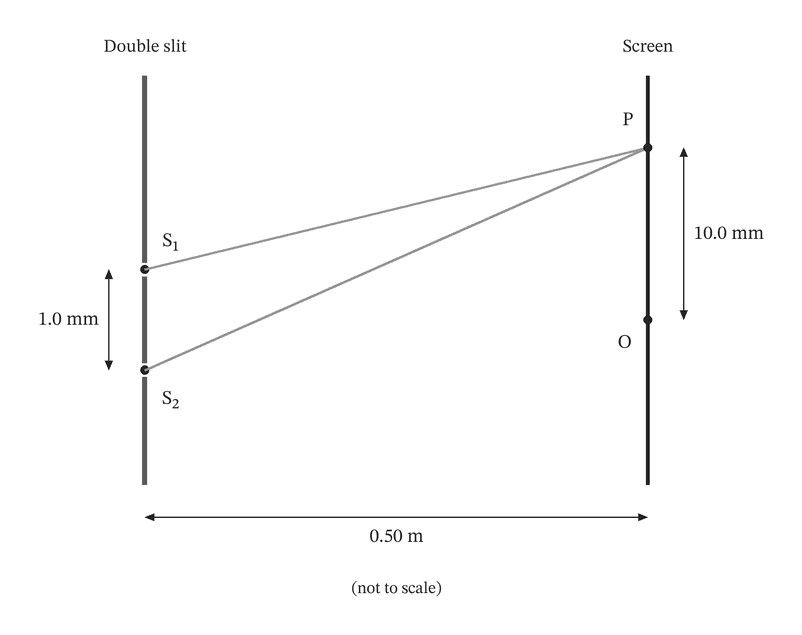
(i) Using Pythagoras' theorem, find the exact path difference .
(ii) Find the path difference given by the approximate formula .
(iii) By what percentage does the approximate value differ from the exact one? What does this show?
- 284 marks
Question 28
(Hypothetical data.) In a Young's double-slit experiment with slits apart, a small light detector is fixed on the screen from the centre O. Light of wavelength is used. The screen, carrying the detector, is slowly moved from to from the slits.
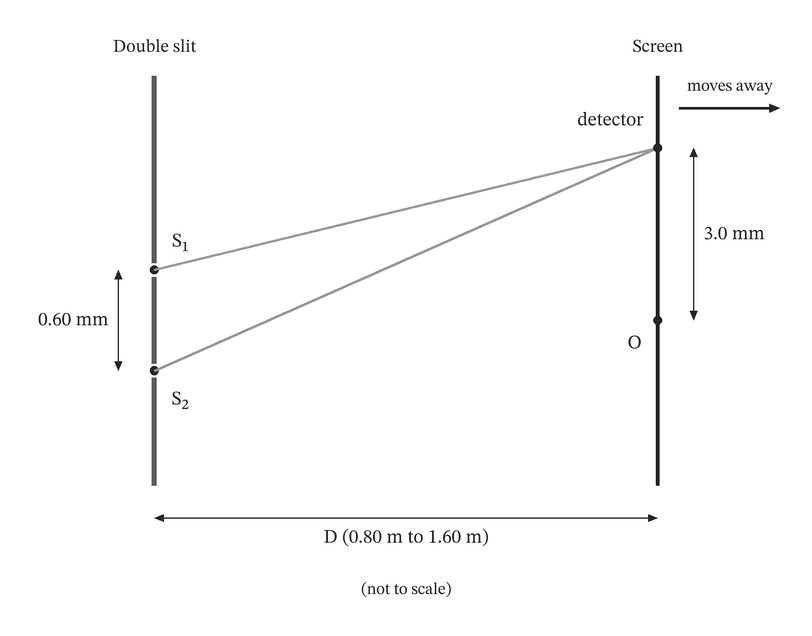
(i) Write the path difference at the detector in terms of .
(ii) At which values of is the detector at the centre of a bright fringe? Name the order of each fringe.
(iii) At which values of is the detector at the centre of a dark fringe? Name each.
(iv) As the screen moves away, do the fringes move towards O or away from O past the detector?
- 294 marks
Question 29
(Hypothetical data.) A school laboratory uses microwaves of wavelength to show interference. The microwaves fall on a metal sheet with two narrow slits apart. A detector is moved along an arc of radius centred on the mid-point M of the slits, and its angle from the central line is measured, as shown.
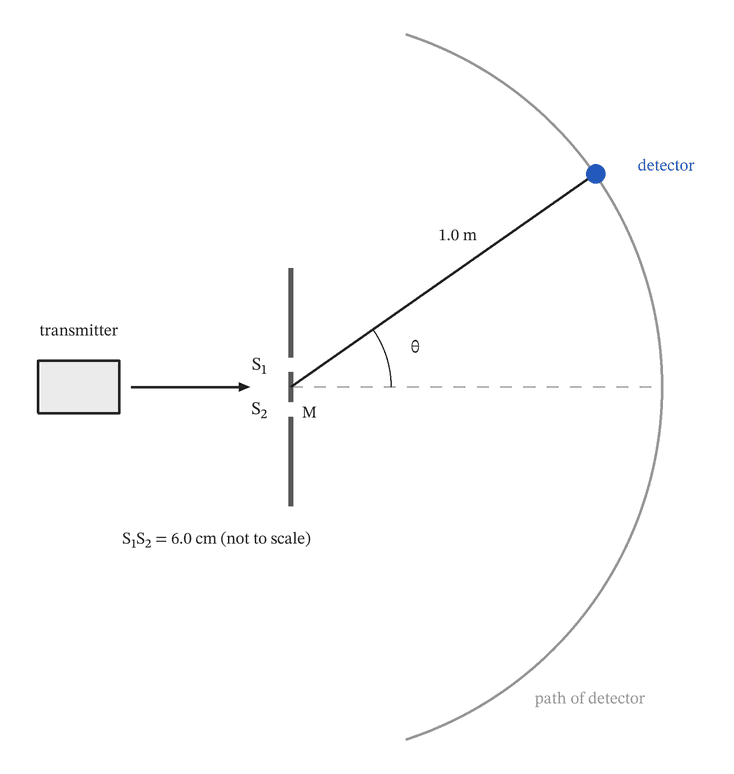
(a) At what angles does the detector find the first-order and second-order maxima?
(b) Explain why the formula cannot be used here to find where the first maximum is.
(c) How many maxima, in all, does the detector find as it moves from one side () to the other ()?
- 303 marks
Question 30
(Hypothetical data.) A double slit is lit by light that has passed through a filter. The filter lets through all wavelengths from to . Take the fringe width to be that of the middle wavelength, , and take the fringes to be washed out at the order where the -th bright fringes of and are half a fringe width apart.
(a) Write the separation of the -th bright fringes of the two extreme wavelengths in terms of , and .
(b) From which order onwards are the fringes washed out?
(c) What does this show about the condition that the light should be monochromatic?
- 313 marks
Question 31
(Hypothetical data.) Sunlight falls directly on a double slit, with no single slit in front. The Sun's disc subtends an angle of about at the Earth. Use the rule of thumb that a source of angular size (in radians) gives clear fringes only if the slit separation satisfies . Take .
(a) Find the largest slit separation that gives clear fringes with direct sunlight.
(b) A pinhole wide is now placed in the sunlight, in front of the double slit, as shown. Find the new largest slit separation.

(c) Will a double slit with show clear fringes in case (a)? In case (b)? Name the condition for sustained interference that this illustrates.
- 324 marks
Question 32
(Hypothetical data.) Two flat glass slides touch along one edge. A strip of aluminium foil thick is placed between them from the line where they touch, so that a thin wedge of air is formed. Sodium light of wavelength falls normally from above, and straight bright and dark bands are seen by reflection. (Light reflected at the surface of an optically denser medium undergoes a phase change of ; reflection at the surface of a rarer medium causes none.) Take the dark bands to lie where the air gap satisfies ().

(a) Explain why the line where the slides touch is dark, although the two reflecting surfaces there are in contact.
(b) Find the distance between neighbouring dark bands.
(c) How many dark bands are seen between the line of contact and the foil, counting the dark line at the contact?
- 334 marks
Question 33
(Hypothetical data.) A thin layer of oil (refractive index ) floats on a puddle of water (refractive index ). Seen almost normally in white light, a certain patch reflects and strongly, with no strong reflection at any wavelength in between. (Light reflected at the surface of an optically denser medium undergoes a phase change of ; reflection at the surface of a rarer medium causes none. For light falling almost normally on a film of thickness and refractive index , the wave reflected from the lower surface travels an extra path of about .)
(a) Explain why strong reflection occurs when , where is the refractive index of the oil, its thickness and
(b) Find for the reflection, and hence the thickness of the oil layer.
(c) Is any other visible wavelength (between and ) reflected strongly by this patch?
- 343 marks
Question 34
In Young's double-slit experiment, the distance between the slits and the screen is 1 m. If the distance between the slits is 5 mm, the fringe width is found to be 0.1 mm. Calculate the wavelength of the light used.

- 353 marks
Question 35
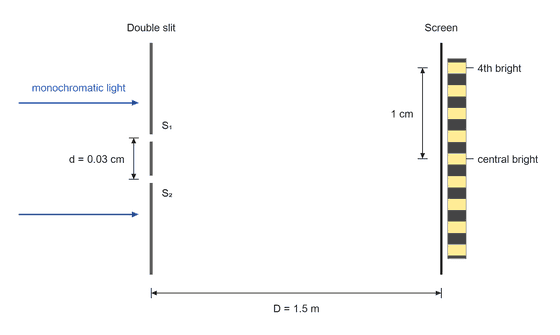
In Young's double-slit experiment, the slits are 0.03 cm and the screen is placed 1.5 m away. The distance between the central bright fringe and the fourth bright fringe is measured to be 1 cm. Determine the wavelength of light used.
- 363 marks
Question 36
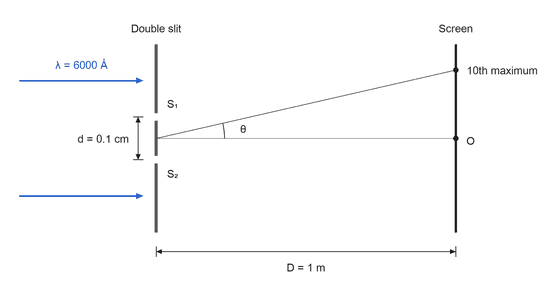
Double slits are illuminated by light of wavelength 6000 Å. The slits are 0.1 cm apart and the screen is placed one metre away. Calculate
(a) the angular position of the 10th maximum in radian and
(b) separation of the two adjacent minima.
- 373 marks
Question 37
In Young's double-slit experiment, the slits are 0.2 mm apart and the screen is 1.5 m away. It is observed that the distance between the central bright fringe and fourth dark fringe is 1.8 cm. Find the wavelength of light used.

- 383 marks
Question 38
The two slits in Young's double-slit experiment are separated by a distance of 0.03 cm. When light of wavelength 5000 Å falls on the slits, an interference pattern is produced on the screen 1.5 m away. Find the distance of the 4th bright fringe from the central maximum.

- 393 marks
Question 39
In Young's double-slit experiment, the intensity of light on the screen, where the path difference is , is . Find the intensity at a point, where the path difference is assuming that the two sources are of equal intensities.
- 403 marks
Question 40
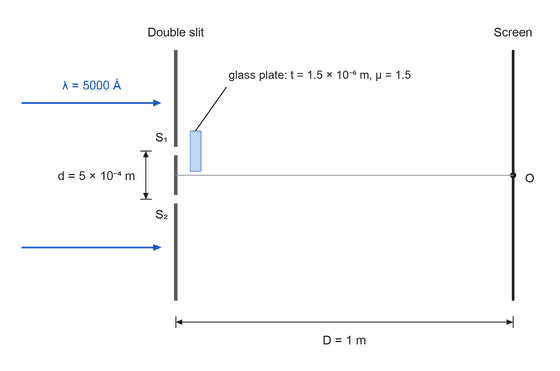
Monochromatic light of Å is incident on two slits separated by a distance of m. The interference pattern is seen on a screen placed at a distance of 1 m from the slits. A thin glass plate of thickness m and refractive index is placed between one of the slits and screen. Find the intensity at the centre of the screen if the intensity there is in the absence of the plate. Also find the lateral shift of the central maximum.
- 415 marks
Question 41
Draw a schematic labelled diagram for the experimental determination of the wavelength of light by Young's interference experiment. Derive the formula used.
- 423 marks
Question 42
Derive an expression for the fringe width in Young's double-slit interference pattern.
- 433 marks
Question 43
The distance between the first and the sixth bright fringes formed in Young's double-slit experiment is found to be 12.5 mm. The separation between the slits is 0.12 mm and the distance of the screen from the slits is 60 cm. Calculate (i) the fringe width and (ii) the wavelength of light used.
