
Question 294 marksHard
(Hypothetical data.) A school laboratory uses microwaves of wavelength to show interference. The microwaves fall on a metal sheet with two narrow slits apart. A detector is moved along an arc of radius centred on the mid-point M of the slits, and its angle from the central line is measured, as shown.
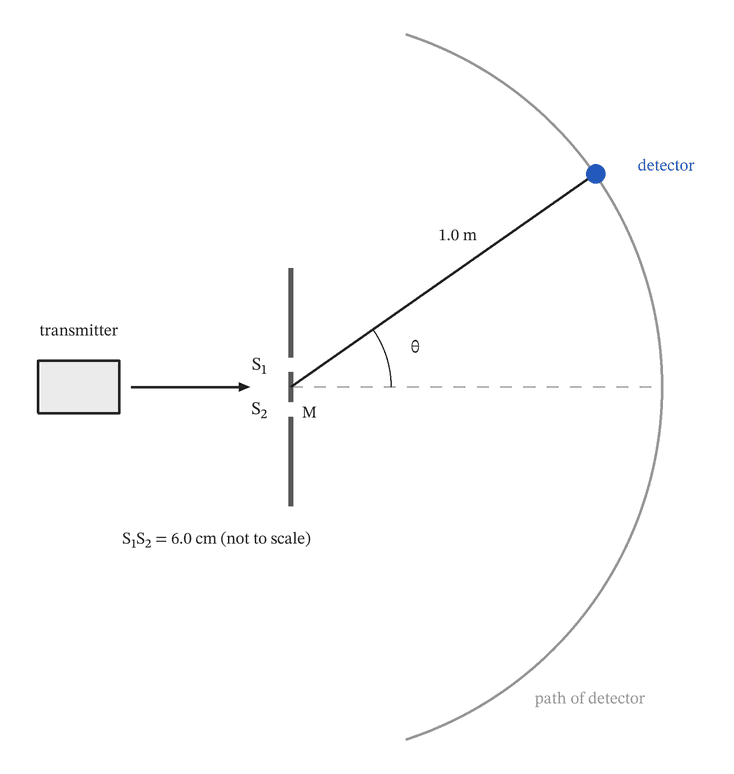
(a) At what angles does the detector find the first-order and second-order maxima?
(b) Explain why the formula cannot be used here to find where the first maximum is.
(c) How many maxima, in all, does the detector find as it moves from one side () to the other ()?