
Competency: Application
Radio telescopes such as the Giant Metrewave Radio Telescope near Pune combine the signals of dishes that are kilometres apart, so that a pair of dishes acts like the two slits of Young's experiment. Two dishes, apart on an east–west line, receive radio waves of wavelength from a distant source at an angle from the vertical. The combined signal is strong whenever the extra path to one dish is a whole number of wavelengths. As the Earth turns, the angle of the source changes at about per hour. (Hypothetical data.)
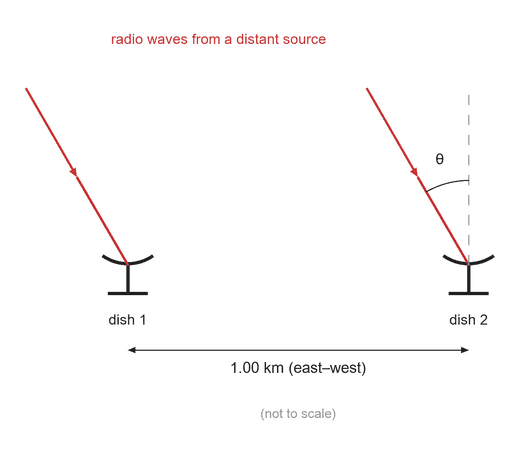
(a) Find the angle, in degrees, between neighbouring directions of strong signal when the source is near the vertical.
(b) How long does the combined signal take to go from one maximum to the next when the source is near the vertical?
(c) How long would this take if the dishes received radio waves of wavelength instead?