Solution:
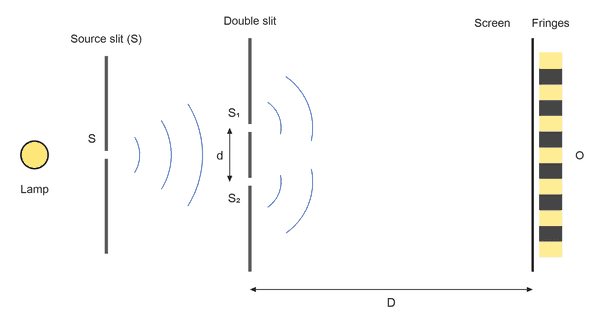
Concept: In Young's double-slit experiment the fringe width (distance between two neighbouring bright or dark fringes) is
β=dλD
where λ is the wavelength of light, D is the distance from the slits to the screen and d is the distance between the two slits.
Step 1 — Part (i): screen moved away. D increases, so β increases and the fringes spread out. The angular width dλ does not change.
Step 2 — Part (ii): smaller wavelength. β is proportional to λ, so β decreases.
Step 3 — Part (iii): white light. The central fringe is white. Each fringe beside it is coloured, blue nearer the centre and red farther away. After a few fringes the colours overlap and no clear fringes are seen.
Step 4 — Part (iv): wider source slit. Different parts of a wide source slit form patterns shifted from one another. As the slit is widened the fringes become less sharp; when its width s and its distance L from the double slit no longer satisfy Ls<dλ, the patterns overlap and no clear fringes are seen.
Step 5 — Part (v): larger slit separation. β is inversely proportional to d, so β decreases.
Step 6 — Part (vi): source slit moved farther away. The fringe width does not depend on this distance, so β is unchanged. The source slit now looks narrower as seen from the double slit (the condition Ls<dλ is satisfied better), so the fringes become sharper, though slightly less bright.
Note: the book's printed answer for (vi) is that no distinct fringe pattern is seen; that happens when the source slit is brought too close to the double slit. Moving it farther away makes the fringes sharper.
Step 7 — Part (vii): slit widths of the order of λ. Each slit then diffracts light through a large angle. The interference fringes are spread over a wide region, and their brightness follows the broad diffraction pattern of each slit.
Therefore, (i) β increases, (ii) β decreases, (iii) a white central fringe with a few coloured fringes is seen, (iv) the fringes blur and finally vanish, (v) β decreases, (vi) β is unchanged and the fringes become sharper, (vii) diffraction from each slit spreads the pattern over a wide region.