Solution:
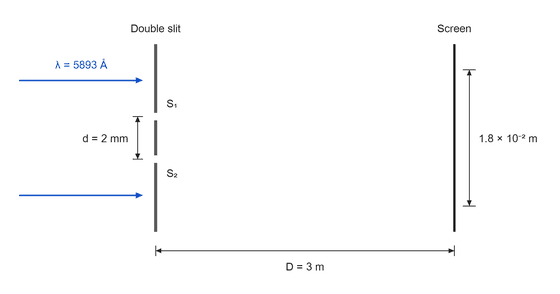
Key idea: The number of fringes in a length L is N=βL, where β=dλD.
Given: Wavelength λ=5.893×10⁻⁷ m (5893 A˚), slit separation d=2×10⁻³ m (2 mm), distance to the screen D=3 m, length of the pattern L=1.8×10⁻² m.
Step 1 — Find the fringe width. Substitute in β=λD/d:
β=2×10−35.893×10−7×3
β≈8.84×10⁻⁴ m
Step 2 — Find the number of fringes. Divide the length of the pattern by the fringe width:
N=8.84×10−41.8×10−2
N≈20.36
Step 3 — Count the fringes. The length holds 20.36 fringe widths: 20 complete fringes and part of another, so the number of fringes is 20.
Therefore, the number of fringes is 20.