
Opening your dashboard
Class 12 Physics Chapter 14: Ray Optics - Reflection of Light by Spherical Mirrors Solutions
49 textbook questions with step-by-step answers, free to read, for ISC 2026-27.
Get talked through Ch 14, not just shown the answer
Reading a finished solution is not the same as being able to do it. The AI tutor takes one question at a time and works it with you, in your own words, until you can.
- Ask it out loud, in your own words
- It gives you the next step, not the answer
- Stuck on part (ii)? Start there
49 questions with solutions
1–5 marks · Mixed difficulty
The first 20 solutions are on this page. This chapter is a long one, so the rest open on their own page to keep this one quick to load.
- 11 mark
Question 1
When a plane mirror reflects a beam of light, a real image is obtained. Then the incident beam is
Solve with AIAnswer
(A) parallel
(B) divergent
- Correct
(C) convergent
(D) convergent or parallel
Answer: (C) convergent
Key idea: A plane mirror forms a real image only of a virtual object, which means the incident rays are converging towards a point behind the mirror.
Step 1 — Recall what a plane mirror does to a beam.
A plane mirror does not change how a beam spreads: a diverging beam stays diverging, a parallel beam stays parallel and a converging beam stays converging after reflection.
Step 2 — Find which beam gives a real image.
A real image needs reflected rays that actually meet in front of the mirror, and only a converging beam gives this. Rays converging towards a point behind the mirror are reflected so that they actually meet at a point in front of it, as far in front as that point is behind. So the incident beam must be convergent.
Why the other options are wrong:
- (A) is wrong: A parallel beam stays parallel after reflection, so its rays never meet at a point and no real image is formed.
- (B) is wrong: A divergent beam, from a real object, stays divergent, so it gives a virtual image behind the mirror.
- (D) is wrong: The "parallel" part fails, for the reason given for (A).
Therefore, the incident beam must be convergent: option (C).
- 21 mark
Question 2
At what angle must two plane mirrors be placed so that the incident and resulting reflected rays are always parallel to each other?
Solve with AIAnswer
(A) 0°
(B) 30°
(C) 60°
- Correct
(D) 90°
Answer: (D) 90°
Key idea: When a ray is reflected once by each of two plane mirrors inclined at an angle , it is turned through a total of , whatever its angle of incidence (for rays in the plane perpendicular to the line where the mirrors meet).
Step 1 — Find the deviation for .
We put into the total deviation.
Step 2 — Interpret the result.
A deviation of means the final ray travels parallel to the incident ray, back the way it came, for every angle of incidence. Two mirrors at right angles therefore always return a ray parallel to itself, and the ray then leaves the pair; this is the principle of the corner reflector.
Note: Two parallel mirrors facing each other () also turn a ray through after one reflection at each, so the ray again ends parallel to its original direction, as in a periscope. Between facing parallel mirrors, however, the ray is parallel to its first direction only after every second reflection and goes on bouncing between them, while at it is sent back out after the two reflections. So is the expected answer.
Why the other options are wrong:
- (A) is wrong as the expected answer: At the ray is parallel to its original direction only after an even number of reflections, and between facing mirrors it keeps being reflected instead of returning, as the Note explains.
- (B) is wrong: An angle of gives a total deviation of , so the final ray makes with the incident ray.
- (C) is wrong: An angle of gives a total deviation of , so the final ray makes with the incident ray.
Therefore, the mirrors must be placed at : option (D).
- 31 mark
Question 3
A person walks towards a plane mirror with a speed of 3 m/s. The speed of the image with respect to the observer is
Solve with AIAnswer
(A) 3 m/s
(B) 1.5 m/s
- Correct
(C) 6 m/s
(D) 4.5 m/s
Answer: (C) 6 m/s
Key idea: A plane mirror forms the image as far behind it as the object is in front of it, so when the object moves towards the mirror, the image moves towards the mirror at the same speed.
Step 1 — Find the speed of the image relative to the mirror.
The person approaches the mirror at m/s, so the person–mirror distance falls by m every second. The image distance behind the mirror falls by the same amount, so the image approaches the mirror at m/s from the other side.
Step 2 — Find the speed of the image relative to the person (the observer).
The person and the image move towards each other, each at m/s relative to the mirror, so their relative speed is the sum of the two speeds.
Why the other options are wrong:
- (A) is wrong: This is the speed of the image relative to the mirror, not relative to the person.
- (B) is wrong: This value halves the person's speed, but the person–image distance changes twice as fast as the person–mirror distance, not half as fast.
- (D) is wrong: This value is times the person's speed; no rule for plane-mirror images gives this factor.
Therefore, the image approaches the person at m/s: option (C).
- 41 mark
Question 4
A boy stands in a room with his eyes at the centre of the room. The height of the ceiling is .
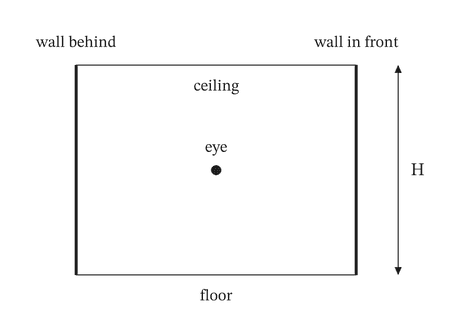
The length of the shortest plane mirror fixed on the wall in front of the boy, so that the boy can see the full image of the wall behind him, is
Solve with AIAnswer
(A)
(B)
- Correct
(C)
(D)
Answer: (C)
Key idea: The eye sees the whole image of the back wall in the mirror if the rays from the top and bottom of that image to the eye pass through the mirror. A plane mirror forms the image of the back wall as far behind the mirror as the wall is in front of it.
Step 1 — Set up the distances.
The figure shows the room from the side, with the mirror on the wall in front of the boy and the image of the back wall behind the mirror.
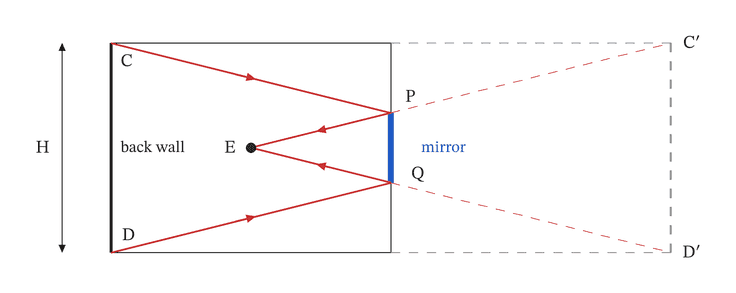
Let the room have width . The eye is at the centre of the room, half the width from the mirror wall. The back wall is from the mirror, so its image is behind the mirror and has the same height . We add the two distances to get the distance from the eye to the image.
Step 2 — Use similar triangles.
Rays from and to the eye cross the mirror at and , and is parallel to . So triangles and are similar, and their sides are in the ratio of their distances from .
Why the other options are wrong:
- (A) is wrong: Half the height is the rule for seeing one's own full height, where the image is twice as far from the eye as the mirror; here the image is three times as far.
- (B) is wrong: A quarter of the height is shorter than , so rays from the top and bottom of the image of the back wall would miss the mirror and parts of the wall would not be seen.
- (D) is wrong: A mirror as tall as the wall would work but is longer than needed; the question asks for the shortest mirror.
Therefore, the shortest mirror has length : option (C).
- 51 mark
Question 5
Two plane mirrors and are parallel to each other and spaced 20 cm apart. An object is kept in between them at 15 cm from . Out of the following, at which point an image is NOT formed in mirror (distance measured from mirror )?
Solve with AIAnswer
(A) 15 cm
(B) 25 cm
- Correct
(C) 45 cm
(D) 55 cm
Answer: (C) 45 cm
Key idea: Each image formed in one mirror acts as an object for the other mirror. A plane mirror forms the image of an object as far behind it as the object is in front of it.
Step 1 — Write the positions.
The object is cm from . The mirrors are cm apart, so is cm from . All images formed in lie behind , and we give their distances from .
Step 2 — Find the first image in .
The object is cm in front of , so its image in is cm behind .
Step 3 — Find the image in of 's image in .
The object is cm in front of , so its image in is cm behind . We add the spacing of the mirrors to get its distance from .
This image is cm in front of , so its image in is cm behind .
Step 4 — Find the image in of 's image in .
The image is cm behind , so its distance from is the spacing plus cm.
Its image in is cm behind , so we add the spacing again to get its distance from .
So its image in is cm behind .
Step 5 — List the images in .
Continuing in the same way, the next image in is at cm (from the cm image, reflected in and then in ). So the images in are at , , , , … cm from , and none is at cm.
Why the other options are wrong:
- (A) is wrong: The first image in is formed at cm.
- (B) is wrong: The image in of the first image in is formed at cm.
- (D) is wrong: The image in of 's image of is formed at cm.
Therefore, no image is formed in mirror at cm: option (C).
- 61 mark
Question 6
A convex mirror produces an image th of the size of an object. If the focal length of the convex mirror is then the object distance is
Solve with AIAnswer
(A)
(B)
- Correct
(C)
(D)
Answer: (C)
Key idea: For a mirror the magnification can be written (from the mirror formula and ). A convex mirror forms an erect image of a real object, so is positive.
Step 1 — Write the magnification.
The image is of the size of the object and erect, so , and we equate this to the formula.
Step 2 — Solve for .
We cross-multiply and rearrange to get on its own.
Step 3 — Interpret the sign.
In the New Cartesian sign convention of a convex mirror is positive, and comes out negative, so the object is in front of the mirror at a distance .
Why the other options are wrong:
- (A) is wrong: An object distance gives , not .
- (B) is wrong: An object distance gives , not .
- (D) is wrong: An object distance gives ; it comes from dropping the on the left of .
Therefore, the object distance is : option (C).
- 71 mark
Question 7
A wall clock has no numerals, but marks on its dial. The clock forms an image on a plane mirror on the opposite wall. The time read by the clock in the mirror is 2.25. Then the time on the clock is
Solve with AIAnswer
(A) 2.25
(B) 9.25
- Correct
(C) 9.35
(D) 2.35
Answer: (C) 9.35
Key idea: A plane mirror reverses the clock face left to right, so a hand at an angle clockwise from 12 is seen at anticlockwise from 12. As a result, the time read in the mirror and the actual time add up to hours.
Step 1 — Write the rule.
Both hands are reflected about the 12–6 line, so the actual time is minus the time read in the mirror.
Step 2 — Do the subtraction.
We write as hours minutes and subtract the hours and the minutes separately.
The clock shows .
Why the other options are wrong:
- (A) is wrong: This is the time seen in the mirror, not the actual time.
- (B) is wrong: This reading reflects the hour hand but leaves the minute hand at minutes; the minute hand is reflected too, to minutes.
- (D) is wrong: This reading reflects the minute hand but leaves the hour hand near ; the hour hand is reflected too, to between and .
Therefore, the actual time on the clock is : option (C).
- 81 mark
Question 8
A short linear object of length lies along the axis of a concave mirror of focal length at a distance from the pole of the mirror. The size of the image is approximately equal to
Solve with AIAnswer
(A)
(B)
(C)
- Correct
(D)
Answer: (D)
Key idea: For a short object lying along the axis, each end has its own image, and the image length is the gap between these two images. Differentiating the mirror formula shows how far the image moves when the object point moves a little, so the length along the axis is multiplied by the square of the transverse magnification.
Step 1 — Write the mirror formula.
Both ends of the object are at slightly different distances from the pole, and both obey the mirror formula.
Step 2 — Differentiate it.
The focal length is fixed, so we differentiate both sides and keep constant.
We solve this for , the shift of the image.
Step 3 — Write the ratio of to without .
We multiply the mirror formula by so that only the ratio of the two distances appears.
Turning this ratio upside down gives the transverse magnification in size.
Step 4 — Find the image length.
The object length is and the image length is , so we put the ratio from Step 3 into the result of Step 2.
So the longitudinal magnification is the square of the transverse magnification. An image lying along the axis is stretched (or squeezed) much more than an upright one.
Note: The book prints this option without the square, as . That expression is the transverse (sideways) magnification times , which applies to an object standing upright, not to one lying along the axis, so the option is shown here with the square.
Why the other options are wrong:
- (A) is wrong: Its dimensions do not work, because a square root of a length divided by a length has the unit ; multiplied by it is not a length at all.
- (B) is wrong: It uses the square root of the transverse magnification, but the working gives its square, because depends on .
- (C) is wrong: It turns the transverse magnification upside down, , and does not square it.
Therefore, the length of the image is : option (D).
- 91 mark
Question 9
A ray of light is incident normally on a plane mirror. The angle of reflection will be
Solve with AIAnswer
- Correct
(A) 0°
(B) 90°
(C) will not be reflected
(D) None of the above
Answer: (A) 0°
Key idea: Angles of incidence and reflection are measured from the normal, the line at right angles to the mirror at the point of incidence. By the law of reflection, the angle of reflection equals the angle of incidence.
Step 1 — Find the angle of incidence.
A ray incident normally travels along the normal itself, so the angle between the ray and the normal is zero.
Step 2 — Apply the law of reflection.
The angle of reflection is equal to the angle of incidence.
So the reflected ray also travels along the normal: the ray goes straight back along its own path.
Why the other options are wrong:
- (B) is wrong: The ray makes with the mirror surface (the glancing angle), but the angle of reflection is measured from the normal, not from the surface.
- (C) is wrong: A mirror reflects light at every angle of incidence; at normal incidence the ray is simply sent straight back.
- (D) is wrong: Option (A) is correct, so "none of the above" cannot be the answer.
Therefore, the angle of reflection is : option (A).
- 101 mark
Question 10
A man of height requires a mirror, to see his own complete image, of height at least equal to
Solve with AIAnswer
(A)
(B)
- Correct
(C)
(D)
Answer: (C)
Key idea: A plane mirror forms the image as far behind the mirror as the object is in front of it. Light from the top of the head and from the feet must reach the eye after reflection, and the two points where these rays meet the mirror mark the least length of mirror needed.
Step 1 — Set up the heights.
Let the eye be at height above the floor and the top of the head at height . If the person stands a distance from a vertical mirror, the image stands behind it, so the image is a distance from the eye.
Step 2 — Find where the ray from the top of the head meets the mirror.
The ray from the image of the top of the head to the eye crosses the mirror halfway along the horizontal distance . By similar triangles it therefore meets the mirror at a height halfway between and .
Step 3 — Find where the ray from the feet meets the mirror.
In the same way, the ray from the image of the feet (height ) to the eye meets the mirror halfway between the heights and .
Step 4 — Find the least length of the mirror.
The mirror must stretch from the lower point to the upper point, so we subtract the two heights.
The result does not depend on the height of the eye or on the distance from the mirror. The top of the mirror must be placed halfway between the eye and the top of the head.
Why the other options are wrong:
- (A) is wrong: A mirror one-quarter of the height covers only half of the span needed, so either the head or the feet would be missing from the image.
- (B) is wrong: One-third of the height is the answer when the image seen is three times as far from the eye as the mirror is, as for the wall behind a person standing in the middle of a room; for one's own image the ratio is two, which gives one-half.
- (D) is wrong: A mirror of full height shows the whole body, but half of it is never used, so it is more than the least height asked for.
Therefore, the least height of the mirror is : option (C).
- 111 mark
Question 11
State the laws of reflection.
Solve with AIWritten solution
Solution:
Key idea: Reflection at a smooth surface follows two laws. Both are stated using the normal, the line drawn at right angles to the surface at the point where the ray strikes it.
Step 1 — State the first law (the plane of the rays).
The first law says where the rays lie. The incident ray, the reflected ray and the normal at the point of incidence all lie in the same plane.
Step 2 — State the second law (the angles).
The second law compares the two angles, each measured from the normal. The angle of reflection is equal to the angle of incidence.
Step 3 — Say where the laws apply.
These laws hold at every point of a smooth reflecting surface, plane or curved. At a spherical mirror the normal at each point is the radius through that point.
Therefore, (i) the incident ray, the reflected ray and the normal lie in one plane, and (ii) the angle of reflection equals the angle of incidence.
- 121 mark
Question 12
What is glancing angle?
Solve with AIWritten solution
Solution:
Key idea: The angle of incidence is measured from the normal. The glancing angle is measured from the mirror surface instead, and the normal is at right angles to the surface.
Step 1 — Define the glancing angle.
The glancing angle is the angle between the incident ray and the surface of the mirror at the point of incidence.
Step 2 — Relate it to the angle of incidence.
The normal and the surface are at right angles, so the glancing angle and the angle of incidence together make .
For example, a ray with an angle of incidence of has a glancing angle of .
Therefore, the glancing angle is the angle between the incident ray and the mirror surface; it equals .
- 131 mark
Question 13
What is a virtual image? Give an example.
Solve with AIWritten solution
Solution:
Key idea: An image is real if the reflected (or refracted) rays actually meet at it, and virtual if they only appear to come from it when they are traced backwards.
Step 1 — Define a virtual image.
A virtual image is formed where reflected or refracted rays only appear to diverge from; the rays do not actually pass through it. They meet only when they are produced backwards, for example behind a mirror.
Step 2 — Say how it differs from a real image.
Because no light actually reaches the position of a virtual image, it cannot be caught on a screen. It can only be seen by looking into the mirror (or through the lens).
Step 3 — Give an example.
The image of your face in a plane mirror is virtual: it appears to be behind the mirror, where no light goes. The image in a convex rear-view mirror is also virtual.
Therefore, a virtual image is one from which the rays only appear to diverge and which cannot be obtained on a screen; for example, the image of a face in a plane mirror.
- 141 mark
Question 14
Define principal focus of a spherical mirror.
Solve with AIWritten solution
Solution:
Key idea: A spherical mirror has a principal axis, the line through its pole and its centre of curvature . Rays parallel and close to this axis (paraxial rays) all pass through one point, or seem to come from one point, after reflection.
Step 1 — Define it for a concave mirror.
For a concave mirror, the principal focus is the point on the principal axis where rays parallel and close to the axis actually meet after reflection. It lies in front of the mirror.
Step 2 — Define it for a convex mirror.
For a convex mirror the reflected rays spread out. The principal focus is the point on the principal axis, behind the mirror, from which these reflected rays appear to diverge.
Step 3 — Locate the focus.
For paraxial rays the focus lies halfway between the pole and the centre of curvature, so the focal length is half the radius of curvature. Rays far from the axis cross it a little nearer the mirror (spherical aberration), which is why the definition uses rays close to the axis.
Therefore, the principal focus is the point on the principal axis where rays parallel and close to the axis meet after reflection (concave mirror), or from which they appear to diverge after reflection (convex mirror).
- 151 mark
Question 15
Draw a diagram to show the image formed by a concave mirror when the object is placed between the principal focus F and the pole O.
Solve with AIWritten solution
Solution:
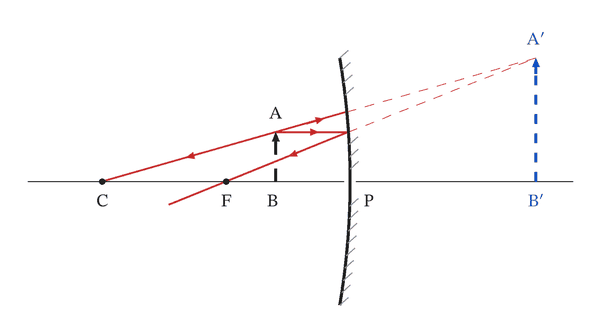
Key idea: The image of the top of the object is found where two reflected rays from meet, or appear to meet. Two easy rays are used: a ray parallel to the axis, which is reflected through the focus , and a ray along the line from the centre of curvature , which strikes the mirror normally and comes back along itself.
Step 1 — Place the object.
We draw the principal axis with , and the pole , and stand the object on the axis between and .
Step 2 — Draw the first ray.
A ray from travelling parallel to the axis strikes the mirror and is reflected so that it passes through .
Step 3 — Draw the second ray.
A ray from directed along the line from through strikes the mirror along the normal. It is therefore reflected straight back along the same line, through and .
Step 4 — Locate the image.
The two reflected rays spread apart in front of the mirror and never meet there. When they are produced backwards (dashed lines) they meet at behind the mirror, and the foot of the image is on the axis directly below .
Step 5 — State the nature of the image.
Since the rays only appear to come from , the image is virtual; it is the same way up as the object and larger than it. This is the arrangement used in a shaving or make-up mirror.
Therefore, the image is formed behind the mirror and is virtual, erect and magnified.
- 161 mark
Question 16
Write down the mirror formula.
Solve with AIWritten solution
Solution:
Key idea: The mirror formula links the object distance, the image distance and the focal length of a spherical mirror. It holds for concave and convex mirrors and for real and virtual images, provided every distance carries its sign.
Step 1 — Write the formula.
The mirror formula is written as follows.
Step 2 — Name each symbol.
Here is the focal length of the mirror, is the distance of the object from the pole and is the distance of the image from the pole.
Step 3 — State the sign rule.
All distances are measured from the pole along the principal axis, positive in the direction of the incident light and negative against it (New Cartesian sign convention). So a real object has a negative , a concave mirror has a negative and a convex mirror has a positive .
Therefore, the mirror formula is , with , and measured from the pole with their signs.
- 171 mark
Question 17
Define magnification.
Solve with AIWritten solution
Solution:
Key idea: Magnification tells how many times larger (or smaller) the image is than the object, and its sign tells whether the image is erect or inverted.
Step 1 — Define it.
The linear magnification of a mirror is the ratio of the height of the image to the height of the object , both measured at right angles to the principal axis.
Step 2 — Write it with distances.
For a spherical mirror it can also be found from the image and object distances.
Step 3 — Read its sign and size.
A negative means a real, inverted image, and a positive means a virtual, erect image. If the size of is more than the image is magnified; if it is less than the image is diminished.
Therefore, magnification is the ratio of the height of the image to the height of the object, ; for a mirror it can also be written as .
- 181 mark
Question 18
What is Newton's formula?
Solve with AIWritten solution
Solution:
Key idea: Newton's formula is a form of the mirror formula in which the object and image distances are measured from the principal focus instead of from the pole.
Step 1 — State the formula.
Newton's formula for a spherical mirror is written as follows.
Step 2 — Name each symbol.
Here is the focal length of the mirror, is the distance of the object from the focus and is the distance of the image from the focus.
Step 3 — Check it against the mirror formula.
Measured with signs from the focus, and , so we multiply these two distances.
Clearing the fractions in the mirror formula shows that and are equal.
So the first two terms cancel.
Therefore, Newton's formula is , where and are the distances of the object and of the image from the focus.
- 191 mark
Question 19
Mention four uses of mirrors.
Solve with AIWritten solution
Solution:
Key idea: A concave mirror gives a magnified, erect image of an object inside its focus and turns a lamp at its focus into a parallel beam; a convex mirror always gives a small, erect image with a wide field of view. Each use depends on one of these properties.
Step 1 — A concave mirror is used as a shaving or make-up mirror.
With the face between the pole and the focus, a concave mirror gives an erect, magnified, virtual image, so fine details are easy to see.
Step 2 — A concave reflector is used in torches, searchlights and headlights.
A lamp placed at the focus of a concave (in practice, parabolic) reflector sends out a strong, nearly parallel beam.
Step 3 — A convex mirror is used as a rear-view mirror.
A convex mirror gives an erect, diminished image of the traffic behind and a wide field of view, so it is used as a rear-view (wing) mirror in vehicles.
Step 4 — A concave mirror is used by dentists and ENT doctors.
A small concave mirror gives a magnified view of a tooth, and a concave head mirror focuses light into the ear, nose or throat. Large concave mirrors are also used in reflecting telescopes and solar furnaces.
Therefore, four uses are: shaving or make-up mirrors (concave), reflectors in torches and headlights (concave), rear-view mirrors in vehicles (convex) and dentists' or ENT mirrors (concave).
- 201 mark
Question 20
Write down the relation connecting magnification , the object distance , image distance and the focal length .
Solve with AIWritten solution
Solution:
Key idea: The magnification of a mirror is . Using the mirror formula, the ratio can be written with the focal length and only one of the two distances.
Step 1 — Write in terms of and .
We multiply the mirror formula by .
Changing the sign gives the magnification.
Step 2 — Write in terms of and .
We multiply the mirror formula by instead.
Turning this ratio upside down and changing the sign gives the magnification.
Step 3 — Check that the forms agree.
All three forms give the same value. We check this for a concave mirror with cm.
We find the image of an object at cm from the mirror formula.
Each of the three forms then gives the same magnification.
Therefore, , and also and .
- 212 marks
Question 21
Distinguish between real image and virtual image.
- 222 marks
Question 22
A concave mirror is called a converging mirror whereas a convex mirror is called a diverging mirror. Why?
- 232 marks
Question 23
For a spherical mirror, show that the radius of curvature where is its focal length.
- 242 marks
Question 24
Explain the new cartesian sign convention.
- 252 marks
Question 25
What is transverse magnification? Write down the expression for magnification in terms of and .
- 262 marks
Question 26
Write any one use for each of the following mirrors:
(a) Convex
(b) Concave
- 272 marks
Question 27
"A concave mirror is preferred to a plane mirror during shaving." Why?
- 282 marks
Question 28
'Convex mirrors are used as rear view mirrors.' Why?
- 292 marks
Question 29
How many images will be formed if two plane mirrors are fitted on the adjacent walls and one mirror on the ceiling?
- 302 marks
Question 30
A man is running towards a plane mirror with a velocity . With what velocity does his image move towards him?
- 312 marks
Question 31
How will you distinguish between a plane mirror, a concave mirror and a convex mirror?
- 323 marks
Question 32
Derive the relation for a spherical mirror.
- 333 marks
Question 33
Derive the mirror formula for a convex mirror.
- 343 marks
Question 34
What is linear magnification? How is it related to the focal length of the mirror?
- 355 marks
Question 35
(a) Define principal focus and radius of curvature of a spherical mirror.
(b) Show that the radius of curvature of a spherical mirror is twice its focal length.
(c) Using suitable diagrams, explain the formation of images by a concave spherical mirror when the object is kept at (i) infinity, (ii) beyond C, (iii) at C, (iv) between C and F, (v) at F and (vi) between F and pole. Discuss the nature of the image in each case.
- 365 marks
Question 36
(a) Explain the sign convention used in ray optics.
(b) Derive the mirror formula for a concave mirror forming a real image.
- 375 marks
Question 37
Derive the relation for a concave mirror forming a virtual image.
- 383 marks
Question 38
An object is placed in front of a concave mirror of focal length 30 cm and an image magnified three times is obtained. Calculate the possible positions of the object.
- 393 marks
Question 39
A virtual image of an object is formed 10 cm away from a concave mirror whose focal length is 40 cm. Calculate the distance of the object from the mirror.
- 403 marks
Question 40
A real image of half the size of the object is produced by a spherical mirror. On moving the object away from the mirror by 30 cm, the size of the image becomes 1/3 that of the object. Calculate the radius of curvature of the spherical mirror.
- 413 marks
Question 41
With a convex mirror, when the object is kept at a distance of 30 cm from the mirror, the image is formed at a distance of 10 cm from the mirror. What will be the change in the image distance if the object distance is doubled?
- 423 marks
Question 42
A candle flame 3 cm high is placed on the principal axis of a concave mirror at a distance of 15 cm from the pole. If the image is inverted, real and 6 cm high, find the position of the image and the focal length of the mirror.
- 433 marks
Question 43
The magnification of a real image produced by a concave mirror was found to be twice as great when the object was 30 cm from the mirror as it was when the object was 20 cm from the mirror. Find the focal length of the mirror.
- 443 marks
Question 44
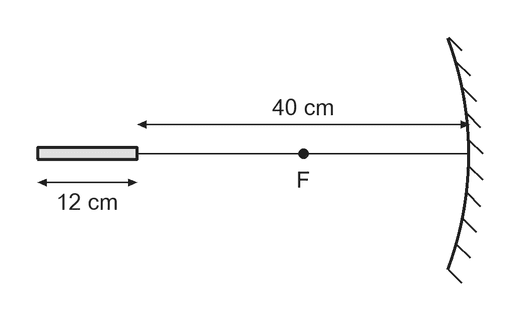
A thin uniform rod of length 12 cm lies along the principal axis of a concave mirror of focal length 20 cm as shown in the figure. The end closer to the pole is 40 cm away from it. Find the length of the image.
- 453 marks
Question 45
The focal length of a concave shaving mirror is 12 cm. What is the magnification when the face is 6 cm from the vertex of the mirror? Where is the image formed?
- 463 marks
Question 46
A candle of 5 cm height is placed at a distance of 25 cm from the pole of a concave mirror of focal length 15 cm. Find the position, size and nature of the image.
- 473 marks
Question 47
A candle flame 3 cm high is placed at a distance of 3 m from a wall. How far from the wall must a concave mirror be placed so that it may form 9 cm high image of the flame on the same wall? Also find the focal length of the mirror.
- 483 marks
Question 48
When an object is kept in front of a concave mirror at a certain distance, a real image thrice the size of the object was obtained on the screen. The object and the screen are adjusted such that another image twice the size of the object is obtained on the screen. If the shift of the object is 5 cm, find the focal length of the mirror and the shift of the screen.
- 493 marks
Question 49
A convex mirror of focal length 30 cm is kept in the path of a converging beam. The distance between the point of convergence in the absence of mirror and the pole of the mirror is 20 cm. Find the distance of the point of convergence from the pole of the mirror, when it is introduced.

What Class 12 Physics Ch 14 covers
The sections of the chapter, in the order the book takes them. Every question above comes from one of these.
- 01Reflection of Light and Laws of Reflection
- 02Plane Mirrors and Rotation of a Mirror
- 03Spherical Mirrors - Terms and Principal Focus
- 04Image Formation by Spherical Mirrors
- 05Sign Convention and Mirror Formula
- 06Magnification
- 07Uses of Mirrors
More ways to study this chapter
The same chapter asked three other ways. Practise it, revise it, and see what the board has set on Ch 14 before.
- Competency-Based Questions (CBQ)Case study questions: a situation, and the part of the chapter that answers it.40questionsOpen
- Previous Year QuestionsQuestions that have actually appeared in board papers, each tagged with its year.3questionsOpen
- Practice QuestionsExtra questions per chapter, for when one attempt at a method is not enough.82questionsOpen
Ch 14 in past ISC papers
The same chapter as the board has actually asked it. These are worded differently from the textbook exercise, which is the point of reading them.
- 11 mark
Board paper question 1
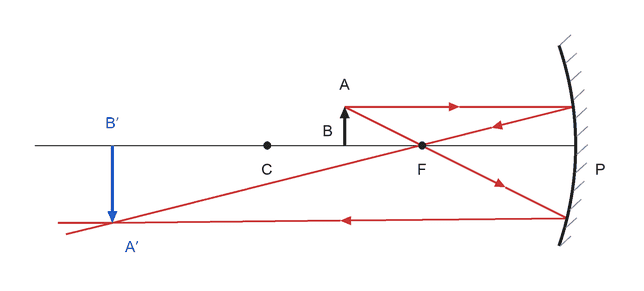
An object is kept on the principal axis of a concave mirror of focal length 10 cm. at a distance of 15 cm from its pole. The image formed by the mirror is:
Solve with AIAnswer
(A) Virtual and magnified
(B) Virtual and diminished
- Correct
(C) Real and magnified
(D) Real and diminished
Answer: (C) Real and magnified
Key idea: For a concave mirror the image of an object placed between the centre of curvature C (at ) and the focus F is real, inverted and magnified, and it forms beyond C. We confirm this with the mirror formula , using the New Cartesian sign convention (distances measured in front of the mirror are negative).
Step 1 — Write the data with signs.
The object is in front of the mirror, so its distance is negative.
A concave mirror has a negative focal length.
The centre of curvature is at twice the focal length, in front of the mirror, so the object lies between F and C.
Step 2 — Find the image distance.
We rearrange the mirror formula for .
The negative sign means the image is in front of the mirror, where the reflected rays really meet, so it is real.
Step 3 — Find the magnification.
The magnification of a mirror is .
The image is twice the size of the object (magnified), and the minus sign shows it is inverted. The ray diagram below shows the two rule rays meeting at the image A′B′, beyond C.
Why the others are wrong:
- (A) A concave mirror gives a virtual, magnified image only when the object is closer than F (here, closer than ); this object is away.
- (B) A concave mirror never forms a virtual, diminished image of a real object; that kind of image is formed by a convex mirror.
- (D) A real, diminished image needs the object beyond C (more than away); this object is between F and C.
Therefore, the image is real (30 cm in front of the mirror), inverted and magnified, option (C).
- 22 marks
Board paper question 2
Write any one use for each of the following mirrors.
(i) Convex
(ii) Concave
Solve with AIWritten solution
Solution:
Key idea: A convex mirror always gives an erect, diminished image and shows a wide field of view. A concave mirror gives an erect, magnified image when the object is closer than its focus, and it can turn light from a source at its focus into a parallel beam.
Step 1 — Part (i): give a use of a convex mirror.
Convex mirrors are used as rear-view (side) mirrors in cars and motorcycles. They always give an erect image, and because the image is diminished, a wide area of the road behind fits into a small mirror.
Step 2 — Part (ii): give a use of a concave mirror.
Concave mirrors are used as shaving or make-up mirrors. When the face is closer to the mirror than its focus, the image is erect and magnified, so fine details are easy to see. (Other uses: reflectors in torches and car headlights, and the mirrors dentists use.)
Therefore, (i) a convex mirror is used as a rear-view mirror in vehicles; (ii) a concave mirror is used as a shaving or make-up mirror.
- 31 mark
Board paper question 3
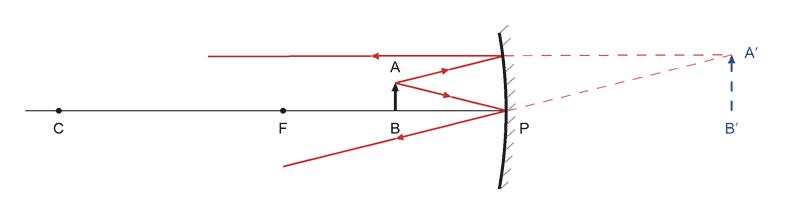
If an object is placed at a distance of in front of a concave mirror of focal length , the image formed will be:
Solve with AIAnswer
(A) real and 20 cm in front of the mirror.
(B) real and 6.67 cm in front of the mirror.
- Correct
(C) virtual and 20 cm behind the mirror
(D) virtual and 6.67 cm behind the mirror.
Answer: (C) virtual and 20 cm behind the mirror
Key idea: An object placed between the focus F and the pole P of a concave mirror gives a virtual, erect, magnified image behind the mirror. We find its position with the mirror formula , using the New Cartesian sign convention (distances in front of the mirror are negative).
Step 1 — Write the data with signs.
The object is in front of the mirror, so its distance is negative.
The focal length of a concave mirror is negative.
The object is closer to the mirror than the focus.
Step 2 — Find the image distance.
We rearrange the mirror formula for .
Step 3 — Interpret the sign.
A positive means the image is behind the mirror. No light actually reaches that point; the reflected rays only appear to come from it, so the image is virtual. The magnification is , so the image is erect and twice the size of the object. The ray diagram below shows the reflected rays diverging, and their backward extensions (dashed) meeting behind the mirror.
Why the others are wrong:
- (A) This distance comes from rearranging the mirror formula wrongly, subtracting from , which puts the image in front; an object inside F cannot give a real image.
- (B) This value comes from giving the object distance the wrong sign (), which puts a real image about in front of the mirror.
- (D) This value comes from adding without signs; the distance is wrong, although the image is indeed virtual.
Therefore, the image is virtual and 20 cm behind the mirror, option (C).
Class 12 Physics Ch 14 questions students ask
How many questions are there in Class 12 Physics Ch 14?
49 questions. Every one is solved step by step on this page.
Are these Class 12 Physics solutions free?
Yes. Every question and its full working is free to read, with no account needed.
Can I download the Class 12 Physics Ch 14 solutions as a PDF?
There is no PDF to download. Every solution is on this page instead, which means it is searchable, always the current syllabus, and readable on a phone. Use your browser's print option if you want it on paper.