
Question 323 marksMedium
Derive the relation for a spherical mirror.
Confirming your payment
Sign up now and get 250 free tokens.
Ray Optics - Reflection of Light by Spherical Mirrors · Question 32 of 49
Derive the relation for a spherical mirror.
Solution:
Key idea: The normal at any point of a spherical mirror is the radius through that point. Using the law of reflection and the small-angle approximation for paraxial rays, we show that a ray parallel to the axis crosses the axis, after reflection, halfway between and .
Step 1 — Draw the ray diagram.
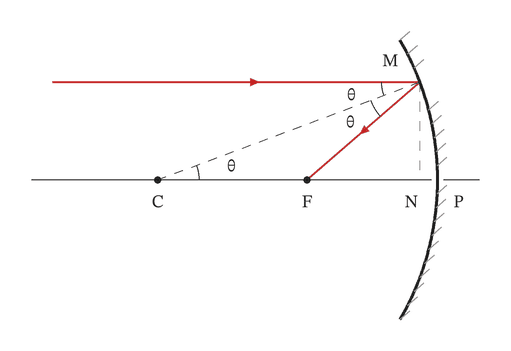
A ray parallel to the principal axis strikes the concave mirror at and is reflected through the principal focus . The point is the centre of curvature, so is the normal at , and is drawn perpendicular to the axis.
Step 2 — Mark the equal angles.
By the law of reflection, the angle of incidence and the angle of reflection at are equal; we call each . The incident ray is parallel to , so the alternate angle is also .
Step 3 — Find the angle at .
In triangle , the exterior angle at equals the sum of the two interior opposite angles.
Step 4 — Write the tangents.
In the right triangles and , we write each angle in terms of the height .
Step 5 — Use the paraxial condition.
For a ray close to the axis, is small, so and . Also almost coincides with , so and .
Step 6 — Divide the two results.
Dividing the second result by the first removes both and .
Step 7 — Name the lengths.
The length is the radius of curvature and is the focal length . With the sign convention both are negative for a concave mirror (and both positive for a convex mirror), so the relation keeps the same form.
Therefore, : the radius of curvature of a spherical mirror is twice its focal length (for paraxial rays).