Solution:
Key idea: The point O, where the converging beam would have met, lies behind the mirror, so it acts as a virtual object for the mirror and its distance is positive.
We use the New Cartesian sign convention: distances are measured from the pole, positive in the direction of the incident light. A point in front of the mirror has a negative distance and a point behind it a positive one. So a convex mirror has f>0.
Step 1 — Write the data with signs.
The point O is 20 cm behind the mirror.
u=+20 cm
The focal length of a convex mirror is positive.
f=+30 cm
Step 2 — Find the image distance.
We rearrange the mirror formula v1+u1=f1 to make v1 the subject.
v1=f1−u1
v1=301−201
v1=−601
v=−60 cm
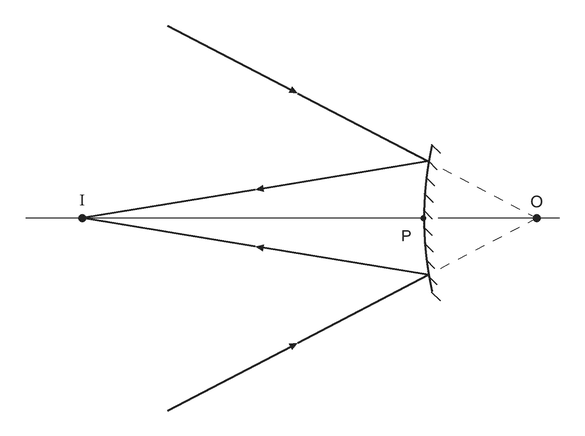
Step 3 — Interpret the result.
The negative sign shows that the reflected rays really meet in front of the mirror, so I is a real image 60 cm from the pole P. The convex mirror weakens the convergence of the beam but does not turn it into a diverging beam, because O lies inside its focal length.
Therefore, the reflected rays converge at I, 60 cm in front of the pole P (a real image).

