
Opening your dashboard
Class 12 Physics Chapter 14 Ray Optics - Reflection of Light by Spherical Mirrors: Previous Year Questions
3 questions on Chapter 14, each solved step by step. Class 12 Physics, ICSE 2026-27.
3 questions with solutions
1–2 marks · Mixed difficulty
- 11 mark
Question 1
An object is kept on the principal axis of a concave mirror of focal length 10 cm. at a distance of 15 cm from its pole. The image formed by the mirror is:
Solve with AIAnswer
(A) Virtual and magnified
(B) Virtual and diminished
- Correct
(C) Real and magnified
(D) Real and diminished
Answer: (C) Real and magnified
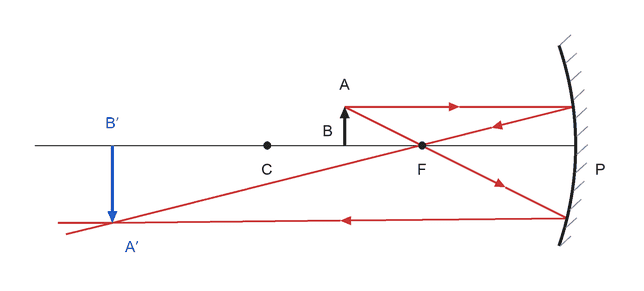
Key idea: For a concave mirror the image of an object placed between the centre of curvature C (at ) and the focus F is real, inverted and magnified, and it forms beyond C. We confirm this with the mirror formula , using the New Cartesian sign convention (distances measured in front of the mirror are negative).
Step 1 — Write the data with signs.
The object is in front of the mirror, so its distance is negative.
A concave mirror has a negative focal length.
The centre of curvature is at twice the focal length, in front of the mirror, so the object lies between F and C.
Step 2 — Find the image distance.
We rearrange the mirror formula for .
The negative sign means the image is in front of the mirror, where the reflected rays really meet, so it is real.
Step 3 — Find the magnification.
The magnification of a mirror is .
The image is twice the size of the object (magnified), and the minus sign shows it is inverted. The ray diagram below shows the two rule rays meeting at the image A′B′, beyond C.
Why the others are wrong:
- (A) A concave mirror gives a virtual, magnified image only when the object is closer than F (here, closer than ); this object is away.
- (B) A concave mirror never forms a virtual, diminished image of a real object; that kind of image is formed by a convex mirror.
- (D) A real, diminished image needs the object beyond C (more than away); this object is between F and C.
Therefore, the image is real (30 cm in front of the mirror), inverted and magnified, option (C).
- 22 marks
Question 2
Write any one use for each of the following mirrors.
(i) Convex
(ii) Concave
Solve with AIWritten solution
Solution:
Key idea: A convex mirror always gives an erect, diminished image and shows a wide field of view. A concave mirror gives an erect, magnified image when the object is closer than its focus, and it can turn light from a source at its focus into a parallel beam.
Step 1 — Part (i): give a use of a convex mirror.
Convex mirrors are used as rear-view (side) mirrors in cars and motorcycles. They always give an erect image, and because the image is diminished, a wide area of the road behind fits into a small mirror.
Step 2 — Part (ii): give a use of a concave mirror.
Concave mirrors are used as shaving or make-up mirrors. When the face is closer to the mirror than its focus, the image is erect and magnified, so fine details are easy to see. (Other uses: reflectors in torches and car headlights, and the mirrors dentists use.)
Therefore, (i) a convex mirror is used as a rear-view mirror in vehicles; (ii) a concave mirror is used as a shaving or make-up mirror.
- 31 mark
Question 3
If an object is placed at a distance of in front of a concave mirror of focal length , the image formed will be:
Solve with AIAnswer
(A) real and 20 cm in front of the mirror.
(B) real and 6.67 cm in front of the mirror.
- Correct
(C) virtual and 20 cm behind the mirror
(D) virtual and 6.67 cm behind the mirror.
Answer: (C) virtual and 20 cm behind the mirror
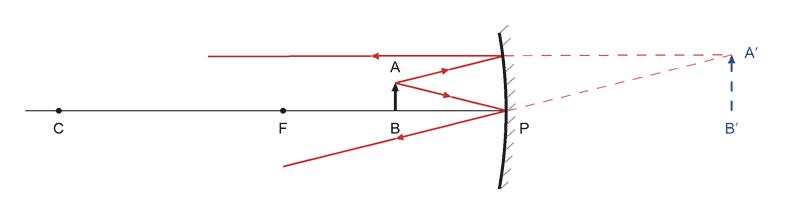
Key idea: An object placed between the focus F and the pole P of a concave mirror gives a virtual, erect, magnified image behind the mirror. We find its position with the mirror formula , using the New Cartesian sign convention (distances in front of the mirror are negative).
Step 1 — Write the data with signs.
The object is in front of the mirror, so its distance is negative.
The focal length of a concave mirror is negative.
The object is closer to the mirror than the focus.
Step 2 — Find the image distance.
We rearrange the mirror formula for .
Step 3 — Interpret the sign.
A positive means the image is behind the mirror. No light actually reaches that point; the reflected rays only appear to come from it, so the image is virtual. The magnification is , so the image is erect and twice the size of the object. The ray diagram below shows the reflected rays diverging, and their backward extensions (dashed) meeting behind the mirror.
Why the others are wrong:
- (A) This distance comes from rearranging the mirror formula wrongly, subtracting from , which puts the image in front; an object inside F cannot give a real image.
- (B) This value comes from giving the object distance the wrong sign (), which puts a real image about in front of the mirror.
- (D) This value comes from adding without signs; the distance is wrong, although the image is indeed virtual.
Therefore, the image is virtual and 20 cm behind the mirror, option (C).