
Question 31 markMCQAsked 2023Medium
If an object is placed at a distance of in front of a concave mirror of focal length , the image formed will be:
Confirming your payment
Sign up now and get 250 free tokens.
Previous Year Questions · Question 3 of 3
If an object is placed at a distance of in front of a concave mirror of focal length , the image formed will be:
(A) real and 20 cm in front of the mirror.
(B) real and 6.67 cm in front of the mirror.
(C) virtual and 20 cm behind the mirror
(D) virtual and 6.67 cm behind the mirror.
Answer: (C) virtual and 20 cm behind the mirror
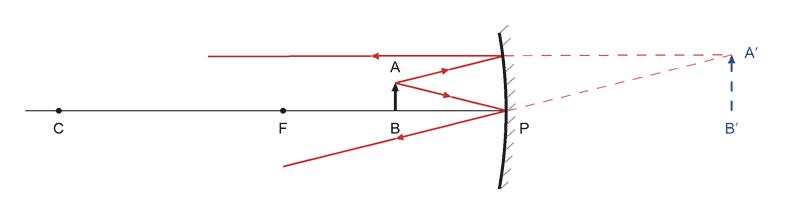
Key idea: An object placed between the focus F and the pole P of a concave mirror gives a virtual, erect, magnified image behind the mirror. We find its position with the mirror formula , using the New Cartesian sign convention (distances in front of the mirror are negative).
Step 1 — Write the data with signs.
The object is in front of the mirror, so its distance is negative.
The focal length of a concave mirror is negative.
The object is closer to the mirror than the focus.
Step 2 — Find the image distance.
We rearrange the mirror formula for .
Step 3 — Interpret the sign.
A positive means the image is behind the mirror. No light actually reaches that point; the reflected rays only appear to come from it, so the image is virtual. The magnification is , so the image is erect and twice the size of the object. The ray diagram below shows the reflected rays diverging, and their backward extensions (dashed) meeting behind the mirror.
Why the others are wrong:
Therefore, the image is virtual and 20 cm behind the mirror, option (C).