
Question 11 markMCQAsked 2018Easy
An object is kept on the principal axis of a concave mirror of focal length 10 cm. at a distance of 15 cm from its pole. The image formed by the mirror is:
Confirming your payment
Sign up now and get 250 free tokens.
Previous Year Questions · Question 1 of 3
An object is kept on the principal axis of a concave mirror of focal length 10 cm. at a distance of 15 cm from its pole. The image formed by the mirror is:
(A) Virtual and magnified
(B) Virtual and diminished
(C) Real and magnified
(D) Real and diminished
Answer: (C) Real and magnified
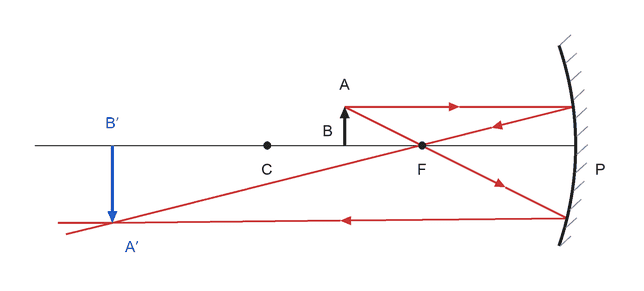
Key idea: For a concave mirror the image of an object placed between the centre of curvature C (at ) and the focus F is real, inverted and magnified, and it forms beyond C. We confirm this with the mirror formula , using the New Cartesian sign convention (distances measured in front of the mirror are negative).
Step 1 — Write the data with signs.
The object is in front of the mirror, so its distance is negative.
A concave mirror has a negative focal length.
The centre of curvature is at twice the focal length, in front of the mirror, so the object lies between F and C.
Step 2 — Find the image distance.
We rearrange the mirror formula for .
The negative sign means the image is in front of the mirror, where the reflected rays really meet, so it is real.
Step 3 — Find the magnification.
The magnification of a mirror is .
The image is twice the size of the object (magnified), and the minus sign shows it is inverted. The ray diagram below shows the two rule rays meeting at the image A′B′, beyond C.
Why the others are wrong:
Therefore, the image is real (30 cm in front of the mirror), inverted and magnified, option (C).