
Question 232 marksMedium
For a spherical mirror, show that the radius of curvature where is its focal length.
Confirming your payment
Sign up now and get 250 free tokens.
Ray Optics - Reflection of Light by Spherical Mirrors · Question 23 of 49
For a spherical mirror, show that the radius of curvature where is its focal length.
Solution:
Key idea: The normal at any point of a spherical mirror is the radius through that point, so it passes through the centre of curvature . Using the law of reflection at one point , and the fact that paraxial rays strike the mirror very close to the pole, we show that lies halfway between and .
Step 1 — Draw the ray diagram.
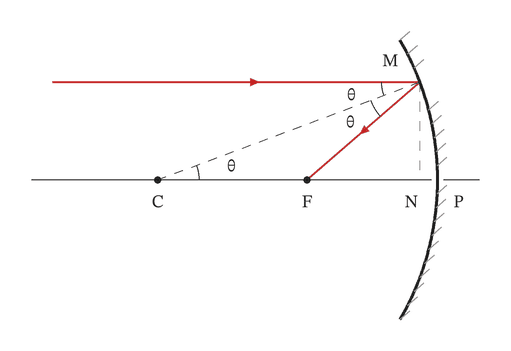
A ray parallel to the principal axis strikes the concave mirror at and is reflected through the focus . The line is the normal at , and is the angle of incidence.
Step 2 — Mark the equal angles.
By the law of reflection, the angle of reflection equals the angle of incidence . The incident ray is parallel to the axis , so the alternate angle is also .
Step 3 — Use the isosceles triangle.
Triangle has two equal angles, at and at , so the sides opposite them are equal.
Step 4 — Use the paraxial condition.
For a ray close to the axis, is very close to the pole , so the length is practically equal to .
Step 5 — Add the two parts of the radius.
The radius is made of the two parts and , which are now equal.
Since is the radius of curvature and is the focal length , this is the required result. The same proof works for a convex mirror, with and behind the mirror.
Therefore, for a spherical mirror (for paraxial rays).