Opening your dashboard
Class 12 Physics Chapter 14 Ray Optics - Reflection of Light by Spherical Mirrors: Practice Questions
82 questions on Chapter 14, each worked through on its own page with the AI tutor. Class 12 Physics, ICSE 2026-27.
82 questions
1–3 marks · Mixed difficulty
- 11 mark
Question 1
A rough sheet of paper scatters a parallel beam of light in all directions, while a polished mirror reflects it as a parallel beam. Which statement about the laws of reflection is correct?
- 21 mark
Question 2
A ray is reflected by a plane mirror. Its angle of deviation turns out to be exactly three times its angle of incidence. The angle of incidence is
- 31 mark
Question 3
A parallel beam of light falls vertically downwards on a rough surface. Two tiny flat patches of the surface are tilted at to the horizontal, one on either side. What is the angle between the rays reflected from these two patches?
- 43 marks
Question 4
In a laboratory, a laser pointer L is held above a long horizontal plane mirror lying on the bench. A small target T is above the mirror, and the horizontal distance between L and T is . The laser beam must reach T after one reflection from the mirror. (Hypothetical data.)
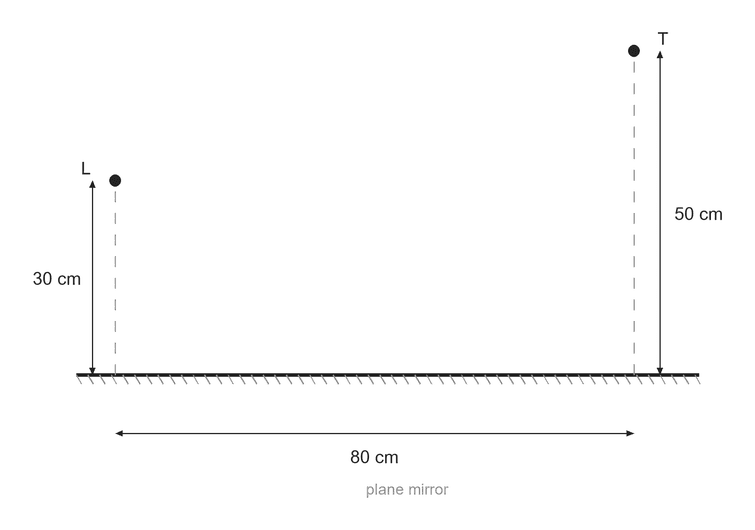
(i) At what horizontal distance from L must the beam strike the mirror?
(ii) Find the angle of incidence at the mirror.
(iii) Find the total length of the beam's path from L to T.
- 52 marks
Question 5
On a dry road at night, a driver sees the road surface clearly in the headlights. After rain, the same road looks dark in the driver's own headlights, but the headlights of oncoming cars produce a strong glare off the road. Explain both observations using the laws of reflection.
- 61 mark
Question 6
A small ball moves towards a fixed plane mirror with a speed of , its velocity making an angle of with the surface of the mirror. The velocity of the ball's image relative to the ball is
- 71 mark
Question 7
Riya stands in front of a large wall mirror. A poster hangs on the wall behind her. She wants to photograph the poster as seen in the mirror, holding the camera at her eye. For a sharp picture, the camera must be focused at a distance of
- 83 marks
Question 8
In a laser show, a fixed horizontal laser beam falls on a plane mirror that rotates steadily at revolutions per minute about a vertical axis lying in the mirror's surface. The reflected beam sweeps across a flat wall whose perpendicular distance from the axis is . (Hypothetical data.)
(i) Find the angular speed of the reflected beam.
(ii) Find the speed of the light spot on the wall at the instant the reflected beam is perpendicular to the wall.
(iii) Find the speed of the spot when the reflected beam makes with the normal to the wall.
- 93 marks
Question 9
Two plane mirrors OA and OB are joined along a common edge at O, with their reflecting surfaces facing each other at an angle of . A ray in the plane perpendicular to the common edge strikes OA at P with an angle of incidence of , and after reflection strikes OB at Q.
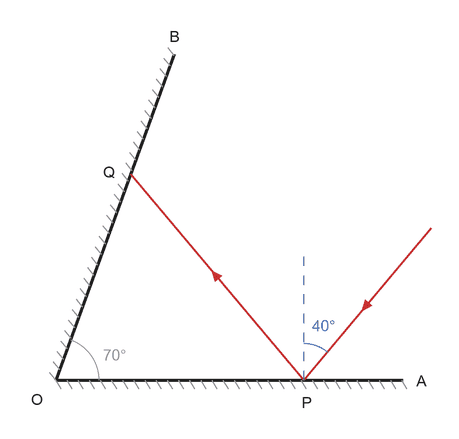
(i) Find the angle of incidence at OB.
(ii) Find the total deviation of the ray after the two reflections.
(iii) Show that this total deviation does not depend on the angle of incidence at OA.
- 101 mark
Question 10
Two plane mirrors inclined to each other form images of a candle placed between them. One mirror is turned so that the angle between the mirrors increases by . How many images are formed now?
- 112 marks
Question 11
A small toy stands in front of a plane mirror. Keeping the toy fixed, the mirror is moved farther away from it, parallel to itself.
(i) By how much does the image shift, and what is the new distance between the toy and its image?
(ii) If the mirror is moved away at a steady , at what speed does the image move away from the toy?
- 122 marks
Question 12
Using the laws of reflection and a ray diagram, prove that the image of a point object formed by a plane mirror is as far behind the mirror as the object is in front of it.
- 131 mark
Question 13
The bowl of a shiny steel spoon is part of a sphere of radius about . When you look into the back (outer side) of the bowl, it acts as a
- 141 mark
Question 14
A concave mirror of focal length in air is placed at the bottom of a tank of water (refractive index ), facing up. Its focal length for light travelling in the water
- 152 marks
Question 15
A concave shaving mirror has a circular rim of diameter and a radius of curvature of . (Hypothetical data.)
(i) Find its focal length.
(ii) Find its angular aperture.
- 163 marks
Question 16
A narrow parallel beam of light, wide and centred on the principal axis, falls on a convex mirror of radius of curvature . Treat all the rays as paraxial. (Hypothetical data.)
(i) State from which point the reflected rays appear to come.
(ii) Find the width of the reflected beam in front of the mirror.
(iii) At what distance in front of the mirror is the reflected beam wide?
- 172 marks
Question 17
A narrow beam of white light parallel to the principal axis falls on a concave mirror of radius of curvature . (Hypothetical data.)
(i) Where are the red and the violet parts of the beam brought to a focus?
(ii) Give the reason for your answer.
- 181 mark
Question 18
A convex mirror has a focal length of . A student claims to have seen images of real objects at the following distances behind the mirror. Which distance is impossible?
- 193 marks
Question 19
An object OB, tall, stands on the principal axis of a concave mirror of small aperture and focal length , at a distance of from the pole P. Treat the mirror as a straight line through P (paraxial rays). (Hypothetical data.)
(i) Using only the ray from B that passes through the principal focus F, find the height of the image.
(ii) Using a second ray from B, find the distance of the image from the mirror.
(iii) State the nature of the image.
- 203 marks
Question 20
A student holds a concave mirror facing a window at the far end of a long hall. The student gets a sharp image of the window on a sheet of paper held in front of the mirror. (Hypothetical data.)
(i) What is the focal length of the mirror?
(ii) For a small candle on the principal axis of this mirror, state the range of object distances that gives (a) an erect image, (b) a real enlarged image, (c) a real diminished image.
- 213 marks
Question 21
An object OB, tall, is placed on the principal axis of a convex mirror of focal length , at a distance of from the pole P. (Hypothetical data.)
(i) Draw a ray diagram, to scale, using two standard rays from B.
(ii) From your diagram, find the position and the height of the image.
(iii) State the nature of the image.
- 221 mark
Question 22
An object on the principal axis of a concave mirror of focal length is moved slowly from a distance to a distance from the pole. During this movement, the image
- 231 mark
Question 23
A ray of light is travelling towards a convex mirror along a line that, if continued, would pass through the principal focus F behind the mirror. After reflection, the ray
- 243 marks
Question 24
A tiny bright source S is placed above the principal axis of a concave mirror of focal length , in the plane through F perpendicular to the axis (that is, in front of the mirror). (Hypothetical data.)

(i) Use the ray from S to the pole P to find the direction of its reflected ray.
(ii) Use the ray from S that travels along the line from C through S to show that the reflected rays are parallel.
(iii) Where is the image of S formed?
- 251 mark
Question 25
A real object is placed in front of a concave mirror and the mirror forms a virtual image. Using the New Cartesian sign convention (incident light travelling along ), the signs of the object distance , the image distance and the focal length are
- 263 marks
Question 26
In a laboratory experiment with a concave mirror, a student records these object and image distances for real images (both measured from the pole, in front of the mirror):
Reading Object distance (cm) Image distance (cm) 1 24.0 71.5 2 30.0 45.4 3 36.0 36.2 4 45.0 30.2 (a) Using the New Cartesian sign convention, find the focal length from each reading.
(b) Find the mean focal length and the radius of curvature of the mirror.
(c) In which reading was the image smaller than the object? Give a reason.
(Hypothetical data.)
- 271 mark
Question 27
Two small objects are placed on the principal axis of a concave mirror of focal length , one at and the other at from the pole. The distance between their images is
- 282 marks
Question 28
A pin is held on the principal axis in front of a concave mirror. When the pin is from the pole, its inverted image coincides with the pin itself (there is no parallax between them).
(a) Find the focal length of the mirror.
(b) Where must the pin be placed so that its real image is formed from the pole?
- 292 marks
Question 29
A real object is placed between the pole and the principal focus of a concave mirror of focal length (so its distance from the pole satisfies ). Using the mirror formula and the New Cartesian sign convention, show that
(a) the image is virtual, and
(b) the image is farther from the mirror than the object.
- 301 mark
Question 30
For a concave mirror, a student plots against , using the signed values of and given by the New Cartesian sign convention. The graph is
- 312 marks
Question 31
An object is placed on the principal axis of a concave mirror of focal length , at a point beyond the principal focus (farther from the mirror than ).
(a) Using Newton's formula, find the distance of the image from the focus and from the pole.
(b) Check your answer with the mirror formula, and find the magnification.
- 323 marks
Question 32
A student works out the image of an object placed in front of a concave mirror of focal length like this:
, so : "the image is behind the mirror and virtual."
(a) Point out the mistake in the working.
(b) Find the correct position of the image.
(c) State the nature of the image and find the magnification.
- 331 mark
Question 33
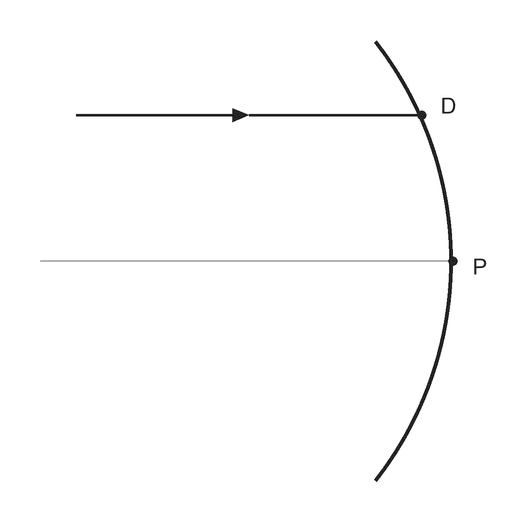
In deriving the mirror formula, the small arc of the mirror (from the pole to the point where a ray parallel to the axis strikes it) is treated as a straight line perpendicular to the axis. This approximation, and hence the mirror formula, is valid only when
- 343 marks
Question 34
A student measures object and image distances and (their sizes, in cm) for real images formed by a concave mirror and plots the graph below. The dashed line is ; it crosses the curve at P.
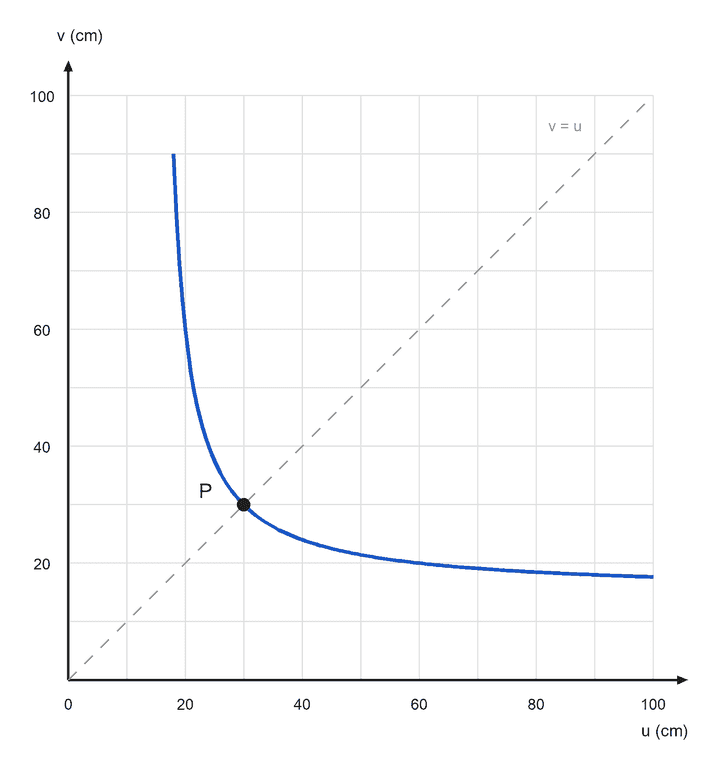
(a) Read the coordinates of P from the graph. Where is the object when the reading at P is taken? Explain.
(b) Hence find the radius of curvature and the focal length of the mirror.
(c) Use the mirror formula to find the image distance when the object is from the mirror, and check it against the graph.
- 351 mark
Question 35
A concave mirror forms an image of an object with linear magnification . The image is
- 361 mark
Question 36
A concave mirror of focal length forms a real image from its pole. The linear magnification is
- 371 mark
Question 37
For a concave mirror of focal length , a student plots (the reciprocal of the linear magnification) against the object distance , using signed values. The graph is a straight line with
- 381 mark
Question 38
An LED tall stands on the principal axis in front of a concave mirror. A sharp image of it is obtained on a screen in front of the mirror. The image is
- 392 marks
Question 39
An object tall is placed on the principal axis of a spherical mirror. The mirror forms an erect image tall, behind the mirror.
(a) Find the object distance.
(b) Find the focal length and state the type of mirror.
- 402 marks
Question 40
Using and the New Cartesian sign convention, show that a convex mirror always forms an erect image that is smaller than the object, wherever a real object is placed in front of it.
- 413 marks
Question 41
A small object is placed on the principal axis at a distance in front of a concave mirror of focal length , where . The concave mirror is then replaced by a convex mirror of the same focal length , the object staying where it is.
(a) Using , find the magnification in each case in terms of and , and state the nature of each image.
(b) Show that the image formed by the concave mirror is times as tall as the one formed by the convex mirror.
(c) Evaluate this ratio for and .
- 422 marks
Question 42
The linear magnifications produced by spherical mirrors for four different real objects are , , and . For each value, state whether the image is real or virtual and erect or inverted, and name the type of mirror (concave or convex) that can produce it.
- 431 mark
Question 43
A plane mirror, not a concave mirror, is fixed on a dressing table because
- 443 marks
Question 44
The passenger-side wing mirror of a car is a convex mirror of radius of curvature . A cyclist tall is behind the mirror.
(a) Find the position and height of the image of the cyclist.
(b) Such mirrors often carry the warning "Objects in mirror are closer than they appear". Explain why, using your answer to (a).
(c) Give one reason why a convex mirror, and not a plane mirror, is used here.
(Hypothetical data.)
- 452 marks
Question 45
A dentist uses a small concave mirror of radius of curvature and holds it from a tooth. A cavity on the tooth is wide.
(a) Find the position of the image of the tooth.
(b) How wide does the cavity appear in the image? Is the image erect or inverted?
(Hypothetical data.)
- 461 mark
Question 46
In a solar cooker that uses a large concave reflector facing the Sun, the cooking pot should be placed
- 473 marks
Question 47
A doctor examining a patient's ear wears a concave head mirror of focal length . The mirror reflects light from a lamp so that a sharp, bright image of the lamp's glowing filament falls on the patient's ear, in front of the mirror.
(a) Why must the mirror be concave?
(b) How far from the mirror must the lamp be placed?
(c) The filament is long. How long is its image on the ear, and is it erect or inverted?
(Hypothetical data.)
- 482 marks
Question 48
Large convex mirrors are fixed at sharp bends on hill roads.
(a) Give two reasons why a convex mirror is used there.
(b) State one drawback a driver must keep in mind when judging an oncoming vehicle in such a mirror.
- 491 mark
Question 49
In a car headlamp, the bulb's filament sits at the principal focus of a concave reflector and the reflected light leaves as a parallel beam. If the filament is moved slightly away from the reflector, so that it lies just beyond the focus, the reflected light becomes
- 502 marks
Question 50
An object is placed between two plane parallel mirrors. Why do the distant images get fainter and fainter?
- 512 marks
Question 51
Why are the mirrors used in searchlights parabolic and not concave spherical?
- 522 marks
Question 52
A man holding a lighted candle in front of a thick glass mirror and viewing it obliquely sees a number of images of the candle. What is the origin of these multiple images?
- 532 marks
Question 53
You read a newspaper because of the light it reflects. Then why do you not see even a faint image of yourself in the newspaper?
- 541 mark
Question 54
If you were driving a car, what type of mirror would you prefer to use for observing traffic at your back?
- 552 marks
Question 55
You have learnt that plane and convex mirrors produce virtual images of objects. Can they produce real images under some circumstances? Explain.
- 562 marks
Question 56
The wall of a room is covered with a plane mirror, and two movie films are made, one recording the movement of a man and the other of his mirror image. From viewing the films later, can an outsider tell which is which?
- 571 mark
Question 57
Can you photograph a virtual image?
- 581 mark
Question 58
What is the focal length of a plane mirror?
- 592 marks
Question 59
A parallel beam of light rays strikes a (i) plane mirror, (ii) concave mirror and (iii) convex mirror. What is the deviation produced in each case in terms of the angle of incidence?
- 603 marks
Question 60
A ray of light strikes a plane mirror such that the angle between the incident ray and the surface of the mirror is 35°. What is the angle of incidence and the angle of reflection?
- 613 marks
Question 61
A ray of light strikes a plane mirror such that the angle of incidence is 50°. What is the angle of deviation?
- 623 marks
Question 62
Light of wavelength 5893 Å falls on a plane reflecting surface. What are the wavelength and frequency of the reflected light? The velocity of light in vacuum is m/s.
- 633 marks
Question 63
Two objects 1 and 2 are kept on the principal axis of a concave mirror of focal length 20 cm. The height of the first object is three times that of the second. Their positions are so adjusted that they give images of the same size. Find the distance of the first object if the distance of the second object is 25 cm.
- 643 marks
Question 64
A convex and a concave mirror of radius of curvature 10 cm each are placed facing each other and 15 cm apart. An object is placed midway between them. Find the position of the final image if the reflection first takes place in the concave mirror and then in the convex mirror.
- 653 marks
Question 65
Find the focal length of a concave mirror to form an image of the sun 3 cm in diameter. Assume the diameter of the sun to be (1/100)th of its distance from the Earth.
- 663 marks
Question 66
The focal length of a convex mirror is . Does this convex mirror produce an image of a real object kept at a distance from the pole of the mirror at infinity? If not, where is the image formed? Where does a convex mirror produce an image at infinity?
- 673 marks
Question 67
A concave mirror of focal length 12 cm and a convex mirror of focal length 17 cm are placed facing each other 48 cm apart. A point object is placed between the mirrors on their common axis, 17 cm from the concave mirror. Find the position and nature of the image produced by reflections first at the concave mirror and then at the convex mirror.
- 681 mark
Question 68
A beam of light from a source L is incident normally on a plane mirror fixed at a certain distance from the source. The beam is reflected back as a spot on a scale placed just above the source L. When the mirror is rotated through a small angle , the spot of the light is found to move through a distance on the scale. The angle is given by
- 691 mark
Question 69
An object is kept at a distance of 60 cm from a concave mirror. For getting a magnification of , focal length of the concave mirror required is
- 701 mark
Question 70
A person wants a real image of his own, 3 times enlarged. Where should he stand in front of a concave mirror of radius of curvature 30 cm?
- 711 mark
Question 71
For unit magnification, the distance of an object from a concave mirror of focal length 20 cm will be
- 721 mark
Question 72
A virtual image larger than the object can be obtained by
- 731 mark
Question 73
If the lower half of a concave mirror's reflecting surface is made opaque, which of the following statements describe the image of an object placed in front of the mirror?
S1: Intensity of the image will increase.
S2: The image will show only half of the object.
S3: No change in the image.
S4: Intensity of the image will be reduced to half.
- 741 mark
Question 74
Radius of curvature of concave mirror is 40 cm and the size of image is twice as that of object, then the object distance is
- 751 mark
Question 75
An object is placed at 15 cm in front of a concave mirror whose focal length is 10 cm. The image formed will be
- 761 mark
Question 76
A convex mirror has a focal length . A real object placed at a distance in front of it from the pole produces an image at
- 771 mark
Question 77
A concave mirror gives an image three times as large as the object placed at a distance of 20 cm from it. For the image to be real, the focal length should be
- 781 mark
Question 78
An object is placed at a distance of 40 cm from a concave mirror of focal length 15 cm. If the object is displaced through a distance of 20 cm towards the mirror, the displacement of the image will be
- 791 mark
Question 79
A concave mirror of focal length is placed at a distance of from a convex lens of focal length . A beam of light coming from infinity and falling on this convex lens–concave mirror combination returns to infinity. The distance must equal
- 801 mark
Question 80
A concave mirror for face viewing has focal length of 0.4 m. The distance at which you hold the mirror from your face in order to see your image upright with a magnification of 5 is
- 811 mark
Question 81
An object is placed beyond the centre of curvature C of the given concave mirror. If the distance of the object is from C and the distance of the image formed is from C, the radius of curvature of this mirror is
- 821 mark
Question 82
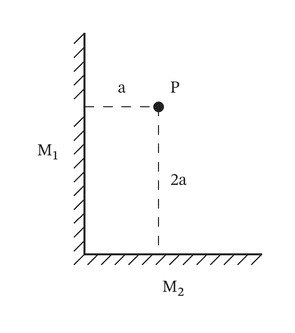
Two plane mirrors and are at right angle to each other as shown in the figure. A point source 'P' is placed at '' and '' metre away from and , respectively. The shortest distance between the images thus formed is (Take )