
Question 375 marksHard
Derive the relation for a concave mirror forming a virtual image.
Confirming your payment
Sign up now and get 250 free tokens.
Ray Optics - Reflection of Light by Spherical Mirrors · Question 37 of 49
Derive the relation for a concave mirror forming a virtual image.
Solution:
Key idea: The relation in the question is the mirror formula solved for the object distance, , applied to a concave mirror of focal length that forms a virtual image at a distance from the mirror. We first derive the mirror formula for this case and then solve it for .
Note: The printed middle step uses the "real is positive" sign convention. There a concave mirror has and a virtual image has .
With these signs the printed relation gives a real object at .
In the New Cartesian convention used in this chapter the same case has and .
With these signs the result is , worked below. Both conventions mean that the object is in front of the mirror.
Step 1 — Draw the ray diagram.
An object stands between and . The ray parallel to the axis is reflected through , and the ray is reflected at the pole at an equal angle. Produced backwards, the two reflected rays meet at behind the mirror, so is the virtual image; is perpendicular to the axis.
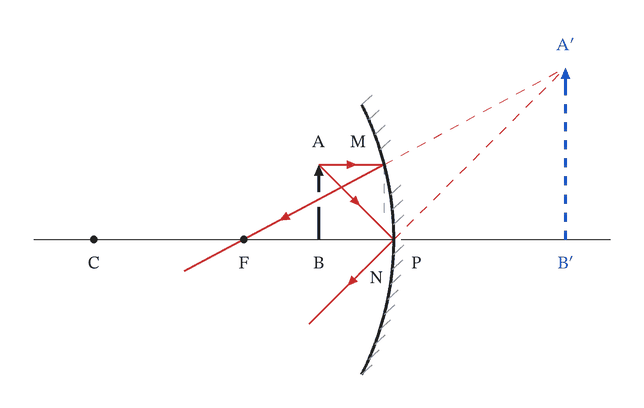
Step 2 — Use triangles and .
The angles at are equal by the law of reflection, and both triangles have a right angle on the axis, so they are similar.
Step 3 — Use triangles and .
The line produced backwards passes through , so these triangles share the angle at ; both have a right angle, so they are similar. For a paraxial ray and , and because and are on opposite sides of . This gives a second ratio.
Step 4 — Put in the signs.
In the New Cartesian convention , (the image is behind the mirror) and (the focus of a concave mirror is in front). Equating the two ratios gives the following.
We cross-multiply and simplify.
Step 5 — Obtain the mirror formula.
Dividing every term by turns each product into a reciprocal.
Step 6 — Solve for .
We write the right-hand side of the first line of Step 5 as one fraction and then invert it.
Step 7 — Apply it to the stated case.
Let the concave mirror have a focal length of size , so , and let the virtual image be a distance behind it, so .
The object is in front of the mirror, between and , as it must be for a virtual image. Its size, , matches the printed relation.
Therefore, , and for a virtual image at a distance from a concave mirror of focal length the object is in front of the mirror.