
Opening your dashboard
Class 12 Physics Chapter 14 Ray Optics - Reflection of Light by Spherical Mirrors: Competency-Based Questions (CBQ)
40 questions on Chapter 14, each worked through on its own page with the AI tutor. Class 12 Physics, ICSE 2026-27.
40 questions
1–4 marks · Mixed difficulty
- 13 marks
Question 1
Competency: Application
A ship's navigator measures the altitude of the Sun (its angle above the horizon) with a sextant. Light from the Sun is reflected first by a plane "index mirror" and then by a plane "horizon mirror", and reaches the eye together with light coming straight from the horizon. The two mirrors face each other, and the ray stays in the plane perpendicular to the line where the planes of the mirrors meet. (Hypothetical data.)
(a) Two plane mirrors face each other with an angle between them. Using the laws of reflection, show that a ray reflected once by each mirror is turned through an angle , whatever its angle of incidence on the first mirror.
(b) The Sun's image just touches the horizon when the angle between the two mirrors is . Find the altitude of the Sun.
(c) On a rolling ship the whole sextant tilts slightly in the plane of the ray. Explain why the reading does not change.
- 21 mark
Question 2
Competency: Analysis & Evaluation
A surveyor's laser rangefinder is aimed at a target that is a hollow "corner reflector": three plane mirrors meeting at right angles, like the inside corner of a box. Take axes along the three edges, so the mirrors lie in the , and planes. A ray with direction is reflected once by each of the three mirrors. Its final direction is
- 31 mark
Question 3
Competency: Analysis & Evaluation
In a light-show rig, a fixed laser beam falls obliquely on a plane mirror mounted on a sliding rail. The rail is perpendicular to the mirror's surface, and the operator slides the mirror along it, keeping the mirror parallel to its first position.
Assertion (A): As the mirror slides, the reflected beam shifts sideways but keeps the same direction.
Reason (R): The normal at the new point of incidence is parallel to the old normal, so the angle of incidence, and hence the angle of reflection, stays the same.
- 43 marks
Question 4
Competency: Application
An eye test needs the letter chart to be from the patient's eyes, but a clinic room is only long. So the chart (printed in mirror writing) hangs on the back wall above the patient's head, and a large plane mirror is fixed on the front wall. The patient's eyes are in front of the back wall and the patient reads the chart's image in the mirror. (Hypothetical data.)
(a) Explain why the patient sees the chart farther away than the mirror itself.
(b) How far from the patient's eyes must the mirror be? Check that it fits in the room.
(c) During the test the patient leans forward, towards the mirror. Find the new distance between the eyes and the image of the chart.
- 51 mark
Question 5
Competency: Application
In a solar power tower, each flat mirror (a heliostat) must keep sunlight reflected onto a fixed receiver at the top of the tower. Take the Sun's direction to turn steadily at per hour in the plane of incidence. At what rate must each mirror turn so that the reflected beam stays fixed on the receiver?
- 61 mark
Question 6
Competency: Analysis & Evaluation
The word AMBULANCE on the front of an ambulance is painted as mirror writing (each letter and the order of letters reversed left to right).
Assertion (A): This lets a driver ahead of the ambulance read the word correctly in the plane rear-view mirror.
Reason (R): A plane mirror forms an image as far behind the mirror as the object is in front of it.
- 73 marks
Question 7
Competency: Application
At a crowded cricket ground, a spectator uses a cardboard periscope to watch over the heads of the crowd. It has two plane mirrors, one at the top and one at the bottom of a vertical tube, with their centres apart. A batter is (horizontally) from the top mirror, and the spectator's eye is from the bottom mirror. (Hypothetical data.)
(a) How must the two mirrors be set, and why?
(b) How far from the spectator's eye is the image of the batter that she sees?
(c) Is this image erect? Is it laterally inverted? Give reasons.
- 83 marks
Question 8
Competency: Application
A garden "gazing ball" is a polished steel sphere of diameter . Its outer surface acts as a convex mirror. A window wide is in front of the ball, on its principal axis. (Hypothetical data.) (Treat the rays as paraxial and use the New Cartesian sign convention.)
(a) Write the radius of curvature and the focal length of this mirror, with signs.
(b) Find the position of the image of the window and the width of the image.
(c) A friend says that the image of a hill far away will be formed at the centre of the ball. Correct the friend.
- 91 mark
Question 9
Competency: Analysis & Evaluation
An optician cuts two concave mirrors from the same hollow silvered glass sphere: one with a rim of diameter and the other with a rim of diameter .
Assertion (A): For paraxial rays, the two mirrors have the same focal length.
Reason (R): The focal length of a spherical mirror increases as its aperture increases.
- 101 mark
Question 10
Competency: Analysis & Evaluation
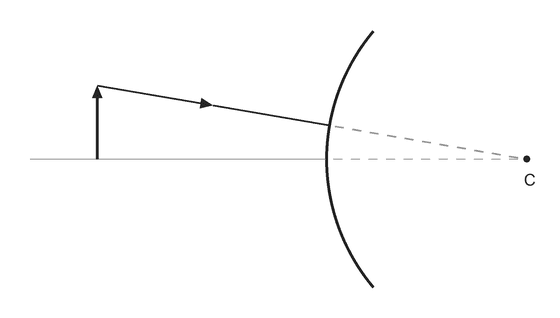
While drawing a ray diagram for a convex mirror, a student aims one ray from the top of the object towards the centre of curvature , which lies behind the mirror.
Assertion (A): After reflection, this ray travels back along its own path.
Reason (R): A ray aimed at meets the mirror along the normal at the point of incidence.
- 113 marks
Question 11
Competency: Application
An amateur telescope maker grinds a glass disc of diameter into a concave mirror. The depth of the hollow at the centre (the "sag" , measured from the plane of the rim) is related to the radius of curvature and the half-width of the disc by . (Hypothetical data.)
(a) He wants a focal length of . What radius of curvature must the surface have?
(b) Find the sag he must grind to. (Since , you may use .)
(c) He stops grinding when the sag is . What focal length does his mirror have?
- 123 marks
Question 12
Competency: Analysis & Evaluation
A science-fair "floating coin" toy has two identical concave mirrors, each of focal length , facing each other on a common vertical axis with their poles apart. The upper mirror has a small hole at its pole. Small objects are put on the centre of the lower mirror, and an image of them is seen floating in the hole. (Hypothetical data.) (Treat all rays as paraxial.)
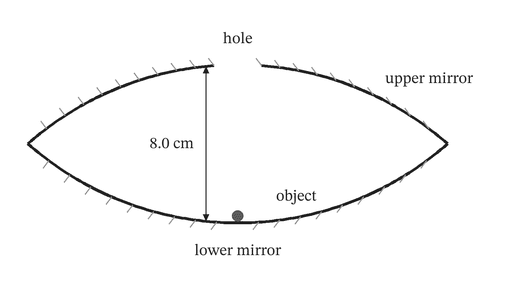
(a) Describe the light from a point of the object at the centre of the lower mirror after it is reflected by the upper mirror.
(b) Where is the final image formed after reflection at the lower mirror? Is it real or virtual?
(c) A tiny bead lies on the lower mirror from the axis. Find where its image is formed, and say what this tells you about the size of the image of an object.
- 131 mark
Question 13
Competency: Analysis & Evaluation
In a dark room, a concave mirror forms a sharp real image of a lit candle. One student looks towards the mirror from a point well beyond the image, without any screen, and sees the inverted flame hanging in the air.
Assertion (A): A real image formed by a concave mirror cannot be seen unless a screen is placed at the image position.
Reason (R): At a real image the reflected rays actually meet, and then travel on, diverging from that point.
- 141 mark
Question 14
Competency: Analysis & Evaluation
A student draws a ray diagram to scale for a mirror and forgets to mark and . The figure shows her diagram on a grid of squares. One ray from the top of the object is aimed at the centre of curvature and returns along itself; the other strikes the pole . Their extensions behind the mirror meet at .
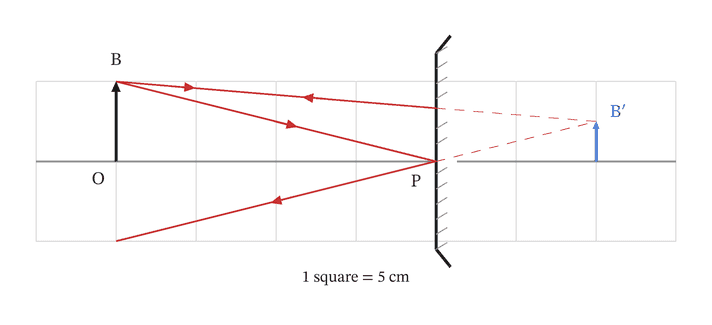
Using the New Cartesian sign convention, the focal length of the mirror is
- 151 mark
Question 15
Competency: Application
A shop has a convex security mirror of radius of curvature . A shopper walks along its principal axis from to in front of it. How far does her image move, and in which direction?
- 163 marks
Question 16
Competency: Analysis & Evaluation
An ant crawls along the principal axis towards a concave mirror of focal length at a steady . A student follows its image on a screen. (Hypothetical data.) (Use the New Cartesian sign convention.)
(a) Find the position of the image when the ant is from the pole.
(b) By differentiating the mirror formula with respect to time, find how fast the image moves at that instant, and in which direction.
(c) At what distance from the mirror does the image move exactly as fast as the ant?
- 171 mark
Question 17
Competency: Application
A jeweller needs an erect image of a tiny gem, times its size, formed behind an inspection mirror. Which mirror should she use?
- 181 mark
Question 18
Competency: Analysis & Evaluation
A student moves a candle along the axis of a concave mirror and keeps a screen on the image, measuring the distance between the candle and its real image each time.
Assertion (A): The distance between a real object and its real image formed by a concave mirror can never be less than the radius of curvature of the mirror.
Reason (R): When the object is at the centre of curvature, the image is formed at the centre of curvature.
- 193 marks
Question 19
Competency: Application
A stamp collector holds a square stamp of side parallel to a concave mirror of focal length , centred on its principal axis. (Hypothetical data.) (Use the New Cartesian sign convention.)
(a) The stamp is from the mirror. Find the position of the image and its linear magnification.
(b) Find the area of the image of the stamp. How many times the area of the stamp is it?
(c) The stamp is moved to from the mirror. Find the area of the image now, and state its nature.
- 201 mark
Question 20
Competency: Analysis & Evaluation
A magnifying cosmetic mirror is concave with focal length . A girl first holds her face from it and then brings it to . What happens to her image?
- 211 mark
Question 21
Competency: Analysis & Evaluation
In a lab activity, students form images of a bulb with a concave mirror at many positions and record the sign of the magnification each time.
Assertion (A): The real image of a real object formed by a concave mirror is always inverted.
Reason (R): The magnification is negative for every image formed by a concave mirror.
- 223 marks
Question 22
Competency: Analysis & Evaluation
A "fun mirror" toy is a polished steel strip bent into part of a cylinder with a horizontal axis, so that it bulges outwards in the vertical direction only: a vertical section is a convex arc of radius , and a horizontal section is a straight line. A toy doll tall and wide stands on the axis in front of it. (Hypothetical data.) (Treat the rays as paraxial; for heights use the convex section and for widths treat the strip as a plane mirror.)
(a) Find the height of the image of the doll.
(b) Find the width of the image, and describe how the doll looks in the mirror.
(c) The doll is moved back to from the strip. Find the new height and width of its image.
- 233 marks
Question 23
Competency: Application
In a slide projector, a small concave reflector of focal length sits behind the lamp. Light that the filament sends backwards is reflected and sent forward again through the filament region towards the lenses. (Hypothetical data.) (Use the New Cartesian sign convention.)
(a) At what distance from the reflector should the filament be placed so that the backward light returns through the filament itself? Give the reason.
(b) State the nature and size of the image of a wide filament at this position.
(c) By mistake the filament is fixed from the reflector. Where is its image now, and why is the lamp less effective?
- 241 mark
Question 24
Competency: Application
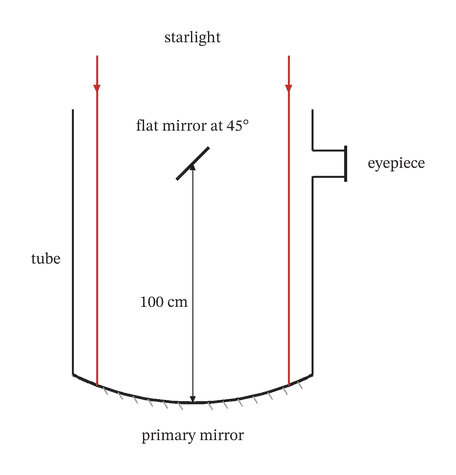
A school's reflecting telescope has a concave primary mirror of focal length at the bottom of its tube. A small flat mirror, set at to the axis with its centre on the axis from the primary, turns the light sideways towards an eyepiece on the side of the tube. Where is the image of a star formed?
- 251 mark
Question 25
Competency: Analysis & Evaluation
A shopkeeper fixes a large convex mirror high in a corner so that, from the counter, he can see every aisle of the shop.
Assertion (A): A convex mirror is used for this because it gives a much wider field of view than a plane mirror of the same size.
Reason (R): The image formed by a convex mirror is laterally inverted.
- 263 marks
Question 26
A concave spherical mirror has a radius of curvature of and a large aperture. A ray travelling parallel to the principal axis, above it, strikes the mirror at B.
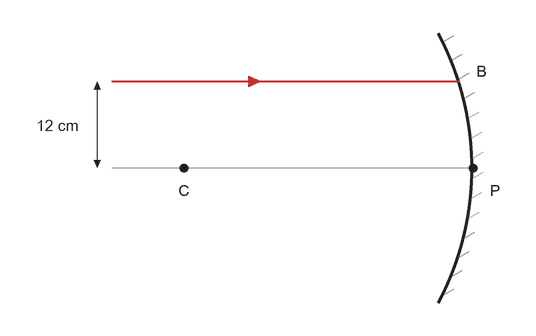
(i) Find the angle of incidence at B.
(ii) Find the distance from the pole P at which the reflected ray crosses the principal axis.
(iii) Compare your answer with the focal length , and explain why the principal focus of a spherical mirror is defined only for rays close to the principal axis.
- 273 marks
Question 27
An object is placed at a distance of 8 cm from the pole of a concave mirror of focal length 16 cm on the principal axis of the mirror. Find the position and nature of the image.
- 283 marks
Question 28
The radius of curvature of a convex mirror is 20 cm and it forms the image of an object on its principal axis, at a distance of 5 cm from the pole of the mirror. Find the distance of the object and the magnification.
- 293 marks
Question 29
Find the position and nature of the image formed by a concave mirror of focal length 12 cm when an object is placed on the principal axis at a distance of 10 cm from the pole.
- 303 marks
Question 30
The radius of curvature of a convex mirror is 40 cm, and the size of the object is twice as that of the image. Calculate the image distance.
- 313 marks
Question 31
A man is using a concave mirror for shaving. If his face is 20 cm from the mirror having magnification 2, what will be the radius of curvature of the mirror.
- 323 marks
Question 32
A concave mirror of focal length 15 cm forms an image having twice the linear dimensions of the object. Determine the position of the object when the image is virtual.
- 333 marks
Question 33
In front of a concave mirror of focal length 16 cm, a plane mirror is placed at a distance of 36 cm from the pole of the concave mirror. Where should an object be placed between them so that the images formed by the two mirrors coincide?
- 343 marks
Question 34
A concave mirror of focal length 30 cm is kept in the path of a converging beam. The distance between the point of convergence in the absence of the mirror, as shown in the figure, and the pole of the mirror is 15 cm, when the mirror is introduced. Find the distance of the point of convergence from the pole of the mirror.

- 351 mark
Question 35
Competency: Analysis
For a science-club exhibit, a small bright bulb is fixed on the principal axis in front of a concave mirror of radius of curvature , and a sharp image of the bulb is caught on a small screen. The club then replaces the mirror with a concave mirror of radius of curvature , placed exactly where the first one was. The bulb is not moved. (Hypothetical data.)
To get a sharp image again, the screen must be moved
- 361 mark
Question 36
Competency: Evaluation
A family wants to fix one vertical plane mirror on a bedroom wall so that both the father and his son can see their full images in it while standing upright in front of it. The father is tall with his eyes above the floor. The son is tall with his eyes above the floor. (Hypothetical data.)
The shortest mirror that serves both of them, and the height of its lower edge, are
- 372 marks
Question 37
Competency: Application
A farmer wants to look down an old open well at midday, but the inside is dark. He holds a flat mirror above the mouth of the well so that sunlight reflected by it goes vertically downwards into the well. The Sun is above the horizon, and the incident ray, the reflected ray and the normal lie in one vertical plane. (Hypothetical data.)
(a) Find the angle of incidence of the sunlight on the mirror.
(b) At what angle to the horizontal must the mirror be held, and which way must its reflecting face be turned?
- 382 marks
Question 38
Competency: Evaluation
A man shaves standing with his face from a cabinet mirror, and the cabinet does not let him come closer. A shop offers him two concave shaving mirrors: mirror of focal length and mirror of focal length . (Hypothetical data.) (Use the New Cartesian sign convention.)
(a) Find the linear magnification each mirror gives for his face at .
(b) Which mirror should he buy? Give a reason based on your answers to (a).
- 393 marks
Question 39
Competency: Analysis
A guard at the exit of a multi-storey car park watches the ramp in a circular convex mirror of diameter and radius of curvature . His eye is on the principal axis of the mirror, in front of its pole. (Hypothetical data.)
A ray from the scene reaches his eye after reflection only if, before reflection, it is heading towards the image of his eye formed by the mirror (the paths of light are reversible). So the region he can see is bounded by straight lines drawn from through the rim of the mirror. (Treat the rays as paraxial for this estimate, use the New Cartesian sign convention, and take the rim to lie in the plane through the pole.)
(a) Find the position of .
(b) Find the angle of the cone of view he gets, and compare it with that of a plane mirror of the same diameter at the same place.
(c) How wide a strip of the ramp, across a line in front of the mirror and perpendicular to its axis, can he see in the convex mirror?
- 404 marks
Question 40
Competency: Analysis & Evaluation
A school eco-club wants a concave mirror to heat water with sunlight. It compares three spherical concave mirrors, each turned so that sunlight falls along its principal axis. The Sun has a diameter of and is from the Earth. The sunlight a mirror collects is in proportion to the area of its circular rim, and all of it is spread over the Sun's image. Treat the rays as paraxial, ignore losses, and use the New Cartesian sign convention. (Hypothetical data.)
Mirror Rim diameter (cm) Focal length (cm) (a) Use the mirror formula to show that each mirror forms the Sun's image at its principal focus, and state the nature of this image.
(b) Find the diameter of the Sun's image formed by each mirror.
(c) A club member says, "Mirror is the biggest, so it will give the brightest, hottest spot." Compare the intensity (power per unit area) at the three images, and evaluate the claim.