
Question 343 marksMedium
What is linear magnification? How is it related to the focal length of the mirror?
Confirming your payment
Sign up now and get 250 free tokens.
Ray Optics - Reflection of Light by Spherical Mirrors · Question 34 of 49
What is linear magnification? How is it related to the focal length of the mirror?
Solution:
Key idea: Linear magnification compares the height of the image with the height of the object. Similar triangles give it in terms of and , and the mirror formula then lets us replace one of the distances by the focal length.
Step 1 — Define linear magnification.
Linear magnification is the ratio of the height of the image to the height of the object .
Step 2 — Express it in terms of and .
In the figure, the ray striking the pole is reflected at an equal angle, so triangles and are similar.
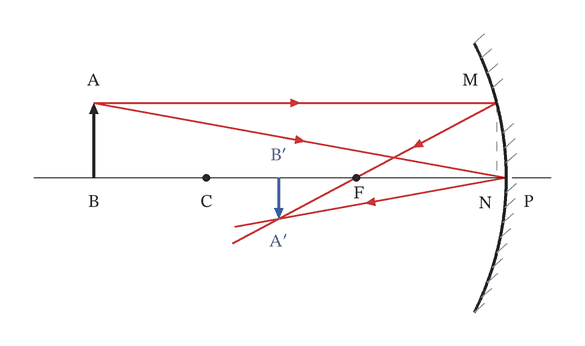
Their sides are in the same ratio.
With signs, and (the image is inverted, so is negative), while and . We put these lengths into the ratio.
Step 3 — Express it in terms of and .
We multiply the mirror formula by .
Changing the sign gives the magnification.
Step 4 — Express it in terms of and .
We multiply the mirror formula by instead.
Turning this ratio upside down and changing the sign gives the magnification.
Step 5 — Check with numbers.
We take a concave mirror with cm.
We find the image of an object at cm from the mirror formula.
All three forms then give the same magnification, a real, inverted image half the size of the object.
Therefore, , and in terms of the focal length or (both equal to ).