
Opening your dashboard
Class 11 Physics Chapter 17: Heat Transfer Solutions
71 textbook questions with step-by-step answers, free to read, for ISC 2026-27.
Get talked through Ch 17, not just shown the answer
Reading a finished solution is not the same as being able to do it. The AI tutor takes one question at a time and works it with you, in your own words, until you can.
- Ask it out loud, in your own words
- It gives you the next step, not the answer
- Stuck on part (ii)? Start there
71 questions with solutions
1–5 marks · Mixed difficulty
The first 61 solutions are on this page. This chapter is a long one, so the rest open on their own page to keep this one quick to load.
- 11 mark
Question 1
The coefficient of thermal conductivity of a metal depends on
Solve with AIAnswer
(A) temperature difference between two sides
(B) thickness of metal plate
(C) area of the plate
- Correct
(D) none of the above factors
Answer: (D) none of the above factors
Concept: The coefficient of thermal conductivity in is a property of the material itself (it changes a little with temperature), not of the size or shape of the piece.
Step 1 — Read the law of conduction. The heat flowing through a plate depends on its area , its thickness and the temperature difference , and the constant multiplies all of these.
Step 2 — Separate the constant from the variables. If we double the area or the thickness of a copper plate, changes, but for copper stays the same. So depends only on the nature of the material.
Step 3 — Check the other options. Each listed factor changes the heat flow, not the conductivity:
- (A) The temperature difference changes the rate of heat flow, but is the same for any difference.
- (B) A thicker plate passes less heat, but its is unchanged.
- (C) A larger plate passes more heat, but its is unchanged.
Therefore, the answer is (D): thermal conductivity depends only on the nature of the material.
- 21 mark
Question 2
A sphere, a cube and a thin circular plate, all made of the same material and having the same mass are initially heated to a temperature of 3000°C. Which of these will cool fastest?
Solve with AIAnswer
(A) sphere
(B) cube
- Correct
(C) plate
(D) none of these
Answer: (C) plate
Concept: A hot body loses heat mainly by radiation from its surface, so the rate of loss of heat is proportional to the surface area. The rate of fall of temperature is this rate divided by .
Step 1 — Compare the heat capacities. The three bodies have the same mass and are of the same material, so they have the same and the same starting temperature.
Step 2 — Compare the surface areas. For a given volume a sphere has the least surface area, a cube a little more, and a thin plate by far the most.
Step 3 — Decide which cools fastest. The plate loses heat fastest from its large surface, and with the same its temperature falls fastest.
Step 4 — Check the other options. Each of the other options fails for a definite reason:
- (A) The sphere has the smallest surface for its volume, so it cools slowest.
- (B) The cube has more surface than the sphere but much less than a thin plate.
- (D) The rates are not equal, because the surface areas differ.
Therefore, the thin circular plate cools fastest.
- 31 mark
Question 3
Equal temperature difference exists between the ends of two metallic rods 1 and 2 of equal length. Their thermal conductivities are and and cross-sectional areas are respectively and . The condition for equal rate of heat transfer will be
Solve with AIAnswer
(A)
(B)
- Correct
(C)
(D)
Answer: (C)
Concept: The rate of heat flow through a rod is .
Step 1 — Equate the two rates. The length and the temperature difference are the same for both rods, so equal rates need
Step 2 — Cancel the common factor. Cancelling from both sides leaves
Step 3 — Check the other options. Each of the other options fails for a definite reason:
- (A) This pairs each conductivity with the other rod's area; the rate depends on the product of a rod's own and .
- (B) The rate is proportional to , not to .
- (D) The rate is proportional to , not to .
Therefore, the condition is .
- 41 mark
Question 4
Heat is flowing through two cylindrical rods of the same material. The diameters of the rods are in the ratio 1:2 and the length in the ratio 2:1. If the temperature difference between the ends is same, then ratio of the rate of flow of heat through them will be
Solve with AIAnswer
(A) 1:1
- Correct
(B) 1:8
(C) 2:1
(D) 8:1
Answer: (B) 1:8
Concept: The rate of heat flow is .
The area of a rod of diameter is , so for the same material and temperature difference .
Step 1 — Write the ratio of the rates. For rods 1 and 2,
Step 2 — Put in the given ratios. We substitute and :
Step 3 — Check the other options. Each of the other options fails for a definite reason:
- (A) Equal rates would need the area ratio to cancel the length ratio; here the thinner rod is also the longer one, so both effects lower its rate.
- (C) This is just the ratio of the lengths; it ignores the areas and puts the length on top, although the rate falls as the length grows.
- (D) This is the correct ratio turned upside down: rod 2 to rod 1.
Therefore, the rates of flow of heat are in the ratio 1 : 8.
- 51 mark
Question 5
If two metallic plates of equal thickness and thermal conductivities and are put together face-to-face and a common plate is constructed, then the equivalent thermal conductivity of this plate will be
Solve with AIAnswer
(A)
- Correct
(B)
(C)
(D)
Answer: (B)
Concept: Plates put face to face carry the same heat one after the other, so their thermal resistances add like resistors in series.
Step 1 — Add the two resistances. Each plate has thickness and area , so the combined plate of thickness has
Step 2 — Solve for the equivalent conductivity. Cancelling gives
Step 3 — Check the other options. A quick test is to make and both equal to ; two plates of the same metal must behave like that metal, so the answer must be :
- (A) This gives ; it forgets that the combined plate is twice as thick.
- (C) This gives , which is too large.
- (D) This gives , which is also wrong.
Therefore, the equivalent thermal conductivity is .
- 61 mark
Question 6
Two vessels of different materials are similar in size in every respect. The same quantity of ice filled in them gets melted in 20 minutes and 40 minutes respectively. The ratio of thermal conductivities of the metals is
Solve with AIAnswer
(A) 5:6
(B) 6:5
(C) 3:1
- Correct
(D) 2:1
Answer: (D) 2:1
Concept: The heat conducted through a wall is .
Melting the same mass of ice needs the same heat, , in both vessels.
Step 1 — Find how depends on the time. The vessels have the same area , the same wall thickness and the same temperature difference, and both supply the same heat . So is the same for both:
Step 2 — Put in the times. With min and min,
Step 3 — Check the other options. Each of the other options fails for a definite reason:
- (A) This would make the first vessel the poorer conductor, yet its ice melts in half the time.
- (B) This ratio is close to 1, but the melting times differ by a factor of 2, so the conductivities must too.
- (C) A factor of 3 would need one melting time to be three times the other, not twice.
Therefore, the thermal conductivities are in the ratio 2 : 1.
- 71 mark
Question 7
The coefficients of thermal conductivity of copper, mercury and glass are respectively , and such that . If the same quantity of heat is to flow per second per unit area of each and corresponding temperature gradients are , and , then
Solve with AIAnswer
(A)
(B)
- Correct
(C)
(D)
Answer: (C)
Concept: The heat flowing per second per unit area is , where is the temperature gradient.
Step 1 — Find how the gradient depends on . The same heat flows per second per unit area in each, so is the same for all three:
Step 2 — Order the gradients. The gradient is inversely proportional to , so the best conductor needs the smallest gradient. Since , we get .
Step 3 — Check the other options. Each of the other options fails for a definite reason:
- (A) Equal gradients would give equal heat flows only if the conductivities were equal, which they are not.
- (B) This is the order of the conductivities, not of the gradients, which run the other way.
- (D) Copper conducts better than mercury, so its gradient is the smaller of the two, not the larger.
Therefore, .
- 81 mark
Question 8
A cylindrical rod has temperatures and at its ends. The rate of flow of heat is cal/s. If all the linear dimensions are doubled keeping temperature constant, then rate of flow of heat will be
Solve with AIAnswer
(A)
- Correct
(B)
(C)
(D)
Answer: (B)
Concept: The rate of heat flow through a rod of radius and length is , so .
Step 1 — Double every length. When becomes and becomes ,
Step 2 — Check the other options. Each of the other options fails for a definite reason:
- (A) This counts only the fourfold area and forgets that the rod is also twice as long.
- (C) This needs two slips at once: it takes the area effect upside down (dividing by instead of multiplying, although a thicker rod carries more heat, not less) and it also leaves out the doubled length. Taking the area upside down alone would give .
- (D) This counts only the doubled length and forgets the fourfold area.
Therefore, .
- 91 mark
Question 9
Three rods made of same material and having same cross-section have been joined as shown in the given figure. Each rod is of same length. The left and right ends are kept at 0°C and 90°C respectively. The temperature of the junction of the three rods will be
 Solve with AI
Answer
(A) 45°C
- Correct
(B) 60°C
(C) 30°C
(D) 20°C
Answer: (B) 60°C
Concept: In the steady state the junction neither gains nor loses heat, so the heat flowing into it per second equals the heat flowing out. For identical rods the rate of flow is proportional to the temperature difference across each rod.
Step 1 — Write the heat balance at the junction. Let the junction be at . Heat flows into it through rods 2 and 3 (from 90 °C) and out of it through rod 1 (to 0 °C). With the same , and length for every rod,
Step 2 — Solve for . Cancelling gives
Step 3 — Check the other options. Each wrong value breaks the heat balance:
- (A) At 45 °C, rods 2 and 3 would bring in heat in proportion to while rod 1 removes only 45; 45 °C is just the mean of 0 °C and 90 °C, which ignores that two rods feed the junction.
- (C) At 30 °C the inflow would be against an outflow of 30.
- (D) At 20 °C the inflow would be against an outflow of 20.
Therefore, the junction is at 60 °C.
- 101 mark
Question 10
In which process, the rate of transfer of heat is maximum?
Solve with AIAnswer
(A) Conduction
(B) Convection
- Correct
(C) Radiation
(D) In all these, heat is transferred with the same speed
Answer: (C) Radiation
Concept: Radiation carries heat as electromagnetic waves, which travel at the speed of light ( in vacuum) and need no medium.
Step 1 — Compare the three processes. In conduction heat is passed slowly from particle to particle; in convection it is carried by the bulk movement of a fluid, which is also slow. Radiation reaches a distant body almost at once, at the speed of light.
Step 2 — Check the other options. Each of the other options fails for a definite reason:
- (A) Conduction passes energy from one particle to the next and is the slowest of the three.
- (B) Convection depends on the actual movement of the fluid. Convection currents usually move at centimetres to metres per second, and even the fastest updrafts in a storm reach only tens of metres per second, which is far slower than light.
- (D) The speeds are not the same: radiation travels at about , while conduction and convection both depend on the movement of matter and are many millions of times slower.
Therefore, heat is transferred fastest by radiation.
- 111 mark
Question 11
The energy supply being cut-off, an electric heater element cools down to a temperature of its surroundings, but it will not cool further because
Solve with AIAnswer
(A) supply is cut off
(B) it is made of metal
(C) surrounding are radiating
- Correct
(D) element and surroundings have same temperature
Answer: (D) element and surroundings have same temperature
Concept: By Prevost's theory, every body radiates all the time and also absorbs radiation from its surroundings. A body cools only while it emits more than it absorbs, that is, while it is hotter than its surroundings.
Step 1 — Look at the element once it reaches room temperature. When the element is at the same temperature as its surroundings, it absorbs as much radiation per second as it emits, so the net loss of heat is zero.
Step 2 — Check the other options. Each of the other options fails for a definite reason:
- (A) Cutting off the supply is the reason the element starts to cool, not the reason it stops.
- (B) Being made of metal does not decide the final temperature; a body of any material stops cooling at the temperature of its surroundings.
- (C) The surroundings radiate at every temperature, also while the element is cooling; what stops the cooling is that the exchange becomes balanced.
Therefore, the element stops cooling because it and its surroundings are at the same temperature.
- 121 mark
Question 12
A solid sphere and a hollow sphere of same material and size are heated to same temperature and allowed to cool in the same surroundings. If the temperature difference between each sphere and its surrounding is , then
Solve with AIAnswer
- Correct
(A) the hollow sphere will cool at a faster rate for all values of
(B) the solid sphere will cool at a faster rate for all values of
(C) both spheres will cool at the same rate for all values of
(D) both spheres will cool at the same rate only for small values of
Answer: (A) the hollow sphere will cool at a faster rate for all values of
Concept: The rate of fall of temperature is . The rate of loss of heat depends on the surface (area, nature) and on the temperature difference.
Step 1 — Compare the rates of loss of heat. The spheres have the same size, material and surface, so at any temperature difference they lose heat at the same rate.
Step 2 — Compare the heat capacities. The hollow sphere has less mass, so its is smaller.
Step 3 — Compare the rates of cooling. With the same rate of loss of heat and a smaller , the hollow sphere's temperature always falls faster, whatever the value of .
Step 4 — Check the other options. Each of the other options fails for a definite reason:
- (B) The solid sphere has the larger heat capacity, so it cools more slowly.
- (C) The rates would be equal only if the masses were equal.
- (D) Small is the condition for Newton's law to hold; it does not make the two masses equal.
Therefore, the hollow sphere cools faster for all values of .
- 131 mark
Question 13
A body in a room cools from 85°C to 80°C in 5 minutes. The time taken to cool from 80°C to 75°C is
Solve with AIAnswer
(A) 5 minutes
(B) less than 5 minutes
- Correct
(C) more than 5 minutes
(D) less or more than 5 minutes
Answer: (C) more than 5 minutes
Concept: By Newton's law of cooling, the rate of cooling is proportional to the excess of the body's temperature over that of its surroundings.
Step 1 — Compare the average excess temperatures. In the first interval the mean temperature is 82.5 °C; in the second it is 77.5 °C. The room is cooler than both, so the excess over the room is smaller in the second interval.
Step 2 — Compare the times. A smaller excess means slower cooling, so the same fall of 5 °C takes longer the second time.
Step 3 — Check the other options. Each of the other options fails for a definite reason:
- (A) Equal times would need the same rate of cooling, but the excess temperature has fallen.
- (B) The body cools more slowly as it gets closer to room temperature, not faster.
- (D) The answer is not uncertain: the excess temperature is smaller in the second interval, so that interval is definitely the longer one.
Therefore, it takes more than 5 minutes to cool from 80 °C to 75 °C.
- 141 mark
Question 14
If the temperature of a perfectly black body measured in Kelvin is doubled, then the energy radiated per second becomes
Solve with AIAnswer
(A) twice the original value
- Correct
(B) 16 times the original value
(C) half the original value
(D) 4 times the original value
(E) 1/16 times the original value
Answer: (B) 16 times the original value
Concept: Stefan's law: the energy radiated per second by a black body is , so .
Step 1 — Double the temperature. With replaced by ,
Step 2 — Check the other options. Each of the other options fails for a definite reason:
- (A) This takes , the first power instead of the fourth.
- (C) A hotter body radiates more, not less.
- (D) This takes .
- (E) This is the correct factor upside down; the energy rises, it does not fall.
Therefore, the energy radiated per second becomes 16 times the original value.
- 151 mark
Question 15
A wire is heated gradually as temperature rises, at first it appears
Solve with AIAnswer
- Correct
(A) red
(B) green
(C) yellow
(D) white
Answer: (A) red
Concept: Wien's displacement law: . The lower the temperature, the longer the wavelength at which a hot body radiates most.
Step 1 — Look at a moderately hot wire. At first nearly all the radiation is invisible infrared. When the wire becomes hot enough to glow (roughly 500 °C to 600 °C), the only visible light it gives out in useful amount is at the long-wavelength end of the visible spectrum, which is red.
Step 2 — Follow the colour as it gets hotter. As the temperature rises further, more and more of the shorter visible wavelengths are given out, so the glow turns orange, then yellow, and finally white.
Step 3 — Check the other options. Each of the other options fails for a definite reason:
- (B) A heated wire never glows green: by the time it gives out much green light it also gives out red and yellow, and the mixture looks yellowish-white.
- (C) Yellow appears only at higher temperatures, after the red glow.
- (D) White is the colour at the highest temperatures, when all visible wavelengths are given out strongly.
Therefore, the heated wire at first appears red.
- 161 mark
Question 16
If the temperature of a black body is doubled, the wavelength at which the spectral radiancy has its maximum is
Solve with AIAnswer
(A) doubled
- Correct
(B) halved
(C) quadrupled
(D) unchanged
Answer: (B) halved
Concept: Wien's displacement law: , a constant, so .
Step 1 — Double the temperature. With replaced by ,
Step 2 — Check the other options. Each of the other options fails for a definite reason:
- (A) This treats as proportional to ; in fact it falls as rises.
- (C) A fourfold change would need , which is not the law.
- (D) The peak does shift: this shift with temperature is what the displacement law describes.
Therefore, the wavelength of maximum spectral radiancy is halved.
- 171 mark
Question 17
The plots of intensity versus wavelength for three black bodies at temperatures , and respectively are shown in the given figure. Their temperatures are such that
 Solve with AI
Answer
(A)
- Correct
(B)
(C)
(D)
Answer: (B)
Concept: Wien's displacement law: , so the hotter a black body, the shorter the wavelength at which its curve has its peak.
Step 1 — Read the peak wavelengths. In the figure the curve for peaks at the shortest wavelength, the curve for next, and the curve for at the longest wavelength:
Step 2 — Turn this into temperatures. Since , the shortest peak wavelength belongs to the highest temperature, so
Step 3 — Check the other options. Each of the other options fails for a definite reason:
- (A) This puts above , but the curve peaks at a longer wavelength than the curve.
- (C) This is the order of the peak wavelengths, not of the temperatures, which run the opposite way.
- (D) This ranks the curves by the heights of their peaks as sketched. The question is about the peak positions, which the displacement law links to temperature; the heights in this sketch are not drawn to scale.
Note: in a true set of black-body curves the hotter body's curve lies above the cooler one's at every wavelength, so the curves never cross and the curve that peaks at the shortest wavelength is also the tallest. The sketch shows the curves crossing and the curve lowest, so only the peak positions can be used.
Therefore, .
- 181 mark
Question 18
“Insulators also contain electrons, but they are not conductors.” Why?
Solve with AIWritten solution
Solution:
Concept: A material conducts electricity (and conducts heat well) when it has free electrons that can move through it.
Step 1 — Look at the electrons in an insulator. In an insulator every electron is tightly bound to its own atom; there are practically no free electrons.
Step 2 — See the result. Bound electrons cannot drift through the material, so they cannot carry charge from one end to the other (and heat is carried only by the slower vibrations of the atoms).
Therefore, insulators are not conductors because their electrons are bound to atoms and are not free to move.
- 191 mark
Question 19
“Water can be boiled in a paper cup”. Explain how?
Solve with AIWritten solution
Solution:
Concept: Paper catches fire only above roughly 230 °C, while water at normal pressure cannot rise above its boiling point of 100 °C.
Step 1 — Follow the heat through the paper. The paper wall is very thin, so the heat from the flame passes through it quickly into the water, which conducts heat better than paper and also carries it away by convection.
Step 2 — See why the paper does not burn. The water takes up the heat and keeps the paper in contact with it near the temperature of the water, which never goes above 100 °C. The paper therefore never reaches the temperature at which it would burn.
Therefore, water can be boiled in a paper cup because the water quickly takes away the heat and keeps the paper below its burning temperature.
- 201 mark
Question 20
“It is hotter at the same distance over the top of a fire than in front of it.” Why?
Solve with AIWritten solution
Solution:
Concept: Heat reaches us from a fire by radiation in every direction, but hot air carries heat only upwards, by convection.
Step 1 — Look at a point in front of the fire. Heat reaches it mainly by radiation.
Step 2 — Look at a point above the fire. Heat reaches it by radiation and also by the hot gases rising from the fire as convection currents.
Therefore, it is hotter above the fire because heat arrives there by both radiation and convection, but in front of it mainly by radiation.
- 211 mark
Question 21
Two bodies of different temperatures and , if brought in thermal contact, do not necessarily settle to the mean temperature . Why?
Solve with AIWritten solution
Solution:
Concept: When two bodies are in contact, the heat lost by the hotter body equals the heat gained by the colder one: .
Step 1 — Solve for the final temperature. The common final temperature is
Step 2 — See when this is the mean. This equals only when , that is, when the two bodies have equal heat capacities.
Therefore, they do not necessarily settle at the mean temperature because their masses and specific heat capacities (heat capacities) may be different.
- 221 mark
Question 22
Pieces of glass and copper are heated to the same temperature. Why does the piece of copper feel hotter on touching?
Solve with AIWritten solution
Solution:
Concept: How hot a body feels depends on how fast heat flows from it into our hand. For bodies at the same temperature, this rate is much larger for a material that conducts heat well (high thermal conductivity) than for a poor conductor.
Step 1 — Compare the conductivities. Copper is a good conductor of heat; glass is a poor conductor.
Step 2 — Compare the heat reaching the hand. Copper quickly brings heat from deep inside the piece to the spot we touch and delivers it to the hand, so the skin warms quickly. Glass passes heat on only slowly, so the layer touching the skin cools a little and the heat reaches the hand slowly.
Therefore, the copper feels hotter because, being a good conductor, it conducts heat into our hand quickly.
- 231 mark
Question 23
Name the method of heat transfer which does not depend on gravity.
Solve with AIWritten solution
Solution:
Concept: Convection needs gravity: warm fluid rises only because it is less dense and the buoyant force on it exceeds its weight.
Step 1 — Look at each process. Conduction passes energy from particle to particle, and radiation travels as electromagnetic waves; neither needs gravity. Natural convection does.
Therefore, radiation (and also conduction) does not depend on gravity.
- 241 mark
Question 24
Does a body at 0°C radiate any heat?
Solve with AIWritten solution
Solution:
Concept: Prevost's theory: every body above absolute zero (0 K, or −273.15 °C) emits thermal radiation, whatever its surroundings.
Step 1 — Compare 0 °C with absolute zero. 0 °C is 273.15 K, far above absolute zero, so a body at 0 °C does radiate.
Therefore, yes, a body at 0 °C radiates heat.
- 251 mark
Question 25
Name the instrument used to measure temperature using the radiation emitted from the body.
Solve with AIWritten solution
Solution:
Concept: A hot body radiates more strongly the higher its temperature, so its radiation can be used to find its temperature without touching it.
Step 1 — Name the instrument. The instrument that works on this principle is the radiation pyrometer.
Therefore, the instrument is a radiation pyrometer.
- 261 mark
Question 26
What is () the absorbing power and () the reflecting power of a ‘perfect black body’?
Solve with AIWritten solution
Solution:
Concept: For any body, absorbing power + reflecting power + transmitting power = 1. A perfect black body absorbs all the radiation falling on it.
Step 1 — Absorbing power. It absorbs all the radiation falling on it, so its absorbing power is 1.
Step 2 — Reflecting power. Nothing is left to be reflected, so its reflecting power is 0.
Therefore, (i) the absorbing power is 1 and (ii) the reflecting power is zero.
- 271 mark
Question 27
“A hot liquid remains hot and a cold liquid remains cold in a thermos flask.” Explain how?
Solve with AIWritten solution
Solution:
Concept: Heat can pass by conduction, convection and radiation. A thermos flask is built to cut down all three.
Step 1 — Stop conduction and convection. The flask has double glass walls with a vacuum between them. Conduction and convection need a medium, so almost no heat crosses the vacuum. The insulating stopper and supports also conduct very little.
Step 2 — Stop radiation. The facing surfaces of the walls are silvered (shiny). A shiny surface is a poor emitter and a good reflector, so very little heat is radiated across the vacuum.
Therefore, the vacuum stops conduction and convection and the silvered walls cut down radiation, so a hot liquid stays hot and a cold liquid stays cold.
- 281 mark
Question 28
“Lamp black and platinum black are used as perfect black body one for absorption of heat radiation.” Why?
Solve with AIWritten solution
Solution:
Concept: A perfect black body absorbs all radiation of every wavelength falling on it.
Step 1 — Look at the two coatings. Lamp black and platinum black absorb nearly all the radiation that falls on them over a very wide range of wavelengths (lamp black about 98 %).
Step 2 — See why they are only nearly perfect. They reflect a little and absorb less well at some long infrared wavelengths, so for an ideal black body a cavity with a small opening is used.
Therefore, they are used as black bodies for absorption because they absorb almost all the radiation of nearly all wavelengths falling on them.
- 291 mark
Question 29
At what temperature does a body stop radiating heat?
Solve with AIWritten solution
Solution:
Concept: Prevost's theory: every body above absolute zero emits thermal radiation.
Step 1 — Find the limit. Emission stops only at absolute zero, 0 K (−273.15 °C), which can be approached but never actually reached.
Therefore, a body stops radiating heat only at absolute zero, 0 K.
- 301 mark
Question 30
“A black dot on a porcelain cup appears dark. But when heated to a high temperature, it becomes brighter than the rest of the cup.” Why?
Solve with AIWritten solution
Solution:
Concept: Kirchhoff's law: a good absorber of radiation is also a good emitter at the same temperature.
Step 1 — Look at the cold cup. At room temperature the black dot absorbs most of the light falling on it and reflects little, while the white porcelain reflects most of it, so the dot looks dark.
Step 2 — Look at the hot cup. When the cup is heated, the black dot, being the better absorber, is also the better emitter. It gives out more light than the white porcelain at the same temperature, so it glows brighter.
Therefore, the dot looks dark when cold because it absorbs well, and bright when hot because a good absorber is also a good emitter.
- 312 marks
Question 31
What is heat transfer? Explain conduction of heat.
Solve with AIWritten solution
Solution:
Concept: Heat always flows from a place at a higher temperature to a place at a lower temperature, by conduction, convection or radiation.
Step 1 — Define heat transfer. The passage of thermal energy from a body (or part of a body) at a higher temperature to one at a lower temperature is called heat transfer.
Step 2 — Explain conduction. Conduction is the transfer of heat through a body from its hotter part to its colder part without any bulk movement of the material. When one end of a metal bar is heated, the atoms there vibrate more strongly and pass some of this energy to their neighbours through the bonds between them; in metals, free electrons also carry energy quickly towards the cold end.
Therefore, heat transfer is the flow of thermal energy from a hotter to a colder body, and conduction is heat transfer through a material by particle-to-particle passing of energy, without the material itself moving.
- 322 marks
Question 32
Define thermal conductivity. Give its S.I. unit and dimensional formula.
Solve with AIWritten solution
Solution:
Concept: In the steady state the heat flowing through a slab is , where is the coefficient of thermal conductivity, the area, the thickness, the temperature difference and the time.
Step 1 — Define . Making the subject of the formula shows what it measures:
So the thermal conductivity of a material is the quantity of heat flowing per second through unit area of the material, at right angles to that area, when the temperature gradient is unity, in the steady state.
Step 2 — Find the S.I. unit. We put the S.I. unit of each quantity into this formula:
Since , this unit is
Step 3 — Find the dimensional formula. Heat has the dimensions of energy, . We write for the dimension of temperature (many books write it as K), so that it is not confused with the symbol for conductivity:
In the other common notation this is .
Note: The book's printed answer gives . The correct formula is , because heat per second (power) carries .
Therefore, thermal conductivity is the heat flowing per second through unit area for unit temperature gradient; its S.I. unit is and its dimensional formula is (that is, ).
- 332 marks
Question 33
“After the steady state, the temperature of a conductor does not rise, even though heat is supplied”. Why?
Solve with AIWritten solution
Solution:
Concept: Heat entering any layer of a conductor is used in three ways: part raises the temperature of the layer, part is lost from its surface to the surroundings, and the rest is passed on to the next layer.
Step 1 — Look at the variable state. At first, some of the heat entering each layer is absorbed by it, so its temperature rises.
Step 2 — Look at the steady state. Once the steady state is reached, each layer passes on (or loses from its surface) exactly as much heat per second as it receives. No heat is left over to raise its temperature.
Therefore, after the steady state the temperature does not rise because all the heat supplied is conducted onward or lost to the surroundings, and none is absorbed by the conductor.
- 342 marks
Question 34
When you touch a piece of metal and a piece of wood simultaneously, metal appears colder or hotter. Can wood and metal feel equally cold or hot when touched?
Solve with AIWritten solution
Solution:
Concept: We feel a body as hot or cold according to how fast heat flows between it and our skin, and this depends on the temperature difference and on the body's thermal conductivity.
Step 1 — Compare metal and wood. Metal is a good conductor, so when it is colder than the hand it draws heat from the hand quickly and feels colder than wood at the same temperature; when it is hotter than the hand it delivers heat quickly and feels hotter.
Step 2 — Find when they feel the same. If both are at the temperature of our body (skin), no heat flows into or out of the hand, and conductivity no longer matters.
Therefore, yes: when both are at the temperature of our body, the metal and the wood feel equally hot or cold.
- 352 marks
Question 35
“We supply electric current continuously to an electric heater. But the temperature of the heater remains constant after some time.” Why?
Solve with AIWritten solution
Solution:
Concept: The temperature of a body stays constant when it loses heat at the same rate as it receives heat.
Step 1 — Follow the heat produced and lost. The current produces heat in the element at a steady rate. As the element gets hotter, it loses heat faster by conduction, convection and radiation.
Step 2 — Reach the steady state. The temperature rises until the rate of loss of heat equals the rate at which heat is produced. From then on no heat is left over to raise the temperature.
Therefore, the heater's temperature stays constant because it has reached a steady state in which heat is lost as fast as it is produced.
- 362 marks
Question 36
“Cooking utensils are provided with wooden handles.” Why?
Solve with AIWritten solution
Solution:
Concept: A poor conductor of heat passes heat only very slowly from its hot end to its cold end.
Step 1 — Look at the handle. Wood is a poor conductor of heat, so very little heat travels from the hot utensil along the handle.
Step 2 — See the benefit. The end of the handle stays cool enough to hold.
Therefore, utensils have wooden handles because wood is a poor conductor, so they can be held without burning the hand.
- 372 marks
Question 37
“Ice is packed in saw dust”. Why?
Solve with AIWritten solution
Solution:
Concept: Still air is a very poor conductor of heat, and air that is trapped cannot carry heat by convection.
Step 1 — Look at saw dust. Saw dust is a poor conductor, and the air trapped between its particles is an even poorer conductor that cannot circulate.
Step 2 — See the effect on the ice. Very little heat from the surroundings reaches the ice through the saw dust, so the ice melts very slowly.
Therefore, ice is packed in saw dust because the saw dust and the air trapped in it are poor conductors, which keeps heat out of the ice.
- 382 marks
Question 38
“Birds swell their feathers in winter.” Why?
Solve with AIWritten solution
Solution:
Concept: A layer of still air is a very poor conductor of heat.
Step 1 — See what swelling the feathers does. By fluffing up its feathers, a bird traps a thicker layer of air between its body and the feathers.
Step 2 — See the effect. This still air conducts very little heat and cannot circulate, so the bird loses much less heat from its body.
Therefore, birds swell their feathers in winter to trap a layer of air, a poor conductor, which reduces the loss of body heat.
- 392 marks
Question 39
“In winter, metals appear colder than wood.” Why?
Solve with AIWritten solution
Solution:
Concept: How cold a body feels depends on how fast it takes heat from our hand. A good conductor carries heat away from the skin it touches quickly, so that skin cools a lot; a poor conductor takes heat only slowly, so the skin stays nearly at body temperature.
Step 1 — Compare the temperatures. In winter both the metal and the wood are colder than our body, so heat flows from the hand into each.
Step 2 — Compare the rates. Metal is a good conductor and carries heat away from the hand quickly; wood is a poor conductor and takes heat only slowly. For example, iron conducts about , while dry wood conducts only about .
Therefore, in winter metal feels colder than wood at the same temperature because it conducts heat away from our hand much faster.
- 402 marks
Question 40
In what way is steady-state heat flow analogous to the flow of an electric current?
Solve with AIWritten solution
Solution:
Concept: Fourier's law for steady heat flow, , has the same form as Ohm's law for current, .
Step 1 — Rewrite Fourier's law. Dividing top and bottom by gives the heat current
Step 2 — Compare it with Ohm's law. Matching it term by term with gives these analogies:
- heat current (heat per second) corresponds to electric current (charge per second);
- temperature difference corresponds to potential difference ;
- thermal resistance corresponds to electrical resistance , with thermal conductivity in place of electrical conductivity .
Step 3 — Use the analogy. Because the laws have the same form, thermal resistances in series and in parallel combine exactly like electrical resistances.
Therefore, in steady heat flow the temperature difference plays the part of potential difference, the heat current that of electric current, and that of electrical resistance.
- 412 marks
Question 41
“A blanket keeps our body warm in winter, but the same blanket can protect ice from melting.” Explain how?
Solve with AIWritten solution
Solution:
Concept: A blanket does not produce heat; it only slows down the flow of heat, in whichever direction it flows, because wool and the still air trapped in it are poor conductors.
Step 1 — Wrap a warm body. Our body is warmer than the winter air, so heat tends to flow outward. The blanket slows this flow, so the body stays warm.
Step 2 — Wrap the ice. The ice is colder than its surroundings, so heat tends to flow inward. The blanket slows this flow too, so the ice melts very slowly.
Therefore, the blanket is a poor conductor that slows heat flow in both directions: it keeps body heat in and keeps outside heat away from the ice.
- 422 marks
Question 42
The top of a lake is frozen. Air in contact is at – 15ºC. What do you expect the maximum temperature of water () in contact with the lower surface of ice and () at the bottom of the lake?
Solve with AIWritten solution
Solution:
Concept: Water is densest at 4 °C. In a lake cooled from above, water at 4 °C sinks to the bottom, and the water just below the ice is at the freezing point.
Step 1 — Water touching the ice. Water and ice can be in contact only at the melting point, so the water just below the ice is at 0 °C.
Step 2 — Water at the bottom. As the lake cooled, water at 4 °C, being the densest, sank and collected at the bottom. Water colder than 4 °C is lighter and stays above it, so the bottom water (in a lake deep enough) stays at 4 °C.
Therefore, (i) the water in contact with the ice is at 0 °C and (ii) the water at the bottom of the lake is at 4 °C.
- 432 marks
Question 43
Two rods and are of equal length. Each rod has its ends at temperatures and . What is the condition that will ensure equal rate of flow of heat through the rods and ?
Solve with AIWritten solution
Solution:
Concept: In the steady state the rate of heat flow through a rod is .
Step 1 — Write the two rates. Both rods have length and the same end temperatures and , so
Step 2 — Equate them. Setting and cancelling gives
Note: the book's hint describes a different arrangement, the two rods joined end to end (in series); in the steady state the same heat then flows through each rod whatever their conductivities. For two rods each kept between and , as the question states, the condition is .
Therefore, the rates are equal when , that is, the product of thermal conductivity and area of cross-section is the same for both rods.
- 442 marks
Question 44
A composite slab is made of two parallel layers of two different materials of thermal conductivities and are of same thickness. Show that the equivalent thermal conductivity of the slab is .
Solve with AIWritten solution
Solution:
Concept: In the steady state the same heat current flows through each layer in turn, and the rate through a layer is .
Step 1 — Set up the slab. Let each layer have thickness and area . The outer faces are at and and the interface is at , as in the figure.

Step 2 — Write the heat current through each layer. The same flows through both layers, so
Step 3 — Remove the interface temperature. We make each temperature difference the subject:
Adding these two equations removes :
Step 4 — Compare with a single slab. A single slab of thickness and conductivity carrying the same between the same temperatures would have
Step 5 — Equate and solve for . The two expressions for are equal, so cancelling gives
Therefore, the equivalent thermal conductivity of the slab is .
- 452 marks
Question 45
Explain the difference between ‘steady state’ and ‘variable state’ of a thermal conductor.
Solve with AIWritten solution
Solution:
Concept: When one end of a conductor is heated, its temperatures first change with time and later become constant.
Step 1 — Variable state. Before the steady state, the temperature of every part of the conductor rises with time, because each layer keeps part of the heat it receives. The rate of heat flow then depends on the thermal conductivity and also on the density and specific heat capacity (through the thermal diffusivity ).
Step 2 — Steady state. Later the temperature of each point becomes constant in time (different at different points), and each layer passes on all the heat it receives (apart from any surface loss). The rate of heat flow then depends only on , the area and the temperature gradient.
Therefore, in the variable state temperatures change with time and heat flow depends on , and ; in the steady state temperatures are constant in time and heat flow depends only on .
- 462 marks
Question 46
Mention the two processes responsible for the conduction of heat.
Solve with AIWritten solution
Solution:
Concept: In conduction, energy is handed on inside the material without the material moving.
Step 1 — Vibrations of atoms. Atoms at the hot end vibrate more strongly and pass energy to their neighbours through the bonds between them (lattice vibrations). This happens in all solids.
Step 2 — Free electrons. In metals, free electrons move rapidly through the material and carry energy from the hot end to the cold end. This is why metals are good conductors.
Therefore, heat is conducted by the vibrations of atoms (lattice vibrations) and by the motion of free electrons.
- 472 marks
Question 47
Will a black body appear black at any temperature? If so, when?
Solve with AIWritten solution
Solution:
Concept: A black body absorbs all the light falling on it, but it also emits thermal radiation, and above roughly 500 °C to 600 °C some of this radiation is visible.
Step 1 — Low temperature. At low temperatures a black body reflects no light and emits almost no visible light (its radiation is infrared), so it looks black.
Step 2 — High temperature. At high temperatures it emits visible light strongly, and it glows red, then yellow and white; it no longer looks black.
Therefore, a black body does not look black at every temperature; it appears black only when its temperature is low, for example the hearth of a furnace looks black when it is cold.
- 482 marks
Question 48
Why we use a number of antimony–bismuth couple in a thermopile?
Solve with AIWritten solution
Solution:
Concept: A thermocouple gives an e.m.f. when its two junctions are at different temperatures, but the e.m.f. of a single antimony–bismuth couple is very small, only about a tenth of a millivolt per kelvin of temperature difference.
Step 1 — See the problem. The small heating produced by faint radiation on one junction gives too small an e.m.f. to measure easily.
Step 2 — Connect couples in series. In a thermopile many couples are joined in series, with all the hot junctions facing the radiation. The e.m.f.s of all the couples add up, so the total e.m.f. is many times larger.
Therefore, a number of couples are used so that their small thermo e.m.f.s add up in series, making the thermopile sensitive enough to detect weak radiation.
- 492 marks
Question 49
What is the advantage of a linear thermopile?
Solve with AIWritten solution
Solution:
Concept: To find how energy is distributed among the wavelengths of a spectrum, a detector must receive just one narrow band of wavelengths at a time.
Step 1 — Look at its shape. In a linear thermopile the hot junctions are arranged in a single narrow line.
Step 2 — See the advantage. This line can be set along one narrow strip of a spectrum, so the instrument measures the radiation in just a narrow band of wavelengths; moving it across the spectrum gives the energy at each wavelength.
Note: the book's hint describes the linear bolometer, an instrument used for the same purpose.
Therefore, a linear thermopile can measure the radiation in a narrow band of wavelengths, so it is used to study the distribution of energy in a spectrum.
- 502 marks
Question 50
Mention four properties of thermal radiation.
Solve with AIWritten solution
Solution:
Concept: Thermal radiation consists of electromagnetic waves, mostly infrared at ordinary temperatures.
Step 1 — Speed. It travels in vacuum with the speed of light, .
Step 2 — Reflection and refraction. It obeys the same laws of reflection and refraction as light and travels in straight lines.
Step 3 — No medium needed. It needs no material medium, so heat from the Sun reaches us across empty space. A transparent medium such as dry air absorbs very little of it, so the radiation passes through without heating that medium much. Gases such as water vapour and carbon dioxide do absorb some infrared, and this is the cause of the greenhouse effect.
Step 4 — Diffuse reflection. Like light, it is reflected diffusely (scattered in all directions) when it falls on a rough surface.
Therefore, thermal radiation travels at the speed of light, obeys the laws of reflection and refraction, needs no medium and hardly heats a transparent medium it passes through, and undergoes diffuse reflection at rough surfaces.
- 512 marks
Question 51
What is meant by temperature radiation?
Solve with AIWritten solution
Solution:
Concept: The radiation coming out of a small opening in a uniformly heated enclosure (a black body) depends only on the temperature of the enclosure.
Step 1 — Look at black-body radiation. The nature and intensity of the radiation emitted by a black body do not depend on the material or shape of its walls.
Step 2 — Name it. Because this radiation is decided by the temperature alone, it is called temperature radiation.
Therefore, temperature radiation is the radiation emitted by a black body, whose nature and intensity depend only on its temperature.
- 522 marks
Question 52
Name the factors on which the thermal radiation emitted by a hot body depend.
Solve with AIWritten solution
Solution:
Concept: By Stefan's law the energy a body emits per second is .
Step 1 — Read the factors from the law. The emitted energy depends on:
- the temperature of the body;
- the nature of its surface, through the emissivity (a dull black surface emits more than a polished one);
- the area of the surface, that is, the size of the body (and, for a total amount, the time).
Step 2 — Separate emission from net loss. The temperature of the surroundings does not change how much the body emits; it changes how much it absorbs, and so the net loss, .
Note: the book's answer also lists the surroundings; strictly, they affect the net loss of heat, not the radiation the body emits.
Therefore, the thermal radiation emitted depends on the temperature of the body, the nature of its surface and its surface area.
- 532 marks
Question 53
Define emissivity.
Solve with AIWritten solution
Solution:
Concept: A perfect black body emits more radiation than any other body at the same temperature.
Step 1 — State the definition. The emissivity of a body is the ratio of the total emissive power of the body to the total emissive power of a perfectly black body at the same temperature:
Step 2 — Note its range. Emissivity has no unit; it is 1 for a perfect black body and less than 1 for every other body.
Therefore, emissivity is the ratio of the total emissive power of a body to that of a black body at the same temperature.
- 542 marks
Question 54
What is the difference between Stefan’s law and Newton’s law of cooling?
Solve with AIWritten solution
Solution:
Concept: Stefan's law gives the energy radiated by a black body, per unit area; Newton's law of cooling says the rate of cooling is proportional to the excess temperature, .
Step 1 — Range of Stefan's law. Stefan's law applies to a black body radiating at any temperature, large or small temperature difference with the surroundings.
Step 2 — Range of Newton's law. Newton's law is only approximate. It holds when the excess temperature of the body over its surroundings is small, and the surroundings stay at a fixed temperature. It works best when the body is cooled by a steady draught of air (forced convection), because the heat lost per kelvin of excess then stays constant. In still air the convection loss grows a little faster than the excess (roughly as its power), and for a large excess the radiation loss, which depends on (with and the absolute temperatures of the body and the surroundings), makes the law fail.
Therefore, Stefan's law holds for a black body at any temperature, while Newton's law of cooling holds only for small temperature differences and under the stated conditions.
- 552 marks
Question 55
State Wien’s displacement law. Why is it called so?
Solve with AIWritten solution
Solution:
Concept: The spectrum of a black body has a peak at a wavelength that depends on its temperature.
Step 1 — State the law. For a black body, the wavelength at which the intensity of radiation is greatest is inversely proportional to its absolute temperature :
Here is Wien's constant.
Step 2 — Explain the name. As the temperature rises, the peak of the spectrum is displaced (shifted) towards shorter wavelengths, for example from the infrared towards the visible.
Therefore, = constant, and it is called the displacement law because the peak of the spectrum shifts towards shorter wavelengths as the temperature rises.
- 562 marks
Question 56
Name the law which helps us to explain the distribution of energy in the spectrum of a black body for () short wavelength only and () long wavelength only.
Solve with AIWritten solution
Solution:
Concept: Early formulas for the black-body spectrum each fitted only one end of the curve; Planck's law later fitted the whole curve.
Step 1 — Short wavelengths. Wien's distribution law agrees with experiment at short wavelengths.
Step 2 — Long wavelengths. The Rayleigh–Jeans law agrees with experiment at long wavelengths.
Therefore, (i) Wien's law explains the short-wavelength part and (ii) the Rayleigh–Jeans law explains the long-wavelength part of the spectrum.
- 572 marks
Question 57
Which body will emit more radiation under the similar condition, a black body or a polished body?
Solve with AIWritten solution
Solution:
Concept: Kirchhoff's law: a good absorber is a good emitter. A black body has emissivity 1, the highest possible.
Step 1 — Compare the two surfaces. A polished body reflects most of the radiation falling on it, so it is a poor absorber and therefore a poor emitter. A black body absorbs all radiation, so it is the best emitter.
Therefore, under the same conditions the black body emits more radiation.
- 582 marks
Question 58
Which star is at a higher temperature, a red star or a blue star?
Solve with AIWritten solution
Solution:
Concept: Wien's displacement law: , so a hotter body radiates most strongly at a shorter wavelength.
Step 1 — Compare the colours. Blue light has a shorter wavelength than red light, so the radiation of a blue star peaks at a shorter wavelength.
Step 2 — Compare the temperatures. A shorter means a higher .
Therefore, the blue star is at the higher temperature.
- 592 marks
Question 59
“The Earth is not in thermal equilibrium with the Sun.” Why?
Solve with AIWritten solution
Solution:
Concept: Two bodies are in thermal equilibrium only when they are at the same temperature, so that there is no net flow of heat between them.
Step 1 — Compare the temperatures. The Sun's surface is at about 5800 K, while the Earth's surface is at about 288 K on average, so heat keeps flowing from the Sun to the Earth by radiation.
Step 2 — See why the Earth does not heat up to the Sun's temperature. The Earth radiates away into space the heat it absorbs (in the daytime and at night), so it settles at a much lower temperature where gain and loss balance. This is a steady state, not equilibrium with the Sun.
Therefore, the Earth is not in thermal equilibrium with the Sun because it is far colder than the Sun and keeps radiating away into space the heat it receives.
- 603 marks
Question 60
What is conduction? Explain steady state. What is temperature gradient? Define thermal conductivity. Mention the uses of good and poor conductors.
Solve with AIWritten solution
Solution:
Concept: Heat flows through a solid from its hotter part to its colder part; once the steady state is reached, the rate of flow is .
Step 1 — Define conduction. Conduction is the transfer of heat from the hotter part of a body to its colder part without any bulk movement of the material. Energy is passed on by the vibrations of atoms and, in metals, by free electrons.
Step 2 — Explain the steady state. When one end of a bar is heated, every layer at first keeps part of the heat it receives, so its temperature rises (variable state). After some time the temperature of every point becomes constant in time, though different at different points, and each layer passes on all the heat it receives (apart from any loss from its surface). This is the steady state.
Step 3 — Define the temperature gradient. In the steady state, the rate of fall of temperature with distance along the direction of heat flow is the temperature gradient. For two layers at and a distance apart, it is , or in general; its unit is .
Step 4 — Define thermal conductivity. For the slab in the figure, the heat flowing in time is proportional to the area , the temperature gradient and the time:
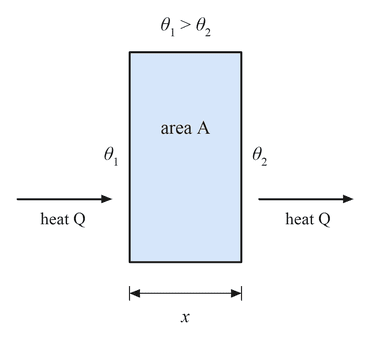
The constant is the coefficient of thermal conductivity: the quantity of heat flowing per second, normally through unit area, for unit temperature gradient. Its S.I. unit is .
Step 5 — Give uses of good conductors. Good conductors are used where heat must pass quickly: cooking pans and boiler plates (copper, aluminium), and radiators and cooling fins of engines and electronic devices. A metal gauze over a Bunsen flame conducts heat away so quickly that the flame does not pass through it (the principle of Davy's safety lamp).
Step 6 — Give uses of poor conductors. Poor conductors are used where heat must be kept in or out: wooden or plastic handles of utensils, woollen clothes and quilts, saw dust round ice, thick walls of refrigerators and ice boxes, and the felt or glass wool used to lag pipes.
Therefore, conduction is heat flow through a material without bulk movement; in the steady state temperatures stay constant in time; the temperature gradient is the fall of temperature per unit length; is the heat flowing per second per unit area per unit temperature gradient; and good and poor conductors are used to pass heat quickly or to hold it back.
- 613 marks
Question 61
Explain the term temperature gradient. The two ends of a metal bar are maintained at two different constant temperatures. On a single graph, draw sketches to show the variation of temperature along the bar when its surface is () perfectly lagged and () unlagged. Explain the shape of the two sketches.
Solve with AIWritten solution
Solution:
Concept: The rate of heat flow across a section of the bar is . If no heat escapes from the sides, is the same at every section; if heat escapes, becomes smaller along the bar.
Step 1 — Explain the temperature gradient. In the steady state the temperature gradient is the rate of fall of temperature with distance along the direction of heat flow, (between two layers, ). It is measured in .
Step 2 — Draw the two sketches. Let the hot end be at and the cold end at , with the bar of length . The graph shows the temperature against the distance from the hot end in both cases.
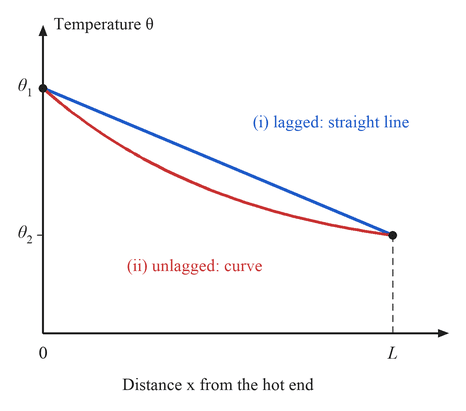
Step 3 — Explain the lagged bar. When the bar is perfectly lagged, no heat is lost from its sides. The same heat current flows through every section, so with the same and the gradient is the same everywhere. The temperature therefore falls uniformly, and the graph is a straight line; the lines of heat flow are parallel.
Step 4 — Explain the unlagged bar. When the bar is unlagged, heat is lost from its sides all along its length, so less and less heat crosses the successive sections. The gradient is steepest near the hot end and becomes gentler towards the cold end. The graph is therefore a curve (exponential in form) that falls quickly at first and lies below the straight line; the lines of heat flow spread out.
Therefore, the lagged bar gives a straight-line fall of temperature (constant gradient) and the unlagged bar gives a curve that falls steeply near the hot end and more gently later, because heat leaks from its sides.
- 623 marks
Question 62
What is convection? Explain how convection currents are setup in a fluid. Explain the uses of convection.
- 633 marks
Question 63
What is radiation? What is a black body? What is cavity radiation? Define emissivity. What is the emissivity of a black body?
- 643 marks
Question 64
State Stefan–Boltzmann law. Why is this law called the law of total radiation? Give the S.I. unit and dimensional formula of Stefan’s constant.
- 653 marks
Question 65
State Newton’s law of cooling. Describe an experiment to verify Newton’s law of cooling.
- 663 marks
Question 66
What are the conclusions drawn from the black body spectrum? State Wien’s displacement law. What is greenhouse effect?
- 675 marks
Question 67
Describe an experiment to determine the coefficient of thermal conductivity of a good conductor by Searle’s method.
- 685 marks
Question 68
(a) Compare thermal conductivity and electrical conductivity.
(b) What is thermal resistance?
(c) Discuss the heat flow through a composite slab.
- 695 marks
Question 69
State Stefan’s law. Sketch graphs showing the distribution of energy in the spectrum of black body radiation at three temperatures and indicate which curve corresponds to the highest temperature.
- 705 marks
Question 70
What is a black body? On what factor does the radiation emitted from it depend? Will the total radiation from it be more or less as compared to another body maintained at the same temperature? How does total energy radiated from it change with temperature? Is it possible for a black body to radiate white light?
- 715 marks
Question 71
State Stefan’s law and Wien’s displacement law. Draw graphs showing the distribution of energy in the spectrum of a black body. Explain what quantity is plotted against the wavelength. By considering how this energy distribution varies with temperature, explain the colour changes which occur when a piece of iron is heated from cold to near the melting point.
What Class 11 Physics Ch 17 covers
The sections of the chapter, in the order the book takes them. Every question above comes from one of these.
- 01Modes of Heat Transfer
- 02Conduction and Temperature Gradient
- 03Thermal Conductivity and Fourier's Law
- 04Thermal Resistance and Composite Slabs
- 05Searle's Experiment
More ways to study this chapter
The same chapter asked three other ways. Practise it, revise it, and see what the board has set on Ch 17 before.
Class 11 Physics Ch 17 questions students ask
How many questions are there in Class 11 Physics Ch 17?
71 questions. Every one is solved step by step on this page.
Are these Class 11 Physics solutions free?
Yes. Every question and its full working is free to read, with no account needed.
Can I download the Class 11 Physics Ch 17 solutions as a PDF?
There is no PDF to download. Every solution is on this page instead, which means it is searchable, always the current syllabus, and readable on a phone. Use your browser's print option if you want it on paper.