
Question 623 marksEasy
What is convection? Explain how convection currents are setup in a fluid. Explain the uses of convection.
Confirming your payment
Sign up now and get 250 free tokens.
Heat Transfer · Question 62 of 71
What is convection? Explain how convection currents are setup in a fluid. Explain the uses of convection.
Solution:
Concept: When part of a fluid is heated it expands, its density falls and the buoyant force on it from the surrounding cooler fluid is greater than its weight.
Step 1 — Define convection. Convection is the process by which heat is carried from a hotter region to a colder region by the actual movement of the particles of the medium. It occurs only in fluids (liquids and gases).
Step 2 — Explain how convection currents form. Suppose a beaker of water is heated at the bottom on one side, as in the figure.
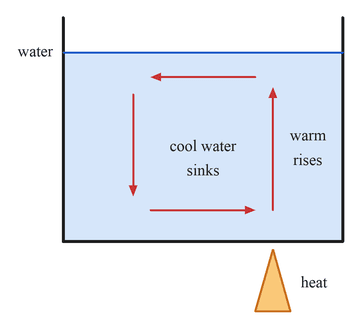
The water just above the flame is warmed, expands and becomes less dense, so it rises. Cooler, denser water from the other parts sinks to take its place and is then heated in turn. This continuous circulation is a convection current; a few crystals of potassium permanganate dropped at the bottom show the coloured streaks moving up and down. The circulation goes on as long as the water is heated, and in this way heat is carried to every part of the water.
Step 3 — Name the two kinds. In natural convection the flow is driven by gravity through differences of density. In forced convection the fluid is pushed by a pump or a fan, as in household heating systems and in the circulation of blood by the heart.
Step 4 — Give uses of convection. Convection is used and seen in many places:
Therefore, convection is heat transfer by the movement of the fluid itself; heated fluid rises and cooler fluid sinks to form convection currents, which are used in ventilation, heating, cooling and which drive breezes and winds.