Solution:
Concept: The rate of heat flow across a section of the bar is H=−KAdxdθ. If no heat escapes from the sides, H is the same at every section; if heat escapes, H becomes smaller along the bar.
Step 1 — Explain the temperature gradient. In the steady state the temperature gradient is the rate of fall of temperature with distance along the direction of heat flow, −dxdθ (between two layers, xθ1−θ2). It is measured in K m−1.
Step 2 — Draw the two sketches. Let the hot end be at θ1 and the cold end at θ2, with the bar of length L. The graph shows the temperature against the distance from the hot end in both cases.
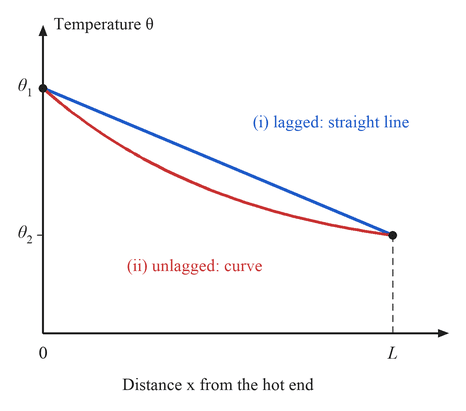
Step 3 — Explain the lagged bar. When the bar is perfectly lagged, no heat is lost from its sides. The same heat current flows through every section, so with the same K and A the gradient dxdθ is the same everywhere. The temperature therefore falls uniformly, and the graph is a straight line; the lines of heat flow are parallel.
Step 4 — Explain the unlagged bar. When the bar is unlagged, heat is lost from its sides all along its length, so less and less heat crosses the successive sections. The gradient is steepest near the hot end and becomes gentler towards the cold end. The graph is therefore a curve (exponential in form) that falls quickly at first and lies below the straight line; the lines of heat flow spread out.
Therefore, the lagged bar gives a straight-line fall of temperature (constant gradient) and the unlagged bar gives a curve that falls steeply near the hot end and more gently later, because heat leaks from its sides.
