
Question 603 marksMedium
What is conduction? Explain steady state. What is temperature gradient? Define thermal conductivity. Mention the uses of good and poor conductors.
Confirming your payment
Sign up now and get 250 free tokens.
Heat Transfer · Question 60 of 71
What is conduction? Explain steady state. What is temperature gradient? Define thermal conductivity. Mention the uses of good and poor conductors.
Solution:
Concept: Heat flows through a solid from its hotter part to its colder part; once the steady state is reached, the rate of flow is .
Step 1 — Define conduction. Conduction is the transfer of heat from the hotter part of a body to its colder part without any bulk movement of the material. Energy is passed on by the vibrations of atoms and, in metals, by free electrons.
Step 2 — Explain the steady state. When one end of a bar is heated, every layer at first keeps part of the heat it receives, so its temperature rises (variable state). After some time the temperature of every point becomes constant in time, though different at different points, and each layer passes on all the heat it receives (apart from any loss from its surface). This is the steady state.
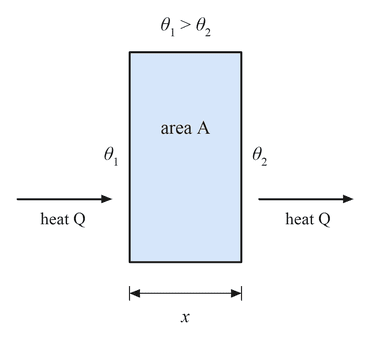
Step 3 — Define the temperature gradient. In the steady state, the rate of fall of temperature with distance along the direction of heat flow is the temperature gradient. For two layers at and a distance apart, it is , or in general; its unit is .
Step 4 — Define thermal conductivity. For the slab in the figure, the heat flowing in time is proportional to the area , the temperature gradient and the time:
The constant is the coefficient of thermal conductivity: the quantity of heat flowing per second, normally through unit area, for unit temperature gradient. Its S.I. unit is .
Step 5 — Give uses of good conductors. Good conductors are used where heat must pass quickly: cooking pans and boiler plates (copper, aluminium), and radiators and cooling fins of engines and electronic devices. A metal gauze over a Bunsen flame conducts heat away so quickly that the flame does not pass through it (the principle of Davy's safety lamp).
Step 6 — Give uses of poor conductors. Poor conductors are used where heat must be kept in or out: wooden or plastic handles of utensils, woollen clothes and quilts, saw dust round ice, thick walls of refrigerators and ice boxes, and the felt or glass wool used to lag pipes.
Therefore, conduction is heat flow through a material without bulk movement; in the steady state temperatures stay constant in time; the temperature gradient is the fall of temperature per unit length; is the heat flowing per second per unit area per unit temperature gradient; and good and poor conductors are used to pass heat quickly or to hold it back.